“Blood & Sand” by Jeremy Tolbert

Blood & Sand

I sit against the wind
with my back hunched over,
as if I’m swinging against a tightrope
high above the vacant sea.

All alone,

I am left out in the cold.
My bones break against the rocks

until the darkest part of my soul
tries to escape the deep end
of my mind.

I lay down words of
what I see in front of me.
One, two, three…
I countdown the final moments
before I am pulled away.
With my heart torn apart

by the tears that pour out of me,
I fall back into the mouth
of the deep blue sea.


Jeremy Tolbert is a poet and writer from Seattle, WA. He has written for the Seattle Post-Intelligencer online,  and is also a contributing writer for the online magazine, Having a Whiskey Coke With You.  He has penned the poetry collection Scribbling’s from a Beer-Stained Napkin and is in the process of completing a second collection entitled Talking with the Devil About Love , coming early 2014 by University Bookstore Press. These pieces will be included in his second book.


An Interview with Nick Brown

Quick-Draw

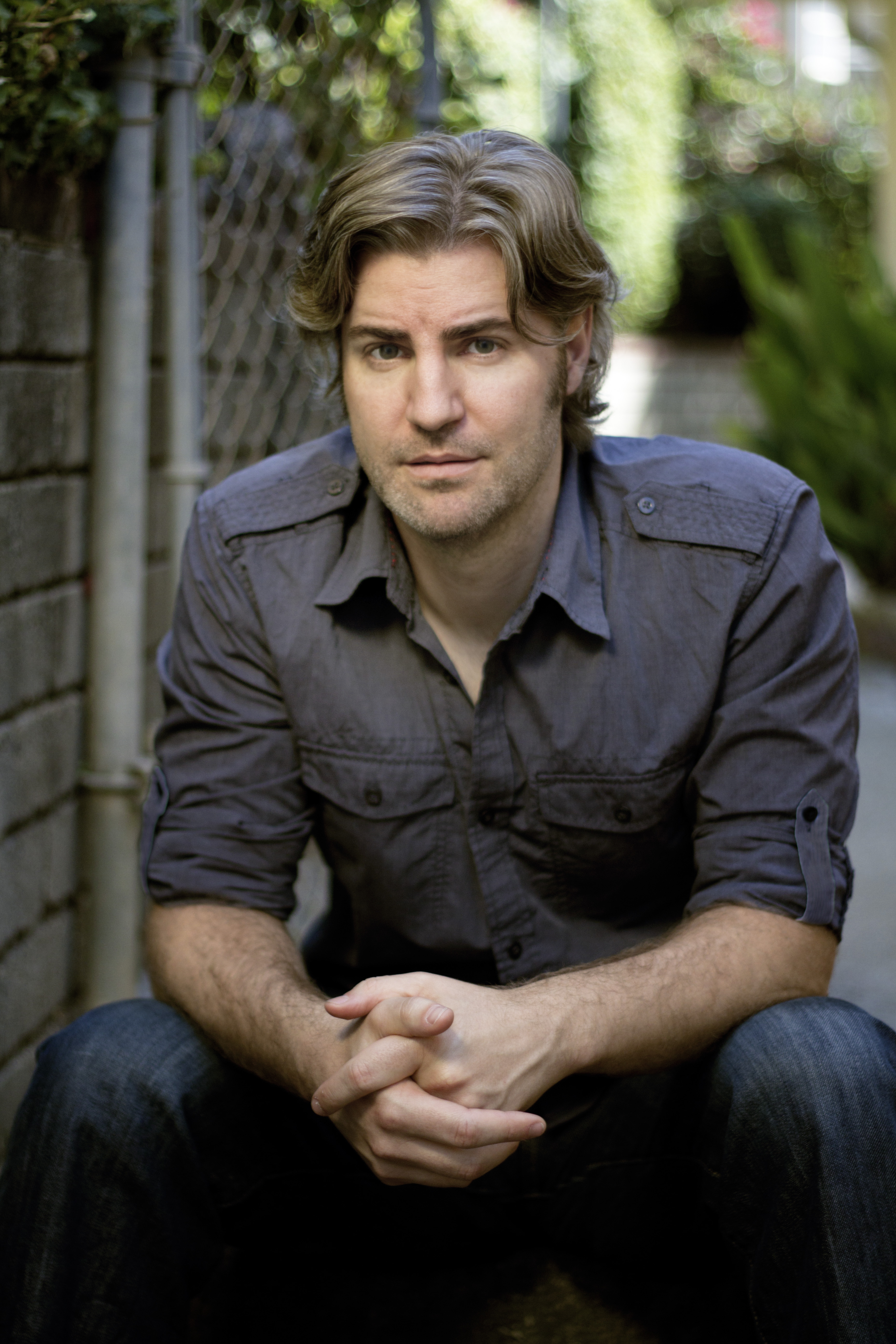
While Nick Brown is a man of many talents, he is most likely best known from his role as Deputy Eli Brocias on the Hulu Original Series Quick Draw. From his work in modeling, to his work blogging for such sites as Huffington Post and Rock the Vote, to his acting career he is always creative to the core. It was my pleasure to bring the world a glimpse into the workings of the mind of Mr. Brown. For more information please see: This Is Nick’s Website.

Where are you from? What was it like growing up there?

An oddly complicated question. My family moved growing up, so I never really know how to answer this one without a small essay of potentially dull information…which I will now subject you to.

My father worked in politics during Democratic administrations and in the private sector during Republican administrations, so you could, if for some reason you wanted to, more or less track where we lived by who the president was.

I was born in the waning days of the Carter administration on August 18th, in Sibley hospital in Washington, DC. Franz Josef had my same birthday. Bill Clinton’s is within a day. My manager also shares it.

I was, at the time, the largest baby every born in Sibley Hospital. I was two feet long. I think I weighed something like 12 pounds. My mother remembers the details better since she was a fully conscious person at that point, whereas I was essentially a drooling, screaming wad of colic.

With the onset of Reagan, we moved to Colorado, where my dad worked to develop a big block of restricted-income housing in Aspen. Both of my sisters were born in Denver. We lived there for eight years. I basically only remember really liking dinosaurs, that there was a scary dog in the alley behind our house, and that I was promoted to the advanced swimming group, ‘the sharks,’ before we left for California when I was eight.

For the first Bush administration (H.W.’s), we lived in Berkeley, California, where Dad was once again working on some large real estate deal. We kept jumping around and living in different houses in Berkeley, though my parents eventually bought a fairly large one on Claremont Boulevard, next to a small park.

I kept a pet rat who eventually escaped and bred with sewer rats that lived under our house, resulting in a very friendly, very populous rat colony whose members periodically dashed through our yard and terrified our dog, a neurotic poodle named Charlie. We had another dog named George who was very fat and affectionate. My mother kept lovebirds in a large cage in the backyard. The male lovebird was an abusive animal who tore the feathers off his female companions, leaving them pink and flightless. It’s worth remembering, I think, that the animal kingdom is full of wonderful characters and real jerks.

Clinton was an old friend of my father’s and, when he was elected, he nominated Dad as the ambassador to the CSCE, an organization that was founded in the Helsinki accords with a somewhat uncertain purpose. It eventually became a multilateral organization whose mission revolved around the ever-shifting borders of the former Soviet satellite states. It also eventually became the OSCE, which is the name it currently has.

Dad was, I believe, among the first ever filibustered ambassadorial nominees. Jesse Helms – a Republican from North Carolina who once accused the Washington Post of being “infested” with homosexuals – led the effort to block dad’s appointment. John Kerry was among Dad’s chief defenders. Eventually, Clinton gave up and appointed dad as the ‘Chief of Mission’ to the OSCE. Later, for a summit in Portugal, Dad received the title of ambassador through a series of byzantine rules that allow the president to give titles without the consent of the senate. We moved to Vienna before I started eighth grade.

For the first part of the Clinton administration we lived in Vienna, in a house two blocks from a park where the Turkish hordes were turned back in the 17th century. We were told that our house was riddled with listening devices and the assumption was that any words we said were being recorded by several foreign governments. That said, we also had a cook, two maids, a gardener, and an armed guard. It was quasi-aristocratic upbringing…by which I mean it was a preposterously aristocratic upbringing. If you do ever get a chance to live in Vienna, I highly recommend doing so as the son or daughter of a US ambassador.

For the second Clinton administration, we were back in California, which was something of a downer after four years living in wildly lavish conditions. That was my senior year of high school. I hadn’t really spent enough time in Vienna cultivating adolescent rage, so I made up for it when I came back to Berkeley by hating everything.

Were you always an imaginative child or is that something you picked up along the way?

I definitely really liked dinosaurs when I was young. And I read a lot of fantasy novels. I also think I spent a lot of time playing by myself with people who didn’t exist. So that’s either ‘imaginative’ or ‘deeply deluded’ and I guess I prefer your word for it.

Are there any little known facts about you that your fans might be surprised to learn?

I have fans?! I mean: the first thing that springs to mind that my fans would be startled to know is that they exist.

I, at least, am startled to know they exist. Maybe we can all have a get together. Punch and sandwiches and I’ll spike the punch and we’ll all talk about how excited we are to know that we all exist, unless they don’t actually exist, in which case it will just be me drinking spiked punch alone and talking to imaginary people…which actually would be kind of similar to how I spent a lot of my early childhood…except that I drank less whisky then.

What was the question?

You’ve worked as a model as well as an actor. Do you prefer one over the other? Did it feel a little odd to see yourself on Billboards and such?

Yes. There was a brief period when I had a Verizon billboard outside Madison Square Garden, which felt incredibly weird, but I would be lying if I said that I didn’t spend a lot of time standing near it and hoping someone would recognize me.

Nobody ever did. So sometimes I would start random conversations with strangers about the billboard and hope someone would say,¨hey, you look kind of like the guy on that billboard.¨ One day, that finally happened. I said, ¨yeah, I guess I kind of do,¨ because when you have been fishing for acknowledgement for that long, it seems inappropriate to actually accept that acknowledgement.

And yes: way prefer acting. That was the question, right?

How did you come to be blogging for Rock the Vote and Huffington Post?

I’ve had long periods – most of my adult life actually – where I have had very little employment and lots of ambition to be employed. I started blogging for the Huffington Post in the hope that they would pay me to do so. I had been volunteering, along with my parents, for Habitat for Humanity in New Orleans. I was only there for a week, but it was a really lovely experience – albeit one where I hammered the hell out of my thumb multiple times. I’ve always liked writing and the general showing off that comes when you have written something reasonably well. So I wrote this quick piece on our experience volunteering, and then I found out that a friend of my parents, the journalist Margaret Carlson, knew Ariana Huffington. This was in the early days of the Huffington Post when Ariana Huffington was encouraging everyone to blog for her and basically publishing anything anyone was willing to post. I got her assistant’s e-mail and I sent her (or maybe it was a him) this piece I had written about volunteering after Katrina. Somebody over there liked it enough to publish it – and again I want to emphasize that it was a lot easier to publish things at the Huffington Post back in 2007 when I was writing.

They eventually allowed me to blog regularly and I tried to write a piece once a week which ended up being really arduous. Eventually, I asked them to pay me (as you do) and they wouldn’t. The person I talked to said something like ¨writing here will really help your sales when you have a book.¨So I stopped writing because I don’t have a book. I’ve written a little since then, but not much.

Rock the Vote happened because I wanted to work in the 2008 campaign and my sister had a job there. She introduced me to the political director and I told the political director that I would work for almost no salary if they put me on the bus and had me be their blogger and photographer. That’s what happened and then I realized that I was working for almost no money at all, which really wasn’t as pleasant as I imagined it would be.

That said, the tour was a lot of fun. And I got to meet a whole host of incredibly talented musicians, including the Beastie Boys, who I loved since I was nine.

You also write fictions where you take a photo and write a short story from that one image. What inspired you to do that?

Well, to be fair, I advertise that I write fictions where I take a photo someone has sent me and write a short story based on it. And I have done it a few times. (You can see the stories on my site.)

When you are an actor – or, at least, you identify yourself as an actor and are not yet very successful – you spend quite a lot of time sitting around waiting for something to happen. So I started writing. I had a number of short stories that I had written over the years from some creative impulse and I put a few of them up on my site with photos. And then I got the notion that I would invite visitors to my site to submit photos for me to write about. The trick is that no one really did that. My mom did. And another friend did. But, mostly, no one did.

The other trick is that even when people did submit pictures, it turned out that writing a good short story was really really time consuming. So I didn’t write good short stories. But even writing a fairly mediocre short story, which most of the ones I have on the site are, takes a ton of time. A few years ago, I started working on a novel and it became kind of unrealistic for me to actually continue writing the stories from the photos. So, while I still appreciate the submissions from strangers, I rarely write stories inspired by them any more. I’m hoping to have a draft of this novel done sometime in the next five or six months, and then maybe I’ll go back to working on short stories again.

What do you love most about the act of writing?

Finishing something you are proud of. And that’s a really fleeting sensation. Because almost everything I have ever written I am disappointed by later. I usually look back at stories after a few years, and then think that I was just an utter moron to have ever written anything so trite and stupid. But for the brief little bit of time when I’m not wise enough to realize how foolish I am, I can still be very satisfied with a newly complete story or article.

Oh and also: I think a lot of the way that people relate to the world today has to do with media. I mean, it probably always has. Today is not unique that way. But it used to be – back in the middle ages – that Western Europe’s big media rollout was the Catholic church. And so people would wander around and talk about that last sermon they heard. Except the sermons were in latin. So most people just wandered around and talked about those funny sounds they heard. But, basically, the stories you had were either biblical or gossip. You sort of see that in The Canturbury Tales. All of Chaucer’s characters are on their way to a religious pilgrimage. And some of them are hypocrites and some of them are devout and some of them are figuring out who they are. But, basically, the central framework is religion.

We don’t really have that anymore. And, in lots of ways, that’s a really good thing. It means we don’t burn witches and, at least in this country, we don’t usually run off into wars with the Turks over the holy land. Those are all really good innovations. But we also don’t have any centralized story that gives meaning to our lives. For all of the flaws of biblical literalism, the bible was, at least, an attempt to derive meaning from the chaos of human existence. Now we have TV and books and movies to do that for us. When they are good, those art forms can actually do a pretty good job of imparting wisdom. So, when writing feels best is when I really struggle through something and feel like I can share some wisdom in the form of a story. I’m not saying I succeed. But other people do. And the best stories are like sugar coating for a deeper human wisdom. (A wisdom, in this metaphor, that you would have to swallow.) They can do a lot of the work that religion used to do. So there’s also a sense in which – and I promise to stop being earnest for the rest of the interview after I make this point – writing is actually a somewhat spiritual practice.

In the short film 10 Minutes with Kurt Vonnegut you interview yourself. What made you decide to do that? What is the most challenging thing a person faces when interviewing one’s self? Just curious, did you learn anything new about yourself during the filming?

Yeah. So, the ‘film’ of that actually ended in preview form. The most interesting thing about filming it was discovering that film doesn’t work like text. It’s really really hard to make something entertaining that just involves two people talking. Linklater does it, and Wallace Shawn in My Dinner with Andre but it’s very very difficult.

I put together the idea for it on a plane ride from LA to San Francisco in 2004. One of my best friends from childhood, a director by the name of Will Backer who is currently working on his first feature, was in San Francisco and I was going to visit him. I knew that I had two or three days off work so I tried to write a script that we could shoot really quickly.

But then Will was cutting a bagel and the bagel turned out to be his thumb, so he had to rush off to the ER and we never shot what I wrote. But I liked the idea, so I worked it into a twelve minute script because, for me, at least initially, the appeal of acting was to be famous. I didn’t particularly care for memorizing lines. But I loved the idea that you could be yourself and people would listen to you. I think it comes from a deep-seated narcissism on my part. So then I started thinking about a character – me – who would interview himself just to be able to talk as if he were being interviewed. And then I read some old Tom Waits interviews and I decided that one character really needed to be obsessed with the idea of lying to an interviewer. Anyway, it sort of proceeded from there.

As for what I learned about myself…I learned that I didn’t really know very much about acting. I had been working professionally as an actor for three years when we shot it. I had small parts in bad plays, mostly. Shooting it made me realize that I really needed to get some training if this was going to be my full on career.

What do you think the vampires are doing with all those livers by the way?

B12 deficiency. They are deeply misunderstood creatures. (I’m pretty sure I stole that from a short story. Possibly one of Kurt Vonnegut’s. Maybe Ray Bradbury.)

DSC_0199

Have you enjoyed playing Eli Brocias on Quick Draw? How would describe that particular character? Any stories from the set you’d like to share with our readers?

Yeah. It’s been a total blast. It’s the first time I’ve ever been on a big set where I am actually the center of attention. And I may have mentioned that I’m pretty narcissistic. I really do like being the center of attention. It’s a character flaw.

Eli knows nothing, but doesn’t think he knows nothing. He’s sort of aggressively wrongheaded. He has a solution to every problem. It’s just that maybe the solution he has in mind isn’t, necessarily, the smartest one available. He’s kind of the voice of 1870’s logic. And John’s character is the voice of modern rationalism. But Hoyle is kind of a blowhard, as is, quite frankly, modern rationalism.

As for stories…That scene in episode 7 where John and I are buried up to our necks was probably the most uncomfortable thing we shot. I mean, it was very miserable. And I talked to John and neither of us really remembered what we were saying when we shot it. But I actually think it’s one of my favorite scenes in the first season. So, really, I should work on being much less comfortable more often, I guess.

What is it like to work with John Lehr and Nancy Hower?

They are lovely lovely people. And ultra supportive. The danger, here, is that I haven’t worked – as a lead – with any other big productions. So I feel like I am starting with the experience of driving a cadillac and somewhere down the road I am going to meet some director who is like the Edsel of directors and I’m not even going to know that it ever could have been so bad because I’ve never driven anything but a Cadillac.

That metaphor may have gotten away from me.

How does working on an impov show differ most from conventional acting? Do you enjoy having the change to be more creative in your role?

You don’t have to memorize anything. That’s pleasant as an actor because memorization is really really dull. And to memorize something and then have it come off as spontaneous you have to memorize really thoroughly. So it takes a very long time. And, sometimes, if you are working on something where the script is really awful then you have just spent hours of your life putting something stupid in your brain that you will probably never forget.

Improv is way better than that.

What have you learned from the experience of working on Quick Draw?

At the end of the day, you have to trust Nancy Hower. That’s just how it is. When we finished shooting the first season, I had absolutely no notion of what any episode would look like. And, because I’m stubborn and mulish when I’m at my worst, I would keep deviating from the point of a scene. And Nancy would sort of gently remind me that, actually, maybe Eli’s thoughts on Shakespearian drama were not as relevant as I thought they might be. Or maybe that whole monologue about mongoose husbandry is not really not the most relevant thing for the scene in question.

I’m really excited to actually be able to relax into myself a bit more for season 2.

Will there be a season 2?

There will!

Do you think original series are a great medium to bring the world a wider variety of entertainment to choose from?

 I mean…It would be really hard to say no to that question. The other option would be to just endlessly redo old franchises…Which is something that actually has its proponents. Basically, though, I think that anything that is worth watching has a responsibility to explore what it means to be human right now. (‘Now’ in this case being when the story in question is made.) Even dumb slapstick has to be dumb slapstick that is relevant to its contemporaries. If you’re fulfilling that really important, quasi-spiritual, element of storytelling – that is, imparting wisdom – then remaking old shows is harder. It can be done. Again: the only form of contemporary entertainment Western Europe had for hundreds of years were riffs on biblical stories – Passion plays and such. But it’s easier to do something interesting and relevant with original characters.

 Your website mentions that you are also a tutor. What do you teach? Do enjoy helping others learn?

I tutor Math up through calculus, English, History, Physics, and some Chemistry. Basically, all the high school subjects…But the vast bulk of my work comes from test prep for either the private middle school tests – the ISEE, Catholic School Exams, and SSAT – or for the SAT. I have tutored the GRE and GMAT as well, but people usually go to one of the big companies for that. (The company I work for, Brownstone Tutors, is a sort of elite New York tutoring organization.)

I do enjoy the work, particularly when I get a higher-level math student. That’s not a part of my brain I get to use much any more, and it’s really satisfying to get to grapple with a tricky calculus problem.

You are also an avid traveler I understand? Is there any one trip that stands out most in your mind? Do you have a particular trip you’d most like to take before you die?

I’ve been lucky on the traveling front. I’ve been to lots of places and, if I had the opportunity, I’d like to go to lots more.

I have this friend, Loki, who is named after the Norse god of mischief. He and I did two trips together and they were marvelous because we each push one another to do things that are somewhat foolish in retrospect.

The last trip I took with him was to Cambodia, in 2006, right after a girlfriend and I broke up. I was a little heartsick and so we rented motorcycles. If a car is coming towards you very quickly on a two-lane highway and you cannot get back into your lane and it is dusk and the one spot where you can go has a dark spot that may or may not be something that will kill you, you quickly forget that you were feeling mopey and sad. Motorcycles are a great way to feel like you might die at any moment, which will really spring you out of your torpor.

Loki and I took this trip to Cambodia and it was very short and very healing and the two of us wandered around the ruins of Ankor Wat and sat out in tropical nights and shared beers. Of course, we also got into three motorcycle accidents in three days and Loki had to go home to Australia to get to a hospital that could deal with all of his abrasions. But, otherwise, it was a wonderful trip.

Speaking of which what are your feelings on death and such?

I would prefer it if it didn’t happen to either me, my sisters, my parents, or really anyone I know anytime soon. But then, I think we all would.

 Anything you’d like to say before you go?

Oh…Lots and lots. I adore talking about myself. I recognize that as a bit of a flaw. And, with luck, I’ll finish this book soon, which will have gobs and gobs of thoughts that are less about myself and then I can talk about those thoughts without feeling as flawed. So, yes…Or no…There isn’t. I think.

What was the question?

” A Life” by Aman Mittal

A Life

Touch it, it won’t shrink

As an eyeball does

Feel it, you can only feel

The feelings inside you,

Yesterday, Today, Tomorrow,

Sometime it’s a landscape view

Blue stream of water

In between the hills

Day in, Day out

Followed by a bright sun,

Sometime it’s a portrait

Hanging on a wall

No movement and very still

A beautiful face

Wearing a set of pearls,

Else, you cannot drag it

Nor can you draw it

On a sheet of paper,

It has no shadow of its own

But reckons the one you have

Nor it can breathe

But breathe with your lungs

Nor it can see

But see through your eyes

Nor it can feel

But feels everything you touch

Actually,

The Life is you.


An Interview with Kasey Lansdale

1378743719_front

Kasey Lansdale is best known for her work as an editor, author, actress, and musician, proving she is a woman of many talents. She is also the founder and host of the East Texas Songwriter’s Workshop. Her much anticipated album Restless from Blue Siren Records was produced by Kasey herself and Mike Clute with John Carter Cash executive producing.

What have you been up to since we spoke to you last?

So much. I just got back from the first portion of my Restless Roadtrip promoting my new album, Restless. The horror anthology, Impossible Monsters, also came out this summer, as well as a few other projects I have going on the side.

Did Joe have a major influence on your musical tastes? Was country music a mainstay in the Lansdale household?

Both my parents made sure that music and art were readily available to me. They each have different tastes, so I was exposed to the whole gamut.

What would you say if the most important thing you have learned from your parents? Do you consider yourself blessed to have come from a household that is so filled with love, respect, and creativity?

I can’t choose one thing only, but I will say the positive outlook on life, the go getter attitudes, and the strength to persevere, rather it be in life or work.

What do you love most about the whole country music genre?

I love the stories. Country music is the music of the people.

Have you been surprised at how well received Restless has been so far?

In fact I have. Not because I don’t think it is a great project, and one I worked very hard on for years, but because I wasn’t sure if people were going to “get me.”

What was it like to work with Mike Clute and John Carter Cash? What are they like as people?

Each of them are quiet, gentle, men, and actually approach production in a similar fashion. I was lucky that in studio, I felt very comfortable. I spent a little more time with John and can’t brag enough about what a kind, intelligent person he is.

You are an avid supporter of PROTECT: The National Association to Protect Children. Can you tell our readers a little more about that organization and what they do? How can others support their work should they wish to do so?

Rather than giving you the pitch that can be googled, I would say the best way is to get involved. You can start by simply joining their mailing list or facebook and following posts. Trust me, they let you know what’s happening, and sometimes, something as simple as making a call or writing a letter can go a long way in advocating for changes in law. They are for the children. Period.

As someone that works as an author as well as a musician do you prefer one over the other, or do you love them both equally?

I have to say I love them differently. I always say I was born into the world of writing, but I was born to be a musician.

Do you have a dream project you’d most like to bring to the world?

I would love to do a sixties’ soul and Motown record. Pay homage to some of my absolute favorite singers of all time. Nobody does it like Otis, or Jackie, Aretha, etc. but I would love to try my hand at it.

What projects are you working on at the moment?

Right now I am still on the Restless Roadtrip tour to promote the new album. I just got back from Europe, and will be hitting about 30 US stops in the spring. I’m also doing some writing projects, but the album is the priority at the moment.

Anything you’d like to say before you go?

As always, thank you.


www.kaseylansdale.com

www.facebook.com/kaseylansdalefans

www.twitter.com/kaseylansdale

“Ici Repose Vincent van Gogh” by Peter Nicholson

vg

ICI REPOSE VINCENT van GOGH


Not here the slippage
Of motive, the bull market,
Dressage of cocktail and auction;
Neither the victory lap nor prize.
And yet, pushed out, vertiginous paint,
Cypress and flower spinning,
Nature’s cusp stubbed on canvas,
A bandaged head staring with love,
And that alone, at each malignant defeat.

Ours is a tepid dreaming
With not even the courage of beauty.
We wish our Age of Noise
To be an almanac footnoted,
Its mug celebrities
Caught in silverfish pages,
But still we won’t avoid
An empty room dimming our glamour.

Theories puffed, the boast
Of a thousand critical niceties,
Are shed in the fierce night,
One name cast
Near sulphurous soil,
Whose paintings keep,
For we who believe
Not in greatness, nor the strength of art,
In the space reserved for grace,
The sharktooth eye
Of a winnowing field
And yellow starlight shining.

Auvers-Van-Gogh-headstones-1


“The Day Before Thanksgiving” by Jed Myers

The Day Before Thanksgiving


I remember not

wanting to wander outside


the lines of

the full-page cartoon turkey


I colored in

with the available browns,


reds, golds,

and yellows the Crayola


box between

Irvin Snyder and me


offered up

while Mrs. Gregory watched


over all of

us, her high-necked solid-green


dress over two

great breasts, belly


and hips also mountainous, calves and ankles


thick as church

columns in their flesh-


colored

stockings. She cruised the aisles


between our

rows of desks, clopping


close then

away in her fat-heeled shoes,


her white hair

cinched in a bun, a patriot


goddess of

George Washington’s Revolution.


Irvin was

fast. In his hand the wax flared


out past the

black demarcations. His turkey looked


jittery, as if

it shook in its dread


anticipation

of being blasted


or having its

head chopped off any moment,


as if it were

radiating already


with oven

heat, crayon feathers and all,


Irvin swiftly

giving it life


on its final

Wednesday, haphazardly


fattening it

by a half-inch outside


its outlines.

It was furry with streaks


of those

sunset and earth tones he slap-dashed


over the

fictional meat.


I proceeded


with care.

Mrs. Gregory’s eyes,


like orbiting

satellites or atomic


electrons, could

be anywhere. She glared


right through

the back of my head, the righteous


witness for

all America, telepathic


reporter to

Congress, the President, God,


and my mom and

dad. My fingers were locked


in meticulous

progress, the tip of my implement


far too fat

for the exactness


I felt was

expected. I squinted


and bent

close. I approached the limits


of each

distinct patch of the image


of our

sacrifice with a selected shade,


keeping my

surgical acts inside


those sacred

edges. My turkey was neat.


But it would

never be ready to eat.


Mrs. Gregory

marched by and leaned,


her right

breast, the very flesh of our manifest


destiny, next

to my pounding temple,


lifted my

sheet, and with an imperious


grunt,

straightened herself and strode on


to the next,

my Thanksgiving bird to remain


mostly white,

its lower reaches and feet


like the map

of a region of nameless provinces


none of us

knew much about. Our nation


and all its

hungry beliefs would race


through the

coming sunset and into the next


mass ritual of

it self-confirmation


without that

perfect portrayal of thanks


I would not

complete. So I wept


at my desk,

over my failed operation,


the golden

autumn afternoon light


like beams of

mysterious glory slanting


in on Ms.

Liberty’s powdered neck.

DrMyers2


Jed Myers is a Philadelphian living in Seattle. His poems have appeared in Prairie Schooner, Nimrod International Journal, Golden Handcuffs Review, qarrtsiluni, Atlanta Review, Quiddity, The Monarch Review, Palooka, Fugue, the Journal of the American Medical Association, the Rose Alley Press anthology Many Trails to the Summit, and elsewhere. By day he is a psychiatrist with a therapy practice and teaches at the University of Washington. By night he hosts the long-running open-mic cabaret NorthEndForum. He likes to weave poetry and music together, and sometimes does so with the ensemble Band of Poets.


An Interview with Cole Haddon

_MG_7821_C (1)


Cole Haddon is best known as the creator and co-executive producer of NBC’s hit series Dracula. The show which offers up the iconic Prince of Darkness in a new light gives fans a more sophisticated from of vampire. Haddon is also author of the graphic novels The Strange Case of Mr. Hyde and Space Gladiator.

Can you tell us a little about your earliest days? What were you like as a child?

I grew up in Michigan in a blue-collar community, nothing particularly special about it. I think I found it intellectually stifling, though, and that’s probably why I retreated into film, books, and comic books. STAR WARS, Indiana Jones, and monsters were all I thought about.

Do you happen to recall what your very first favorite story was?

My first favorite story would be Raiders of the Lost Ark, which is also, maybe not coincidentally, the first film I remember seeing. I was only five years old. My parents were either not very good at censoring what their children watched, or very perceptive about what I, in particular, needed.

As a fan of classic horror what do you think is it about the first films of the genre that make them so timeless in their appeal? Does the fact that seem somewhat human in their varied and flawed ways of suffering through this world have something to do with that?

I think classic horror, the stuff that sprung from the 19th Century and very early years of the 20th Century, continues to be popular today because the ideas and themes explored in so many of them are every bit as topical as they were when the books were first published. The human characters in them continue to resonate, too, because we’re still them. We’re still arrogant and self-destructive, still crippled by antiquated ideas of good and evil, and so much more. When human culture evolves more dramatically, when we transcend the ideas in these books, we’ll collectively start thinking of them as antiquated, charming relics of a past. But somehow I doubt that’s going to occur anytime soon.

Did you have a favorite movie monster growing?

Movie monster? Probably Frankenstein’s Monster, though King Kong is way up there.

What have you enjoyed most about putting a new spin on Dracula?

Dracula had been abused by pop culture for years. There are a few exceptions, but overwhelmingly he had become a punch line. This, by the way, is why I also tackled Mr. Hyde in my graphic novel The Strange Case of Mr. Hyde. I loved these characters as a kid, and I didn’t like where they had wound up in the public consciousness. And so, to answer your question, I most enjoyed trying to find a way to make Dracula feel vital again. Alive, which I get is an odd word to use in association with a vampire. I wanted to remind audiences that the Victorian monster still had some life left to him, in other words.

What did you find most challenging in bringing the story to network television?

In the novel, Dracula is a villain. He has a beginning and a very necessary end. More, there’s no reason to root for him. That does not make a very interesting television character, and so I had to find a way for audiences to get behind him. He needed a reason to exist other than to feed and ultimately be stopped by the familiar coterie of heroes. I and the other writers tried to give that to him in a new origin that tied the character more literally to Vlad Tepes, the Romanian prince who inspired the fictional Dracula. We gave him a backstory, a human backstory, one that humanized him in a way and provided, most importantly, a mission. A reason to follow him, so to say.

Was it nice to have the chance to offer viewers a more sophisticated form of vampire?

Hell yes. There are no mopey, sparkly vampires anywhere near our “Dracula”.

What is like to get work on this series with Daniel Knauf? He seems quite taken with your work on the show. Are you a fan of his work?

I’m not sure if many show runners would have allowed another creator’s vision to be so fully realized, but Dan was in my corner from the beginning. He had my back, and for that I’m eternally grateful. He’s got a wonderful sense of the macabre and ghoulish. He loves monsters and weird shit. In that regard, we’ve got a lot in common. And so in short, yes, I’m a fan of his work. Both on Carnivale—which was a wonderful series—and on Dracula.

What about Jonathan Rhys Meyers? You have said he carries an intensity that is hard to find? Can you elaborate on that? Would you say he is also intense as an individual? Do think that is an inborn trait or something one has to learn? Do you think intensity is a trait we should all carry?

Jonathan Rhys Meyers has an innate quality about him, an intensity, yes, that radiates out of his eyes. His whole body. He crackles with it. I’m not sure where it comes from and, quite honestly, I don’t know him enough to guess. But it’s part of him, yes, and without it his Dracula would be a limp character. We didn’t cast JRM for his angelic looks or abs. We cast him because he was one of the few actors we believed had the necessary qualities to play our take on Dracula.

Have you been surprised by how well the series has been received so far?

I think everything in the world of television is a surprise. There’s nothing one can predict with any accuracy. And so, yes, the show’s reception has been a surprise. I couldn’t be more grateful to the fans.

What do you love most about the act of writing? Why do you think words have always been such powerful things?

I wish I could give you an intelligent answer, but the truth is it’s just something I’ve always done. I was drawn to it, I think, or, rather, storytelling. Maybe I saw too many films and read to many books as a kid. Maybe it rewrote some pathways in my brain. The truth is, I don’t know what else I’d do if I wasn’t a storyteller. As for why words have always been such powerful things…I think that’s because they carry ideas and ideas, more than anything, are powerful.

Can you tell us a little about your graphic novels The Strange Case of Mr. Hyde and Space Gladiator? How do those differ most from your work for television?

The Strange Case of Mr. Hyde is set five years after the events of Robert Louis Stevenson’s novel, and sees a young Scotland Yard inspector team up with an imprisoned Hyde to identify and stop Jack the Ripper – whom they’re both convinced is using a version of Hyde’s serum to fuel his murderous rampage.

Space Gladiator is a sort of Douglas Adams-esque graphic novel about the last human being in existence, an exhibit in an alien zoo, and how this unassuming kid who just wants to play video games winds up an intergalactic gladiator who inspires a rebellion.

Strange Case is pretty damn similar to Dracula in terms of tone and world, though I think it’s probably a bit more fun or, rather, funnier than our series. Space Gladiator is a satire start to finish, very British, an homage to Flash Gordon, Buck Rogers, and similar characters – so it couldn’t be more different than my television work to date.

What are your feelings on death and such?

Terrified of it. Hope to avoid it at all costs.

Anything you’d like to say before you go?

I’m hugely appreciative of the fans of Dracula. They can always find me on Twitter. My handle is @colehaddon. Say hello sometime.

For more information on the titles mentioned please see:

1790538-the_strange_case_of_mr._hyde__1___page_1

The Strange Case of Mr. Hyde on Amazon.

images (7)


 Space Gladiator on Amazon (also available in ebook format)

“And You Will Find Me” by Michael Xavier

3294014001_ae96d0f77b


And You Will Find Me


And you will find me

When you can’t speak

When your heart fails

When your soul is weak

Drunk. Blind. Wet and heaving-

The world will throw you at my door.


Here’s the thing; you know that even if you don’t knock

I will always answer

Then you will lay your trouble down

And all the times I said I loved you

will mean nothing more than

there will be a safe bearable silence


so you may cry honest tears

silent and

deep.

999292_681016535266425_1681213104_n


Michael Xavier is an underground writer based out of Los Angeles, who tends to let his words speak for themselves.