“How I Would Keep the Maybe One Eighth Choctaw Part of Me Alive” by George Drew

How I Would Keep the Maybe One Eighth Choctaw Part of Me Alive

You better hope you never see angels on the rez.

                                                  —Natalie Diaz

Because you damn well know I’m no angel,
you might think, to accomplish this minor mathematical feat,
I would take up bow and spear and read the sign,
that I would crouch in copse and shadow,
learn the way of the warrior, learn the way
of crow and wily coyote; or that I’d bow
before the spirits of ancestors, learn the language,
teach it to the youngsters, keep it on their tongues;
or most of all, that I would chant and dance
under the stars, around and around the campfire
dance until the moon collapsed and from
behind the mountains the sun rose up saying Stop!
And you’re right, maybe I would do any or all of these,
but I’d much rather take up herbs and rattles,
and as a medicine man take my own advice
that the best medicine is strong medicine and kick the hell out
of the seven-eighths white ass part of me.

George Drew was born in Mississippi and raised there and in New York State, where he currently lives. He is the author of four collections of poetry: Toads in a Poisoned Tank, from Tamarack Editions,  The Horse’s Name Was Physics, from Turning Point Press; a third, American Cool, was released by Tamarack in 2009; and a fourth, The Hand that Rounded Peter’s Dome,by Turning Point in 2010. Drew was the winner of the 2003 Paumanok Poetry Prize, the 2007 Baltimore Review Poetry Prize, the 2008 South Carolina Review Poetry Prize, and was runner-up for the 2009 Chautauqua Literary Journal Poetry Contest, which also nominated him for a Pushcart Prize. American Cool won the 2009 Adirondack Literary Award for best poetry book of the year. A fifth collection, The View from Jackass Hill, is the 2010 winner of the X. J. Kennedy Poetry Prize, Texas Review Press, 2011.

http://www.georgedrew.com/

“Bad Girls” by Susanna Roxman

Bad Girls

Believe me, they were thoroughly bad
but not in a sexual sense.

The sky wore a special transparent blue
those never tarnished noons in spring.
Sunsets in the fall glowed redder than today.

Getting away with practical jokes,
thinking other people didn’t count
or not in the same degree,

those girls decided the world was theirs,
yellow apple cut in pieces, one for each,
felt a fierce urge
to be noticed, either praised or blamed.

The reputation haloing their group
never shriveled, couldn’t shrink.

Also individual traits, you’ll add:
one self-appointed leader, mix of sadism and charm,
and the quiet, intelligent one who could almost have passed

for a scholar; the third, fan girl type,
egging others on with praise;

the upper-class poet who struggled so hard
to be ordinary, tough, with simple tastes;
and the loyal, brave child who did as she was told,
who could have died for a friend.

We’ll have to desert them, safe in the past,
leave well and less well alone,
leave them to their fate.
In any case, by now it’s way too late.

One victim resting among grassy dunes
turned her back toward you and them,
strategy of survival or to hide her tears,
impassive young woman under pensive pines.

Make no mistake,
bad girls were never particularly nice,
lacked compassion, made fellow students afraid
to return after summer to school.

Yet something of the charisma remains,
that dry energy still
crackling, sparkling where wicked girls would walk.

They have their admirers even today
who remember golden and green afternoons
in September or May

when wild girls made everything fresh,
wholly transformed, made it spring alive.

Helplessly, you admired
against your better judgment, your true ideals
such confidence and style.

In spite of all, you longed to be one of them
because the feeling they conveyed
by simply being around

was that no limitations could exist
while youth lasted, or life itself.

Wherever the girls happened to be
became the most important place
on the planet: they always appeared

as harbingers of something great,
dwarfing even themselves.

Any door, any gate swung open at their touch.
Leaving, such graduates took something away.

You live much more quietly now,
your mind suspended in the already lackluster air.
All bad girls gone, if not necessarily dead,
nothing matters now as it did to them.

Susanna Roxman, born in Stockholm, writes in English. Her father’s family is Scottish. She has studied at universities — including King’s College, University of London — in Britain and Sweden, and has a PhD in Comparative Literature from the University of Gothenburg. Her poetry collections Broken Angels and Imagining Seals were published by Dionysia Press, Edinburgh; the latter book was supported by the Scottish Arts Council. A third collection of hers, Crossing the North Sea, is supported by Creative Scotland (the Scottish Arts Council + Scottish Screen), and will appear with the same publisher.

Susanna has poems in more than 60 journals world-wide, including Prairie Schooner, Cimarron Review, The Spoon River Poetry Review, Crab Orchard Review, Stand (UK), Orbis (UK), Magma (UK), Poetry Ireland Review (Republic of Ireland),and The Fiddlehead (Canada). She has also written a book of criticism, Guilt and Glory: Studies in Margaret Drabble’s Novels 1963-80 (Almqvist & Wiksell International, Stockholm).

www.roxman.info

“So You Want to be a Poet” by Garrett Cook

So You Want to be a Poet

So you want to be a poet and build sculptures in the sky,
Want to feed the people beauty like some kitchen from on high?
Want to make the make them all hear music when there’s really not a band,
Want to offer them your words when you should give them your hand?
Go ahead.

So you want to be a poet want to suffer, starve and die,
Want to tell them all your stories? Well, I think that’s a lie.
Are you in it for the women, for the glory, for the art,
Are you in it for the hunger and the pain that fills your heart?
Answer me.

So you want to be a poet, but not be glum like old Jack Keats,
Want to sing of lover’s loves and want to tell of heroes’ feats?
What is it that you want then, what is it that you need?
Do you want to be a hero? In words, friend or in deeds?
Good for you.

So you want to be a poet, want to make the people great,
Want to take on extra burden and then take from them their weight?
Want to suffer for the masses ‘til you draw your final breath,
Want to heal the people’s souls just like that man from Nazareth?
I hope you do.

So you want to be a poet, mr. Eliot manque,
Want to show the Nihilists just why they don’t wake up each day?
Keep your metaphors quite deep, and keep your references arcane,
And just write for intellectuals, since the peasantry’s so plain.
Sure, why not?

So you want to be a poet, getting high and sniffing glue,
Just make sure you don’t forget the fact that poets write things too,
So if Kerouac’s your idol, let your addled mind roam free,
Are there Tic Tacs in your pocket? Sounds like a poem to me.
Applesauce.

So you want to be a poet, ‘cause we all know chicks dig scars
And you want things to be easy but you can’t play the guitar,
Do you think that they’re all gasping at the lovely things you say?
Do you think that they’re all gawking at your fancy new beret?
That sounds right.

So you want to be a poet and be Faust without the shame,
Want to run through fields of razors when they’ll still forget your name?
Want to break the people’s shackles so you’ll lead them someplace new?
Want to elevate the earthbound? It’s the only thing to do.
So do I.

Garrett Cook is a small press novelist and poet in the Bizarro movement. His latest book is Jimmy Plush, Teddy Bear Detective from Eraserhead Press. When he is not writing Bizarro, he can be found editing Imperial Youth Review, a magazine from Dog Horn Publishing in the UK and singing in the band Mayonnaise Jenkins and the Former Kings of the Delta Blues.

He is also author of Murderland part 1:h8, Murderland 2:Life During Wartime, and Archelon Ranch. Find out more at : http://thegarrettcook.blogspot.com

“A Triptych: Visibile Parlare in Sotto Voce” by Hedy Habra

A Triptych,

       Visibile Parlare in Sotto Voce


I. What the Painter Hears

A Song from the Viennese, Whispered to Klimt


You wanted our encounter to be a ritual,

         planned every detail:

                Ivy circled your hair,

        I interlaced mine

      with violets and jasmine.

Wrapped in a diaphanous sarong,

    I stood by the bed of forget-me-nots.

             You held me

against your silk kimono,

              the sun’s folded wings framed us

        in its golden coin.

Losing my balance, I fell on my knees,

       clinging to you,

              my arm around your bent shoulder.

Eyes closed, I could see your hands

             cupped around my face

as if holding a precious porcelain.

      I pressed my toes

             against the ground

   afraid we’d sink

              into the abyss,

both trapped within one trunk,

                one womb,

as if  you were my own

        and I, mother earth bearing fruit,

                  merging our beginnings.

Let me become that space

       between your palms,

the mark of your lips on my cheek.

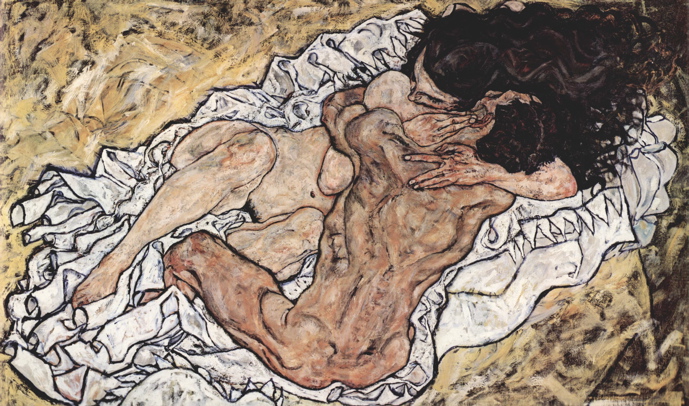
Egon_Schiele_

II. The Artist as Voyeur

                              Schiele’s Glimpse at Love


I want them to hold each other as if it were their last embrace.

It is unusual, I know, for anyone to witness such fiery tenderness

but long to see desire itself as I’ve always dreamt it,

not as I saw it in eyes saddened by layers of Kohl and mascara.

Isn’t it what the child in us seeks,

to be one with the primal act of one’s conception?

I want to forget the circled eyes of children consumed

by their own fire, their pupil, the color of pain and loneliness…

So I tell my models not to delay this embrace.  They undress clumsily,

hug each other so tightly they can’t breathe.  His arms pressed

around her waist crush her, yet she should not feel the pain,

for what is pain if not of longing, or letting go?

I want her hair to cascade in deep green over the white folds

of wrinkled sheets framing their face: let it fall on the nape of his neck,

let him sense her sweet fragrance.  I want him to wish he’d drown

in their dark waters, in the depths of scenes rushing into his mind,

of her of him of them of then of now all at once.


I want to be part of his vision, wish I could paint myself in his place,

feel images flow from her skin to mine.  I turn the hour hand back,

and over moonless waters in the darkness of a womblike warmth,

I glimpse my own reflection in their desire,

the desire of myself dissolving time and space.


Her fingers run over his shoulder, digging nails into his flesh

as if writing on clay, a clay I have become, for I know too well how

she remodels his chin, his lips, his cheekbone, her fingertips rest

in the crease of his earlobe, giving me time to paint, to imagine how

she remodels my chin, my lips, my cheekbone, her fingertips resting

in the crease of my earlobe as I draw myself onto them                                                   


My back overlaps his, as my body and hers become one

with every stroke.  She forgets him, a mere screen for this séance

to take place.  He whispers through her hair, but I know

she only hears my brushstrokes thrusting her face into her shoulder

as if trying to silence her, forcing her to bite her own flesh.

I know she will later read my unwritten words on the canvas

but does she notice how his voice is now covered by the sound of my brush? 

I paint myself as I paint them, a day at a time, my words suffused

in linseed oil muffle even their thoughts, seep through sheets,

beneath wavy curls, fold white curves around her body, between her legs.

She opens up like a flower offering more surfaces to the wind.

As I press the tip of the brush, I hear them think in Braille.

My palette feels heavier, the session is over. They dress up

like empty shells, leave me facing Us in a visibile parlare

She and I, in such an embrace, I will never recapture.


Bride_of_the_Wind-Oskar_Kokoschka-1913
 III.  Before the Storm

            The Wind Trapped by Kokoshka, Rests by his Bride


He lies eyes wide-open, brows tense,

lips pressed together,

his rugged hands

knotted over his belly as if in pain.

They have just made love,

their bodies’ tide lulled her to sleep,

and soon, they’d be swept away

in a whirlwind…

yet she sleeps unaware,

lost in enchanted woods

while he senses the gust      miles away,

hears murmurs      in the thickets,

feels ripples formed

by frightened wings.

Head leaning on his shoulder,

a closed fist against his chest,

her dreams speak in tongues …

in her faint smile…

under her lowered eyelids.

He remembers how she’d wait for him:

in the clearings    at her doorstep,

by the circular fountain

beneath tall beech trees.

He’d watch her read omens

in their bark’s charcoaled eyes,

outline her profile…

               a medallion in evening sepia,

see her dress     tremble

at the slightest breeze

he’d enter the courtyard,

rush through dark corridors…

drape himself with her smell

till she’d bend under his weight.

As though lying in tall branches,

they feel the rustle of leaves,

the sway of sycamores, imposing pines.

He has to leave without looking back,

join forces with the North wind,

break the reflection captured in her eyes.

Could he ever explain he was just

the substance of her dreams?                            

She would wake up soon…

the fury of the storm deafening,

its call      irresistible,

erasing the mirage of her shadow…

He thinks of getting up but cannot move,

          the painter’s gaze anchoring him by her side.


( Originally appeared in Museum Views: Art Info and whenever reprinted Museum Views: Art Info )

Hedy Habra, born and raised in Egypt, is of Lebanese origin. She holds and MA and MFA in English, and an MA and PhD in Spanish Literature from Western Michigan University where she currently teaches. Her poetry and fiction in French Spanish and English have appeared in numerous journals and anthologies including Drunken Boat, Puerto del Sol, The New York Quarterly, Cider Press Review, Nimrod, Poet Lore, Cutthroat, Inclined to Speak, Dinarzad’s Children Second Edition and Poetic Voices Without Borders Vol 2. She is the author of a collection of stories, Flying Carpets (March Street Press 2012); a collection of poetry, Tea in Heliopolis (Press 53, 2013) and a book of literary criticism, Mundos alternos y artísticos en Vargas Llosa (Iberoamericana 2012).

“Perfect Painting” by Chris Castle

The Perfect Painting

Yellow was always important to me. Yellow was the colour Madeleine wore when I first kissed her and yellow was the colour of Dan’s favourite T-shirt. I’ve always painted. When I began my paintings were full of red. Very red and very angry. I was always angry about something. After I met Madeleine and Dan, I turned around. My paintings started to have a lot more yellow after that.

When I look at a painting, especially one I’d worked on for months, I always noticed something different in it, each time I looked. Dan’s face is like a painting; his face shifts from one tone to another so easily. He’s usually clowning and laughing, but sometimes when he looked at my paintings, his whole face tightens, really concentrating on the colours.

I remember one time, I caught him looking at a piece and his eyes were so focused, I hardly recognised them. He always thought if he stopped messing around people would leave him. So he never stopped. Bit I appreciated him most when he was just being himself; his hazel eyes caught up in the picture, the colours animating his looks, with a thin smile of satisfaction at the brush work and the composition. I could tell the quality of a painting by how it moulded his face. When he caught me staring he just threw his head up, a smile flickering over his mouth and he would just say, “Hanging’s too good for it.” That always made me laugh. He could make me laugh at just about anything. It was only after he left I found the picture was one I sketched of Madeleine.

The three of us would often go out, with one of Dan’s many girlfriends and we would laugh so much, Dan always being the centre of attention; but once in a while I’d see him watching Madeleine and I knew. I knew he loved her almost as much as I did and sometimes, as much as I loved Madeleine, I wished Dan could be with her and love her.

One time we had a portrait of the three of us. It caught Madeleine so perfectly, with the hair just past the shoulders, those clear green eyes perfectly. I often looked into her eyes for hours at a time and I’d always find something new in them, every time.

The colour of a painting is important to me. Sometimes Dan would look like a painting, a human painting; I could always find a new aspect to him, behind that big brash yellow shirt, noticing those big, thoughtful, sad eyes, I used to wonder how he would turn out.

I was adding red to my latest when the letter came though. I hated that letter; I hated it because as much as I’d refuse, Dan would accept. I was scared of being forced to go and kill and be killed, but I was scared more for my friend who would willingly face it all.

He came round. There was no real point in me arguing with him. We just accepted it. He looked up from the painting and said, “How could you agree with it? You’re a painter.”

I laughed out loud when he said it, but I quickly subdued it. I could feel my eyes sting as we smiled. There was silence as I whispered it;

“Don’t.” Even then he smiled.

“Sorry. I have to.”

“You don’t have to do anything.”

“I’m going.”

I stopped talking after that and just looked over to him. Through all the red I saw, Dan stood out in-front of it all.

The following week we destroyed almost a whole city saying good-bye. One night Dan hit someone, about the war. I felt it was wrong. I didn’t like him when he was like violent. He was going to have to be like that a lot when he was out there.

As we said goodbye, Dan looked back at the two of us and we both knew that if he left now he would lose Madeleine to me to me forever and he still left, glancing back just that one time. It was the saddest moment of my whole damn life. Dan was now a soldier. I was a draft dodger. Dan would have landed at almost the same time as I crossed the border.

I hoped he had survived out there. I hoped h would come back and settle down. I hoped all these things. I prayed every night that he would live. My paintings became black and incomprehensible to everyone but me, because I knew how it was to leave a best friend behind.

As his letters arrived my guilt increased, as he told me he sat in the mud with a loaded weapon hoping to die and not have to kill. I stood for hours on the mountains, staring out to the forest, clutching the letters he had written.

The words were so cold and so terrible it felt like it wasn’t him. War had changed him. I longed for the letters to arrive and I hoped to god they would stop. I hated myself. I hated Dan for suffering and I hated the war and I hated Madeleine for loving me when I was so full of shame. The images I painted were sharp and full of black and red. So much red.

Still the letters came, and still the pain. The blood and suffering continued. It was constant. Then one day a different letter came, telling me Daniel Gallagher was arriving in my home town, in two weeks’ time. I didn’t even wonder why. I was so happy. It was only as the page unfolded that I read Dan had lost both his legs in a mine explosion. It was only then that I started to cry.

As I drove to the hospital, I began to hate him for what had occurred. I started to hate myself for letting it happen. As I moved up the corridor, my palms itched, sweat forming on my forehead. As I reached the door I faltered, breathed deeply and opened the door.

Everything was so white and cold. I saw my best friend stretched out over the cold, white sheets. His face had changed. It had changed so much. His eyes, when they opened, were vague and distant. I whispered his name. I don’t remember moving closer to him, but I started to put my arms around him and I screamed.

I never asked. I could never comprehend how much he had suffered and he never asked me to. I had seen him suffer pain that I could not and would not endure.

Dan became more mobile over the following months. He started socialising with friends, going to parties and exhibitions. We always had some time alone just to talk. One day we went to a forest. It was beautiful. All the flowers, the grass, the whole scene was so tranquil. A deer moved out in front of us. Dan was shaking and I put his hand on his shoulder. He reached out and put his hand in mine. It was then I realised how scared he was.

“My body’s broken. I know that. But that’s not what keeps me awake. Can’t escape memories.”

“Danny-“

“Do you think I haven’t hated you? I swear to Christ I have. I would have prayed to Jesus to turn us around. You have everything and I have nothing.” His voice was low pitched, as distant as he was angry. His eyes turned red, teeth gritted, spittle shooting out, his veins throbbing. His face was pulsing.

The deer moved on into the woods. I looked over and saw his arms over his face. It was such a beautiful day. He kept crying as the sun broke through and wrapped us in a blinding, burning light.

It was some time before I spoke to him again. I wanted to speak to him so many times but I just couldn’t find the words. A year past. When he turned up on my doorstep I nearly fell backwards in shock.

His face hadn’t changed noticeably, except for his hair had grown, he wore a beard. But his eyes had turned back to the hazel I remembered. I didn’t really notice what he was holding until he handed it to me. I didn’t hear his words or my reply, I simply tugged at the paper ad stared, I couldn’t describe what it depicted, what the images were. But the colours, the vivid, lucid colours, were so powerful, the scene so beautiful, so still and peaceful. I noticed how well the red and yellow went together. It was the best painting I had seen in a long time. I nearly forgot to look back to Dan, but when I did peer over the top of the frame, I saw his face and I saw his smile. I was going to say something, to tell him how I felt, but instead I laughed so much I nearly cried.

After that day we saw each to her regularly. We didn’t pretend that things hadn’t changed but we both accepted it and moved on. We spent the time we had talking and laughing all over again.

I encouraged him to paint, to get about more, while he simply told me things which put my life in perspective. He provided me with ideas for paintings, some funny, some sad, but always interesting. Like Daniel Gallagher.

This brings me to where I am now. Standing nervously by his side. I had remembered all this while waiting to act out my part; waiting for the sun to come through. Spring is here and the daffodils are out. Then, with almost perfect timing as I step over to him, to hand him the ring, the sun beams down on us all. Dan flashes another smile to me and I return it. As always. As he sips the ring on her finger, Daniel Gallagher, without realising it, has just, again, provided me with the inspiration for my next work. My perfect painting.

Support The Original Van Gogh’s Ear Anthology with a Donation Get a Book or Two…

While it is not expected, donations to support our site and Volume 11 are greatly appreciated. For donations of $10 get your choice of one title, $15 gets you two, $20 gets three, and $25 gets you all four. Should you have any questions on our new policy please do not hesitate to ask. We are pleased to now offer you the following gifts from French Connection (http://www.frenchcx.com/press/):

Van Gogh’s Ear Volume One

http://www.frenchcx.com/press/van-goghs-ear-volume-1/

Van Gogh’s Ear Volume Two

http://www.frenchcx.com/press/van-goghs-ear-volume-2/

Van Gogh’s Ear Volume Four

http://www.frenchcx.com/press/van-goghs-ear-volume-4/

(all edited by our very own and very dear Ian Ayres)

and

Tales: From a Distant Planet by Felice Picano

http://www.frenchcx.com/press/tales-from-a-distant-planet/

“Judgement Day” by Angela Cain

Judgment Day

The Sun beamed rays of fire
As every man on earth was deemed a liar.
The sins in the world had become too much
As the Earth began to lose its soft, loving touch.

Everything that was safe became a danger
As if Jesus had just been stolen from his manger;
And all the terrifying, taunting spirits arose,
Taking their prisoners to hell as the story goes.

Then Angels came down bursting through the flames
Looking for heavenly souls they might claim.
They found few, but took all they could find
Back up to heaven where it was safe, beautiful, and divine.

The Angels didn’t linger long for the fire grew and grew
As Judgment Day was upon us as we now knew;
And the world vanished in one great blast
As the Maker looked down and said, “The sins of Earth are gone at last.”

Angela Cain is a graduate student at Stephen F Austin State University majoring in English. She enjoys smelling the flowers as she quietly walks down the side walk at your nearest park while observing nature’s beautiful creations. These walks in the park give her the muse to write poetry and fiction. In her downtime she likes to play with her dogs, Molly and Shadow.

“La Tristesse Durera Toujours (the sadness will last forever)” by Benjamin Blake

La Tristesse Durera Toujours (the sadness will last forever)

Lost in the swirls of a starry night
Blurring the edges of olive groves and cypresses
The yellow moon hangs like a condemned criminal
Spirit lamp illuminating this virgin canvas

Pipe smoke clouds in the air
Foul smelling liquid poured over sugar cubes and through silver spoons
Paint smears these tired hands
Dear Theo, I’m afraid it is getting worse…

Stumble out into the field
Revolver clutched tight in pallid hand
Pull the hammer back and raise to hollow chest
A new portrait done in blood spatter

This bed is where a last breath will be sighed
Sheets stained and pulled over this lifeless face
Hand feels warm and vague
Brother, let me speak these last fatal words

Benjamin Blake was born in the July of 1985, and leads a relatively reclusive life in the New Zealand countryside. His fiction and poetry has been published online, and in print in Australia, the UK, and the States. He is a contributor to the 2012 Horror Zine anthology – A Feast of Frights (introduced by Ramsey Campbell). You can read more of his work (and view his photography) at www.benjaminblake.com

“Medea” by Joel Solonche

Medea

The sculptor has made
her princess of Colchis.
Her eyes are closed.

She is young, small,
frail as a flower.
Her lips begin a smile

for the stranger
come for the fleece
in her father’s city.

She holds a bowl
in one hand laden
with petals and leaves.

Her other is at
her breast where
it weaves the future

from a heart on fire,
a soul that begs: Forget
this story, refute

somehow all you know,
that such a face
conceive of crimes

the graceful innocence
of such a one could execute.
If not, oh, oh, a memory

that understands the cool,
white marble floor,
the pools of blood.

Four-time Pushcart Prize nominee as well as Best of the Net nominee, J.R. Solonche has been publishing poetry in magazines, journals, and anthologies since the early 70’s. He lives in the Hudson Valley and teaches at SUNY Orange.

“No One Could Ever Take Your Place” by Boris Jonathan Novak

No One Could Ever Take Your Place

Today I woke up with you heavy on my mind — it’s nothing new. I thought of the first time we’d kissed, and how the entire world suddenly had meaning. I thought of the precious, flowing fountain of wonder you awoke in me; the way you made me feel; the way you placed me on a pedestal and loved me unconditionally like you did. I think of you today, my body quivering, because no matter when, no matter where, no matter how, no matter what… no one — and I mean no one — could ever take your place.

Today I walked alone. I went to our special place to think of you — it’s nothing new. I felt a warm breeze brush against my face as I sat staring at everything and nothing. I closed my eyes and imagined your gentle hand — not the breeze — caressing me, wiping away the crystalline tears that flowed like miniature rivulets down my cheek. Your ephemeral silhouette comforted me, and I reminded you that no matter when, no matter where, no matter how, no matter what… no one — and I mean no one — could ever take your place.

Today I watched a movie, not on the television, but on a blank wall — it’s nothing new. The projector in my mind played out our story: the love we gave, the love we took, the times we hurt, the way we trembled, and the way we shook; the hopes we had, the dreams we shared; the promises we made, the vows we swore — the way we cared. And inside, my heart beat that familiar pulse — no matter when, no matter where, no matter how, no matter what… no one — and I mean no one — could ever take your place.

Tonight I had dinner alone. No, I didn’t eat a single bite — it’s nothing new. I stared solemnly upon the empty chair across from me. How futile again of me trying in vain to wish you there. But I can close my eyes and wish as I always do, can’t I? I can replay from my memory those delicate words you spoke when you said, “I’ll love you always and forever.” And I’d reply softly into your ear, “no matter when, no matter where, no matter how, no matter what… no one — and I mean no one — could ever take your place.”

Tonight I’ll sleep alone. My soul will cry for you, and my essence will bleed of your memory — it’s nothing new. I’ll remember your angelic arms around me, the warmth of your breath against my neck as we’d cradle each other, surrendering to the deepest of tranquil serenity. I’ll reminisce of how we’d loved and what we’d said, and perhaps in your heart — I’d like to think — you’d felt that no matter when, no matter where, no matter how, no matter what… no one — and I mean no one — could ever take my place.

Boris Novak dabbles in film production, as well as its many other facets. He is also owner and CEO of DARK HATTER FILMS, an eclectic production company, and author of many short stories and poetical works.