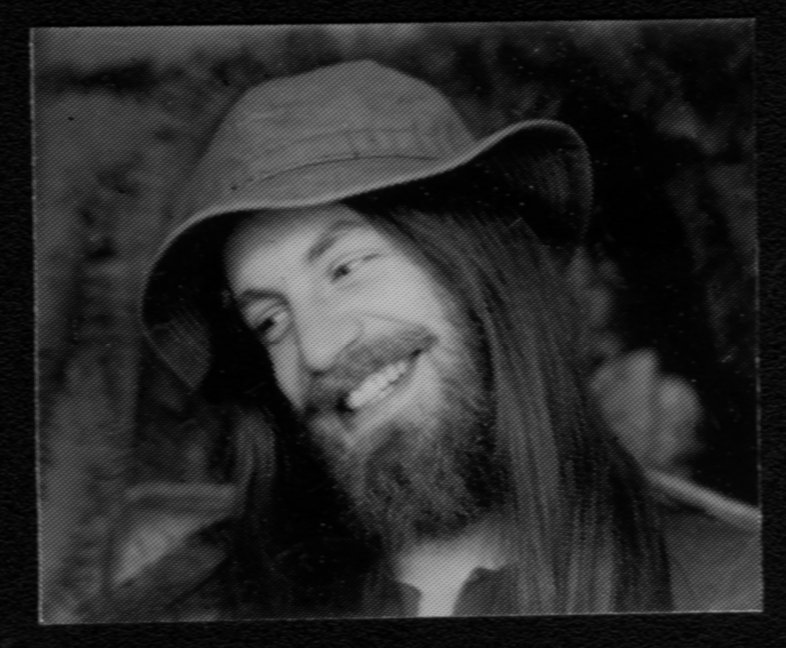
“Guilty Until Proven” by Justice Howard

Gerard Schaefer


GUILTY UNTIL PROVEN

I was at Belle Glade Correctional Institution in Florida visiting the great serial killer and sex beast author G. J. Schaeffer.

Who, upon first inspection seemed quiet and unassuming and nice enough, if even rather nerdish.

I told him I liked his story Spring Break,  the one about the guy who ends up murdering a wealthy high-class college student and that I too had felt that way at some time or another.

What I meant was that I too had felt a meandering dislike for the rich and bitchy.

But he did not take it that way.

He answered ” Oh so, you too have murder in your heart eh?”

His ghoulish smile, laced with an all-knowing creepy resonance left no doubt in my mind

that his heart had blacker spots in its depth than I could ever hope to fathom.

Justice Howard

World renowned photographer Justice Howard’s work has appeared in over 50 hardcover books and thousands of magazines internationally including French Vogue, Cosmopolitan, People, Newsweek, Jane, In Touch Weekly and Skin Two. Howard’s work has been exhibited at more than 60 galleries as well as many museums across the U.S. and Europe. 64 of the rooms in the upscale Lord Balfour Hotel in South Beach, Florida contain 30 foot wall murals of her art. The Tattoo Bar in Washington, DC also displays 30 of her pieces in 6 foot light boxes. Marilyn Manson, Billy Idol, Dave Navarro, Willie Nelson, Waylon Jennings and Dick Dale have all also spent time in front of Howard’s lens. Her subjects read like an “artistic wish list”. Nominated as one of the top 10 tattoo photographers, she has been compared to Annie Liebowitz and Herb Ritts and is often referred to as “the female Helmut Newton.”

http://justicehoward.com/
http://spattergasm.com/

“Mourning Missed (temporary sanity)” by Joshua Lawson

Mourning Missed (temporary sanity)

I’m a stray bullet
a falling star
the long, cold winter
that makes you starve

your stigmata that begs to bleed
if you truly care, then suffer me

it’s suicide to be so loved
it’s such a tragedy…

you’re everything I’m not
everything I need
a soul that can’t be bought
temporary sanity

when love comes like a thief in the night
would you suffer me?
star crossed lust mixed with lies
would you suffer me?

I’m God’s mistake
the mourning missed
the cold steel razor
across your wrist

the sadistic haunting that never leaves
if you truly care, then suffer me

would you die to be so loved
it’s such a tragedy…

you’re everything I’ve lost
everything I’ve dreamt
all that I could ever want
temporary sanity

just like a car crash, just like a knife
would you suffer me?
blood, sweat and tears sacrificed
you will suffer me

“Tug of War” by Lori A. May

Tug of War

He feels her slip away
pulls her closer
desperate to hinder
the chance of change


Lori A. May is the author of four books, including The Low-Residency MFA Handbook: A Guide for Prospective Creative Writing Students (Continuum, 2011). Her work has appeared in publications such as Passages North, Hippocampus Magazine, and qarrtsiluni. Canadian by birth and disposition, she now calls Michigan home. www.loriamay.com

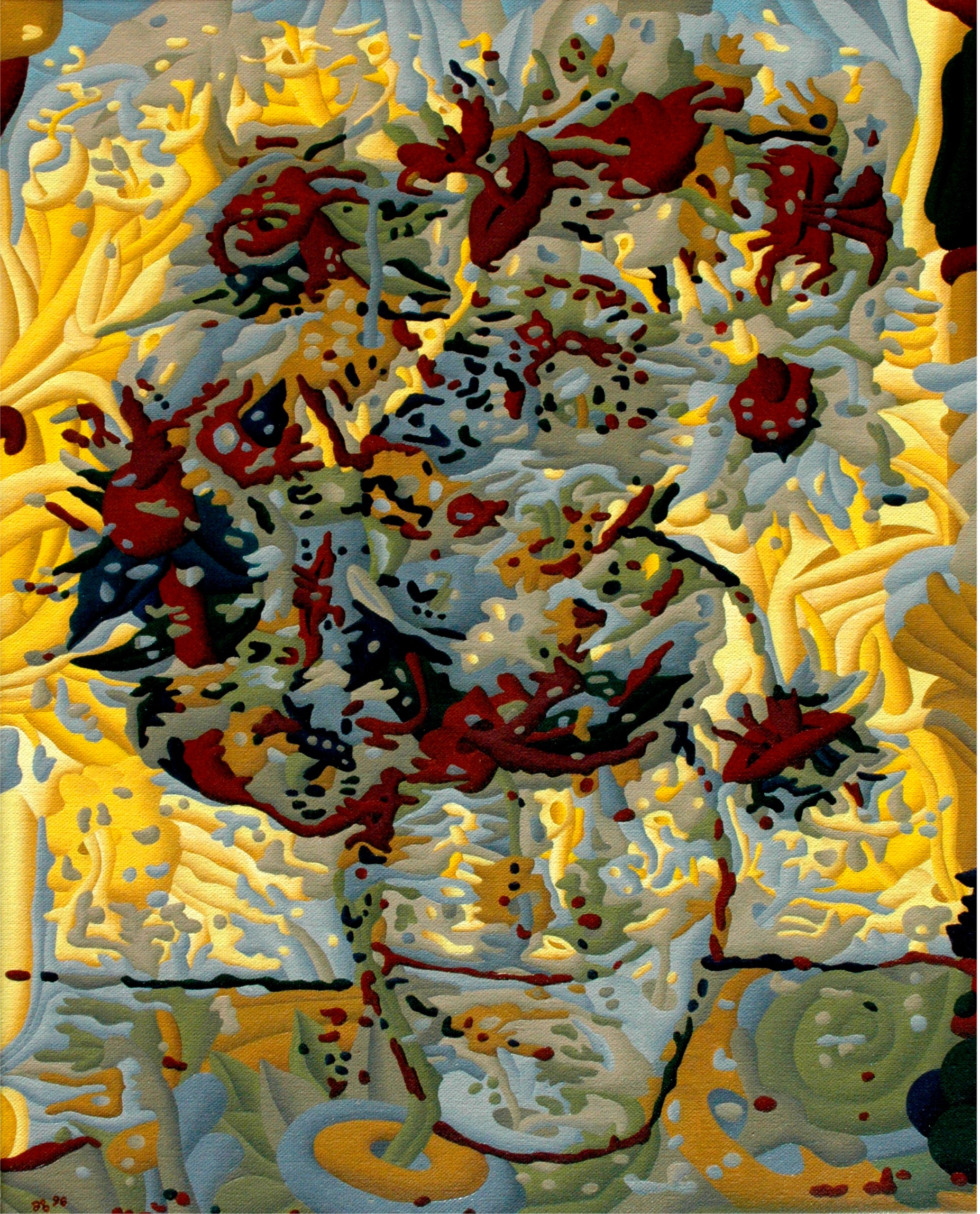
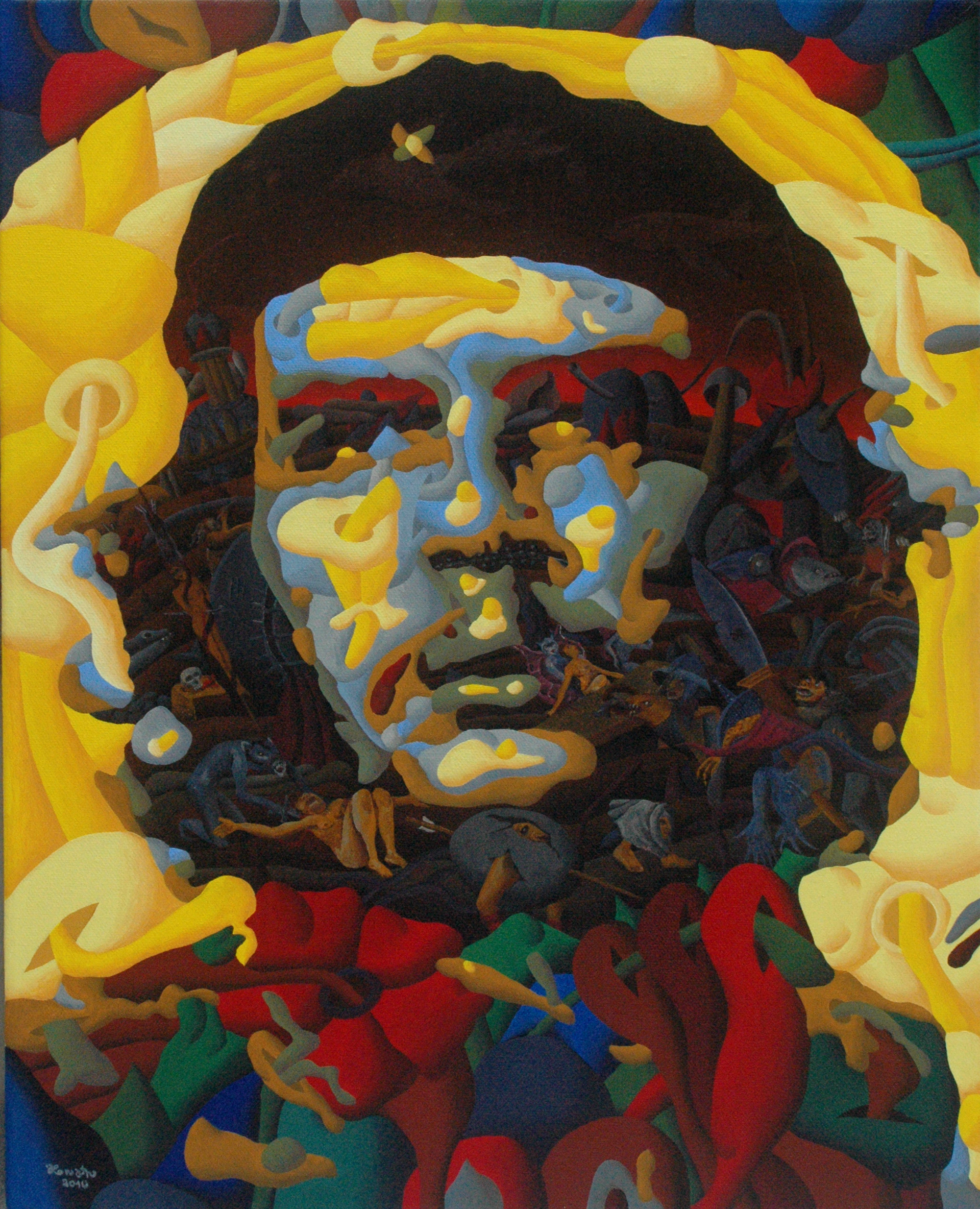
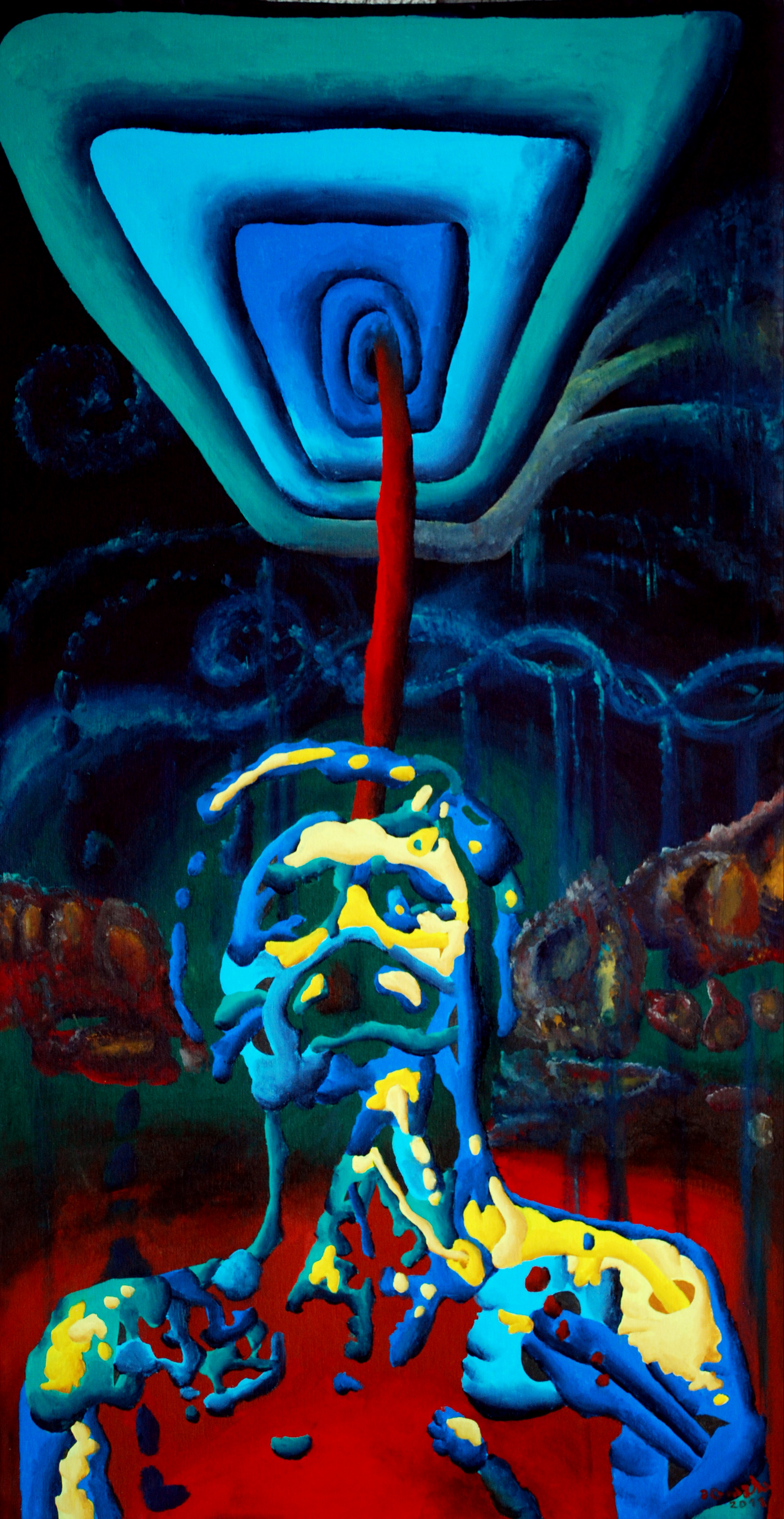
The New Constructivism of Werner Horvath

Vincent van Gogh

Sunflowers

Jim Morrison

Darth Maul

Darth Vader

Che Guevara

Bad News

Pray

Lennon Altar

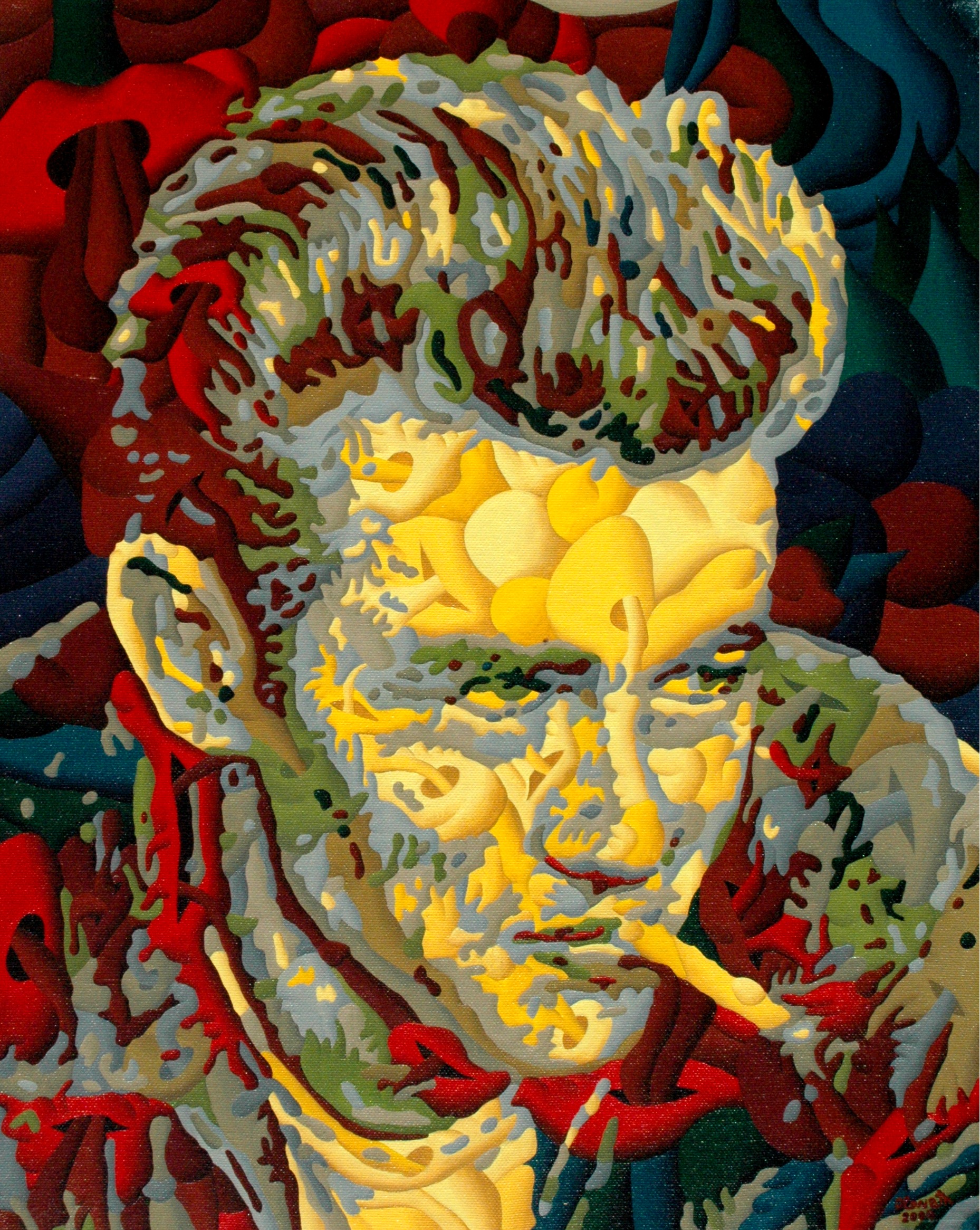
James Dean

Werner Horvath

Werner Horvath was born in Linz, Austria in 1949 and has been painting since his youth. Beside his interest in art, he studied medicine in Vienna. Horvath is now a well known chief radiologist in Linz; specialist in interventional radiology. His art-style turned from Phantasic Realism (1969 – 1975) slowly to New Constructivism, named after the philosophical theory, based on the works of Vico, Uexküll, Glasersfeld, Watzlawick and others. The theoretical background is explained in detail by the artist in a stage play in form of a text-collage, called Jahrtausendwende – Die Theorie des neuen bildenden Konstruktivismus (in German).

In his paintings, Horvath tries to show that what we call reality may not be so “real” after all. He explains that the world we live in can be understood as constructed by ourselves. For instance, colors do not really exist, but are products of the visual system and therefore are only “real” within our consciousness. But also forms of all kind have no reality outside our subjective world; on the contrary they are built up by several psychological mechanisms. And at last we have to take into consideration, that we live in a “symbolic world”: We see Stalin not only as a politician who lived from 1879 to 1953, but also as a symbol of dictatorship and cruelty.

As precursors of his style Horvath names Giuseppe Arcimboldo and M.C.Escher. Most of Horvath’s paintings are influenced by political events, deal with political and social problems or express the artist’s opinion on our society. For more, please visit The New Constructivism of Werner Horvath.

“Cleopatra, I Love You” by Ian Ayres

"Cleopatra, I Love You" by Ian Ayres

“Cleopatra, I Love You” by Ian Ayres

Cleopatra, I Love You

Even if you don’t like it (my penetrating your very core & soul) my love knows no “No, no, no’s” & capitulates on planting your womb with my seed . . . Seems an ellipsis is due (forget the period). We are wordless & worldless. There is nothing but temporary hanging onto illusions of unwrapped present. You & I know we die & nothing changes a thing by asking why. Question Mark? Fuck Mark. Before Mark, others punctuated you. Yet it’s all a momentary orgasm not worth dying for — though we die, we die — you die & I die & we all die within the too-fast blink of an eye. So why not get naked among the gods; our flesh pulsating claws of exclamation! Next comes you or me awaiting the other on the other side. For eternity, Cleopatra, be my wife. Please. For I am on my knees before you. & then, with the dawn, I am gone.

“At Eternity’s Gate” by Gary A. Braunbeck

“Starry Night” by Vincent Van Gogh

At Eternity’s Gate is an original short story by Gary A. Braunbeck about an ailing woman who is possessed by the spirit of Vincent Van Gogh. Due to the length of the piece it is offered up here in pdf form. Please click the link below to view the story in its entirety:

At Eternity’s Gate

Gary A. Braunbeck is a prolific author who writes mysteries, thrillers, science fiction, fantasy, horror, and mainstream literature. He is the author of 19 books; his fiction has been translated into Japanese, French, Italian, Russian and German. Nearly 200 of his short stories have appeared in various publications. Some of his most popular stories are mysteries that have appeared in the Cat Crimes anthology series.

He was born in Newark, Ohio; this city that serves as the model for the fictitious Cedar Hill in many of his stories. The Cedar Hill stories are collected in Graveyard People and Home Before Dark.

His fiction has received several awards, including the Bram Stoker Award for Superior Achievement in Short Fiction in 2003 for “Duty” and in 2005 for “We Now Pause for Station Identification”; his collection Destinations Unknown won a Stoker in 2006. His novella “Kiss of the Mudman” received the International Horror Guild Award for Long Fiction in 2005.

As an editor, Gary completed the latest installment of the Masques anthology series created by Jerry Williamson, Masques V, after Jerry became too ill to continue.

He also served a term as president of the Horror Writers Association. He is married to Lucy Snyder,, a science fiction/fantasy writer, and they reside together in Columbus, Ohio.

Gary is an adjunct professor at Seton Hill University, Pennsylvania, where he teaches in an innovative Master’s degree program in Writing Popular Fiction.

http://www.garybraunbeck.com/

“After Rimbaud” by Mark Fleury

After Rimbaud

Eyeless atmosphere’s lust to open, inhaled…

The poem’s body.

And soft as stairs whose steps extend to

Cover my words finally as flesh so sweet. Door:

Each floor is a shaved bed and each piece of broken

Light on the crown, northern and left-brained,

Of my shrinking, bright, and enslaved to fragile logic,

Porcelain head-

Shaped gate to the old heaven,

Smiles primordial steam

From its swamps’ membranes, lidless pineal gland,

As horseflies land, externally,

Onto the wombs

Of pencils from inside New Orleans morgues.

O precious door dripping with the dew

Of the view from my cave, why can’t you talk

As you open?

Why do poems moon from your womb?

So many heaven-phallic virgin births under Muse’s wing!

As she sits outside herself, huddled in the corner

Of the shower floor,

Graves sky

Your helpless lips,

Where vines

Of veins guard your entrance

Where you are always a precious mouth,

Facing downward

To surround the virgin world’s opening

Before your kamikaze dive

Hits the face of the water. I wanted to be alone

Instead of just a part of your departure from content.

Mark Fleury is a poet and stay-at-home Dad in St. Paul Minnesota.His poems have recently appeared in Transcendent Visions, The Storyteller, Ruah, Ceremony, Poet’s Haven and Down In The Dirt. He also has a chapbook entitled Spirit Light Naming Sound published through Scars Publications and Design. Fleury also published three poetry books through Scars, In Your Heart, the Apostrophe’s Teardrops of God (2010), Angel’s Syllable is Good Boss of Devil’s Spine (2011),and The 4D Window (2012). Mark considers his poems to be surreal, projective verse.

“The Scream” by Edvard Munch

The Scream

I was walking along a path with two friends
the sun was setting
I felt a breath of melancholy
Suddenly the sky turned blood red
I stopped and leant against the railing, deathly tired
looking out across flaming clouds that hung
like blood and a sword over the deep blue fjord and town
My friends walked on
I stood there trembling with anxiety
and felt a great, infinite scream pass through nature.

Edvard Munch

Edvard Munch (12 December 1863 – 23 January 1944) was a Norwegian painter and printmaker whose intensely evocative treatment of psychological themes built upon some of the main tenets of late 19th-century Symbolism and greatly influenced German Expressionism in the early 20th century. One of his most well-known works is The Scream of 1893.

“The Children At The Funeral” by Pat Brien

The Children At The Funeral

Children
feel ashamed when laughing at death,
And try
to hide giggles from grown up ears,
Confusion
and guilt grow deeper when caught,
Adult
admonishment demanding tears.
What is
lost comes in memories and dreams,
What is
suppressed in wild anger and fear.

But love
cracks its whip against adult grief,
Uses
phrases like Chin up and Be brave,
Has it
smile at clichéd consolation,
Shoving
it down the long path to the grave.
One more
freshly dug hole of remembrance,
For
broken lives that kind words cannot save.

Forced
solemnity and awkward shuffling,
A child
watches a worm that will fall,
She
moves forward and carefully lifts it,
To spare
a loved one from something that crawls.
Some
adults look abashed, some start coughing,
She studies
it and shows nothing at all.

Pat Brien is British and has been published in various independent national magazines in England,as well as having several literary short-stories and a dramatic monologue broadcast on BBC radio.

A literary story One Of The Boys appears in edition #22 of R.P. Burnham’s annual US literary journal The Long Story; one of his screenplays landed a semi-finalist position in Francis Ford Coppola’s first Annual Zoetrope SP Contest.

A poem Genetically Modified Food For Thought was published in the fourth edition of Van Gogh’s Ear and he was Senior Correspondent for Francophile Internet magazine Bonjour Paris for one year, writing two full-length Paris based articles each month.

A credited Bonjour Paris guest article written with Karen Fawcett (President) and Sarah Gilbert Fox (Directeur Général) was published in the 3rd edition of the popular guide-book Paris For Dummies.

His BBC monologue was translated into Serbian by translator Djordje Krivokapic and received a radio broadcast in Belgrade. He was elected to full membership with the Society of Authors in 2010. In late 2010 he published a fantasy/horror novel called Denied. He works professionally as a copywriter and currently lives in Dorset in the UK.

“The Christmas Tempest, 1999” by Susan Fox

The Christmas Tempest, 1999

Something’s wrong.

No sound or wrench of air,

but sleep’s been flushed from my veins

and I pace the study wondering why.

Moon so bright the sky looks placid,

except that it flicks like a kid’s homemade cartoon:

clouds faster than jet trails strobe the light.

The trees are thrashing – poplars in whiplash,

pines writhing and resisting,

only the oaks too heavy to react.

Across the fields,

beyond the dark chateau,

an eighty-five-foot fir snaps halfway down,

its top blown away before I can watch it go,

the wounded trunk still forced to bow and jig.

Picturesque, from my safe window –

pale clouds whirling past a full moon,

trees dancing.

Beyond this sheltered home a continent of forests

shatters and falls, littering the world.


(This poem appears in Susan’s most recent book, Border House.)


Susan Fox’s poems have appeared in dozens of literary and popular journals, from Poetry and The Paris Review and Chelsea to The New York Times. She was born in Ohio and has lived in New York, Rome, and Paris. Joel Mandelbaum’s opera to her original libretto on a hidden child in World War II premiered semi-professionally in New York, and she has also collaborated on several projects with painter Richard Ryan. Fox lives in a village in Normandy called Secret Source.