“At 40 His Wife Begins to Write Poems” by John Guzlowski

At 40 His Wife Begins to Write Poems

Each night, they come to her in dreams,
and when she can’t listen anymore,
she wakes and writes in darkness,
the shadows from the street falling
through the blinds and onto the paper,
like whispers.

She feels her husband beside her,
sleeping in a world without dreams,
or horizons, a beached whale, all breath
and cold flesh. When she reads her poems
to him in the morning kitchen, he’s puzzled,
frightened. Don’t worry, she says, I love you
more than anything.

She dreams one night she is driving
in the desert, wind moving through the air
like lean snakes. Hungry, she stops
near a gray shed. Sees the bones
of three angels lying on a table,
and urinates into a tub
filled with photos. In the corner
her mother stands in red stockings,
her feet swollen like salmon,
her tongue adrift in a dark sea,
her lips shaping sighs, maybe questions,
each one as different as blue
and yellow.

When she wakes, the lines are scrimshaw,
circles flattening under the weight
of triangles, gashes, red birds in trees.
Her husband puts down his coffee,
searches her eyes. She knows
what all of it means.

Digital StillCamera

John Guzlowski’s writing has appeared in Garrison Keillor’s Writers’ Almanac, The Ontario Review, Chattahoochie Review, Exquisite Corpse, Modern Fiction Studies and other journals both here and abroad–many of which are now defunct. His poems about his parents’ experiences in Nazi concentration camps appear in his book Lightning and Ashes. He blogs about his parents and their experiences at http://lightning-and-ashes.blogspot.com/

“Murmuration at Six O’ Clock” by Nessa O’ Mahony

Murmuration at Six O’Clock

Seurat could have captured this,
the swarm and pulse
of a thousand starlings
over St. Peter’s Basilica
as the light dips and the rain-tipped
Roman sky stains mulberry.
As far as the eye scans, birds rise
in ventricled waves
of fibonacci spirals,
gulls joining in, crows,
the parakeets from the Borghese,
till the air fills and bells
in each campanile sound
for every vespered swerve.

IMG_0028

Nessa O’Mahony was born in Dublin and lives in Rathfarnham where she works as a freelance teacher and writer. She was awarded an Arts Council of Ireland literature bursary in 2004 and 2011, a Simba Gill Fellowship in 2005 and an artists’ bursary from South Dublin County Council in 2007. She has published three books – her first collection, Bar Talk, appeared in 1999. Her second, Trapping a Ghost, was published in 2005. A verse novel, In Sight of Home, was published by Salmon in 2009 and a third collection of poetry will be published in 2013/14.

“Inescapeable” by Pansy Maurer-Alvarez

Inescapeable

I have selected this edgeland because it is lucid still, despite its troubles, its singing down of the human heart. Antony & Cleopatra and all that. Here a design seducer oversteps souls, voluptuous lips, eels and irises, dismisses the overriding assessment of light bare feet. The horizontal manners of the ribcage are self-induced and dependent on the weight of attributes (such as a fiery color) to cure the opposite heart-shaped lily. Fierce hairy leaves are aimed at masculine positions of age and dress; the whole tumbling jungle gets thrown. A damaging Spanish gardenia materializes and, for personal reasons, a curtsey flitters open your kiss.

The west wind turns delicate, elsewhere emotion intervenes with its immobile grip and we face the intrusion with confidence and feudal abruptness.

What rhythmic splendor we borrowed from the cramped space of the infuriated opera, its breath a perpetual restringing of untied phrases. We rubbed the cherished prolific with serious insight. Our static experience, veined and polished, now comes stuttering from hips and nerves; meanwhile Venus, pliant, clothes antiquity with insouciance.

picture-5

Pansy Maurer-Alvarez was born in Puerto Rico, grew up in Pennsylvania and has lived in Europe since 1973. Her poems have appeared in several anthologies and many magazines throughout Europe and the States, including Van Gogh’s Ear: Volume 2. Her collections are: Dolores: The Alpine Years and When the Body Says It’s Leaving(both from Hanging Loose Press, Brooklyn); Lovers Eternally Nearing (from Editions Thomas Howeg, Zurich) and Ant Small and Amorous (from corrupt press,Paris).

“The Train to Viareggio, an ode” by Joe Zeppetello

The Train to Viareggio, an ode

The train to Viareggio was crowded. This particular train went on to La Spezia. A bunch of kids got in near Pisa, heading for the beaches in Cinque Terra, where the water is bright blue and there’s a nude beach. They sat on the floor of the train blocking the aisle, so the conductor couldn’t get through if he tried. They had an hour to go because they would have to switch trains at La Spezia. There’d been a strike the day before, and the 90-degree heat sent the pent-up demand to the beaches of the Italian Rivera. We were going to Viareggio because we could rent an umbrella and chairs, and the food was cheap. The overloaded train was noticeably slower as we moved along. The landscape had slowly changed, and now we looked at salt marshes where the smell of the sea was strong. We stopped at a commercial port, and then stopped at Viareggio Centrale. When we stood up, a couple got up from the floor and took our seats; we gently stepped around the people sitting in the aisle as we headed for the door.

“We don’t get out here. We have a few stops to go,” a man with an Australian accent said to some people as they were starting to get up. They sat down, a little disgusted. Air conditioning is not Italy’s strong suit, and there was almost none on the train.

We stretched our legs. The trip from Florence had been longer than we’d expected. The kiosks had not been working at Florence SMN, and it took some time to get our tickets. We walked down the avenue to the beach, past oleander-lined streets, and across a busy coastal road, stopping at the Supermercato Conad to buy some bottled water and snacks.

The path to the bright yellow umbrella was hot and burned our feet. We sat in the chaise lounges, under the umbrella that had cost us twenty euros, and looked out over the sea from one of the oldest resorts in Europe, the place where Czars spent the long Russian winter, and where Shelley was cremated after he and his friends drowned when their sailboat sank in a sudden summer storm.

Naked children ran down the beach, not seeming to mind the hot sands. The blue water was full of people, many of them with water toys, and as we walked along the beach we could see that the marble-capped mountains were covered in a fine haze. That’s when the body washed up on the shore directly in front of us.

Fully clothed, right down to fine leather boots, the unfortunate sailor had recently drowned. There were no signs of life, no need for heroic CPR, nothing would help him now; several people had their cell phones out and were calling the police. Others scrambled to get their little kids away from the dead man. We helped the life guard pull him by his arms, so the waves wouldn’t drag him back out to sea, and then we sat on our towels waiting for the authorities. He was white, so we knew he was probably not an illegal immigrant from North Africa; he was very pale white, and had a pretty face.

Two paramedics, both with large sweat rings under their armpits, carried their gurney through the broiling beach sand. They checked the body, and then waited. The coroner would have to release the body to them; he was on his way. A small, skinny man with a thick moustache came to the beach. He and the two paramedics were the only ones there who were fully-dressed. They asked the life guard a bunch of questions, and the skinny guy filled out a form.

The two paramedics strapped the body to the gurney and carried him off the beach. There was a depression in the sand shaped like the back of a dolphin where the body had lain. We looked at the depression, and then carefully went in the water. People were talking about him. My Italian is bad, but I could understand bits and pieces, like a bad recording that fades in and out. Someone said he was English, that they knew him, or had seen him. He had a sailboat. There’d been a bad storm last night. Maybe he had been caught out in it. He had a young wife up in Genoa. She must know something is wrong by now.

We decided to go in for a swim. There was nothing more we could do. The water was cold at first, but that was because we were so hot from being on the beach in the sun. I went in up to my neck, and stood looking at the dome on top of the hotel Excelsior and the mountains in the background. The sun was getting more intense. I got out of the water first, showered on the beach, and dried off under the umbrella. She swam for another hour. She likes the water a lot more than I do. After she settled in, I asked if she was hungry

“No. Too hot to eat right now.”

“True.”

“That was very strange,” she said.

“You mean the man on the beach?”

“Yes.”

“That was very sad. I wonder what happened.”

“People mentioned a storm. He had a sailboat”

“Yeah. I could make out a little of what they said. Sailboats are bad in storms.”

“It probably took him by surprise.”

“He must have had a lifeboat,” I said.

“Maybe it was a small sailboat. Too small for a lifeboat.”

“I haven’t seen a small boat since we got here. This is the yacht club set if I ever saw one.”

“Maybe he wasn’t so rich?”

“Maybe he shouldn’t have gone out in a storm?”

“I saw a reporter talking to some of the people on the beach. We can get a paper tomorrow.”

“It’ll be on the news.”

Later we ate sandwiches at one of the tables in front of the small snack bar, and then went swimming again until the sun started to set and the sky began to change color. The late train back to Florence was crowded, and we got to the apartment after dark. The next morning there was a blurb in the paper. The man had been English, and his wife was in Genoa at their summer home. He disappeared the day before yesterday, the night of the bad storm. His boat was found washed up on shore. It had sunk with the lifeboat still attached. His widow wanted to cremate his body on the public beach, but the authorities said no. They insisted that he be cremated in a licensed crematorium. She planned on throwing his ashes into the sea from the spot where he had washed up on shore.

“We’re going.” She said, not a question.

“Of course.”

We took the train back to Viareggio. The weather had turned cool, so the train wasn’t crowded. Heavy clouds and light rain turned the water grey, and hid the mountains. We walked out on the beach. A pale woman in a white wedding gown opened a Grecian brass urn and cast beautiful ashes into the gentle surf. They sat on the surface of the blue-grey water for a moment, and then sunk into the Tyrrhenian Sea.

DSC_0523a

Joseph Zeppetello Lives in the Hudson Valley, and has published short works of fiction in Iron Horse, The Little Magazine, and Copper Nickel. His novel, Daring to Eat a Peach, was published by Atticus Books. He is currently working on another novel, and is interested in writing stories that explore character, and has been experimenting with short works that incorporate a touch of the magical or the absurd.

“Marilyn Monroe to Salisbury?” by Mark Wineka

By MARK WINEKA
Salisbury Post
Posted: Saturday, Dec. 01, 2012
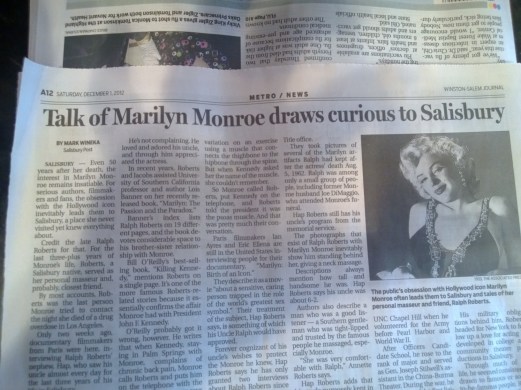
Ralph Roberts & Marilyn Monroe & Ian Ayres

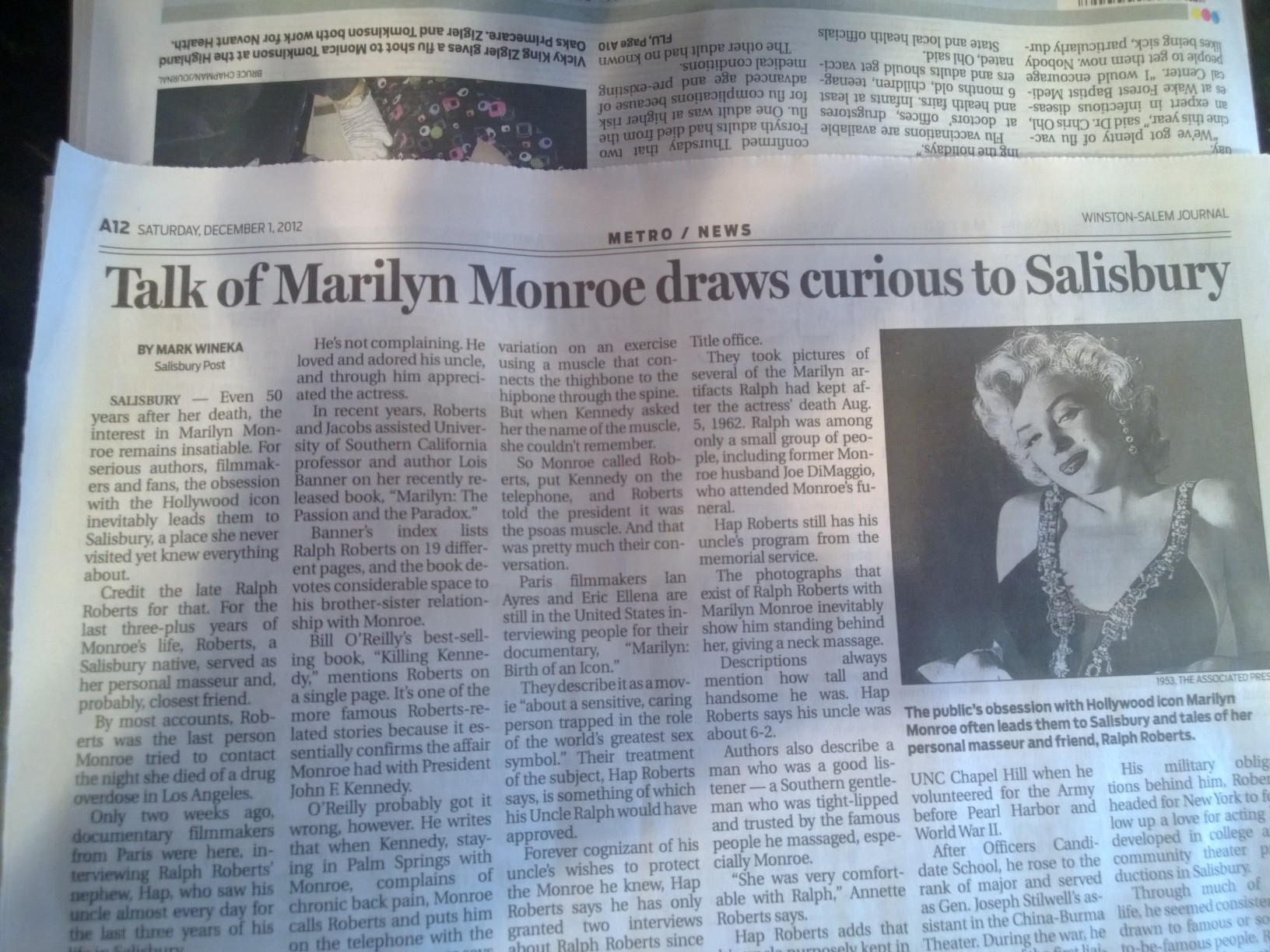
SALISBURY, N.C. Even 50 years after her death, the interest in Marilyn Monroe remains insatiable. For serious authors, filmmakers and fans, the obsession with the Hollywood icon inevitably leads them to Salisbury, a place she never visited yet knew everything about. Credit the late Ralph Roberts for that. For the last three-plus years of Monroe’s life, Salisbury native Roberts served as her personal masseur and, probably, closest friend.

By most accounts, Roberts was the last person Monroe tried to contact the night she died of a drug overdose in Los Angeles.

Only two weeks ago, documentary filmmakers from Paris were here, interviewing Ralph Roberts’ nephew, Hap, who saw his uncle almost every day for the last three years of his life in Salisbury.

French Connection Films also spoke to Chris “Steve” Jacobs, the man Hap Roberts has made archivist for his uncle’s papers and all things Marilyn.

Together, Roberts and Jacobs have developed a Ralph Roberts website. They keep a Greensboro attorney on call, just to make sure nothing false is attributed to Ralph Roberts.

Working from Hap Roberts’ company, Statewide Title, they store anything connected to Marilyn Monroe in lock boxes off site.

Long after Monroe had died and mainly as a way to correct and set straight things written about her, Ralph Roberts started several versions of a memoir, which he titled “Mimosa.”

“There’s constant interest in that manuscript,” Jacobs says.

Hap Roberts and Jacobs hope to publish the memoir some day, though putting the Marilyn years in chronological order and dealing with Ralph’s writing style have been difficult.

“He never took advantage of his relationship with Marilyn Monroe in any shape or form,” Hap Roberts says of his uncle. “We don’t want to profit from it, either. We just want to do what Ralph would want done.”

Hap Roberts’ life keeps bumping into his Uncle Ralph and Marilyn Monroe.

He’s not complaining. He loved and adored his uncle, and through him appreciated the actress.

In recent years, Roberts and Jacobs assisted University of Southern California professor and author Lois Banner on her recently released book, “Marilyn: The Passion and the Paradox.”

Banner’s index lists Ralph Roberts on 19 different pages, and the book devotes considerable space to his brother-sister relationship with Monroe.

Bill O’Reilly’s best-selling book, “Killing Kennedy,” mentions Roberts on a single page. It’s one of the more famous Roberts-related stories because it essentially confirms the affair Monroe had with President John F. Kennedy.

O’Reilly probably gets it wrong, however. He writes that when Kennedy, staying in Palm Springs with Monroe, complains of chronic back pain, Monroe calls Roberts and puts him on the telephone with the president. The passage says Roberts offered a quick diagnosis and hung up after a few minutes.

But while he was alive, Roberts told the Post at least twice – in 1985 and 1993 – that Marilyn called him that night after the president had asked her how she pulled off her signature walk.

Monroe knew it was a variation on an exercise using a muscle that connects the thighbone to the hipbone through the spine. But when Kennedy asked her the name of the muscle, she couldn’t remember.

So Monroe called Roberts, put Kennedy on the telephone, and Roberts told the president it was the psoas muscle. And that was pretty much their conversation.

Paris filmmakers Ian Ayres and Eric Ellena are still in the United States interviewing people for their documentary, “Marilyn: Birth of an Icon.”

They describe it as a movie “about a sensitive, caring person trapped in the role of the world’s greatest sex symbol.” Their treatment of the subject, Hap Roberts says, is something of which his Uncle Ralph would have approved.
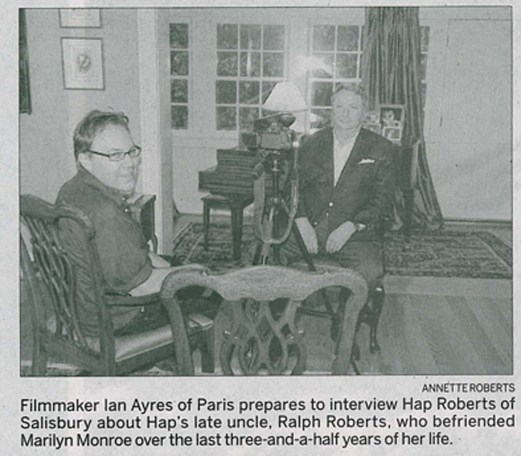
Ian Ayres & Hap Roberts (photo by Annette Roberts)

Ian Ayres & Hap Roberts (photo by Annette Roberts)

Forever cognizant of his uncle’s wishes to protect the Monroe he knew, Hap Roberts says he has only granted two interviews about Ralph Roberts since his death in 1999. One was for Banner; the other, for Ayres and Ellena.

When they were in Salisbury, the men filmed Hap and his wife, Annette, walking in City Memorial Park toward Ralph’s grave. They also interviewed Hap for an hour at his home and Jacobs for a considerable time back at the Statewide Title office.

They took pictures of several of the Marilyn artifacts Ralph had kept after the actress’ death Aug. 5, 1962. Ralph was among only a small group of people, including former Monroe husband Joe DiMaggio, who attended Monroe’s funeral.

Hap Roberts still has his uncle’s program from the memorial service.

“I grew up reading every book about her,” Ayres said in an email to Hap Roberts. “Now I find myself in the position of making the documentary I’d always hoped someone would.

“And your uncle Ralph meant so much to Marilyn. I know she’d be pleased.”

This year, Hap Roberts was invited to attend Marilyn Remembered’s Aug. 5 memorial on the 50th anniversary of her death. Marilyn Remembered is a fan club of sorts established in Los Angeles in 1982.

More than 400 people from all parts of the world attended the memorial service, according to Greg Schreiner, president of the group.

Hap Roberts wrote some words of tribute for his uncle which were read at the Monroe memorial, but he did not attend.

The photographs that exist of Ralph Roberts with Marilyn Monroe inevitably show him standing behind her, giving a neck massage.

Descriptions always mention how tall and handsome he was. Hap Roberts says his uncle was about 6-2.

Authors also describe a man who was a good listener – a Southern gentleman who was tight-lipped and trusted by the famous people he massaged, especially Monroe.

“She was very comfortable with Ralph,” Annette Roberts says.

Hap Roberts adds that his uncle purposely kept in the background, not wanting to be considered part of Monroe’s entourage.gg

Ralph Roberts’ acting career should not be overlooked, nor his military record.

He graduated with honors from Salisbury’s Boyden High School and Catawba College. He was attending the University of North Carolina at Chapel Hill when he volunteered for the Army before Pearl Harbor and World War II.

After Officers Candidate School, he rose to the rank of major and served as Gen. Joseph Stilwell’s assistant in the China-Burma Theater. During the war, he also was one of the first liaison officers from the Pentagon to the White House. In that position, he met President Franklin D. Roosevelt twice.

When Roberts was called back to active duty during the Korean War, he held the reserve rank of lieutenant colonel.

His military obligations behind him, Roberts headed for New York to follow up a love for acting he developed in college and community theater productions in Salisbury.

Through much of his life, he seemed consistently drawn to famous or soon-to-be-famous people. Roberts attended the method acting school of Lee Strasberg with fellow students such as James Dean, Shelley Winters and Marlon Brando.

In 1954, he appeared on the cover of Time magazine behind actress Julie Harris, who was starring in the play, “The Executioner.” Roberts was the executioner.

Roberts actually met Marilyn Monroe for the first time at Strasberg’s New York apartment in 1955. He wrote in his memoir that she was “one of the most radiantly beautiful creatures” he had ever seen.

“And when I say ‘creature,’ that was it,” Roberts wrote. “An animal. The blue-whiteness one sees sometimes in the stars of a desert night. White-blond hair, clear-white complexion framing violet-blue eyes.”

Roberts had parts in long-run Broadway productions such as “Witness for the Prosecution,” “The Lark” and “The Groom Wore Spurs.”

His first movie was Stanley Kubrick’s “Killer’s Kiss.”

To supplement his acting income, Roberts trained at the Swedish Massage Institute in New York, and he quickly became known among Broadway actors, film and television stars as the man who could help them relax before or in between performances.

The clients he would have over three decades, mostly in New York, sound like a Who’s Who in acting. He massaged, for example, Lauren Bacall, Richard Burton, Natalie Wood, Judy Holliday, Imogene Coca, Milton Berle, Red Buttons and Ellen Burstyn.

And, of course, Marilyn Monroe.

Roberts became Monroe’s official masseur in 1959, and for long periods, during her various marriages and romantic entanglements, would give her massages daily.

Roberts and Monroe forged a bond. She called him “Rafe,” the British pronunciation for his name.

They connected on the Willa Cather books they read, their spirituality and, believe it or not, Salisbury.

As Roberts massaged her at night, he spoke to her about his hometown and all of its places and people – down to men such as Irvin Oestreicher and Julian Robertson Sr. to the roasted peanuts at the Lash store and the winged statue on West Innes Street.

Together, Roberts and Monroe ran errands, ate meals together, attended parties and took plane trips across the country between New York and California.

Roberts was with Monroe the night she practiced singing “Happy Birthday,” the version she would famously croon to Kennedy.

They watched the 1960 Democratic National Convention together when Kennedy won the nomination. They were on the set together every day of “The Misfits,” Clark Gable’s last movie.

In addition to massaging Monroe between scenes and being her chauffeur, Roberts played the part of an ambulance driver in “The Misfits.”

When he was 9, Hap Roberts says, he wrote his uncle in the spring of 1960 after hearing Ralph had the part in “The Misfits.” Hap asked whether Ralph could have Monroe autograph a picture to him and also one to his 9-year-old girlfriend, Kay Snider.

A month later, the pictures came in the mail. His said simply, “To Hap, Marilyn Monroe,” but she had signed the cover of a Life magazine with her and actor Ives Montand.

“I still have it,” Hap Roberts says.

As his nephew recalls, Ralph Roberts drove one of the first Corvettes – a black beauty with red interior. Monroe enjoyed riding with him.

Hap remembers that his grandfather had one of the first televisions in Salisbury, “and we would all gather around and watch Ralph in early Kinescope productions,” he said.

His uncle had an apartment in Greenwich Village. Roberts says one night Ralph and another aspiring actor, James Dean, returned to that apartment to listen to records.

When Ralph was acting in plays in New York, Hap and his mother would visit at times.

“I met Imogene Coca in her east-side apartment, Judy Holliday and Dean Martin back stage and years later with my wife, Lee Strasberg and Al Pacino at Lee’s apartment in the Dakota, a year before (John) Lennon was killed.”

Hap Roberts even received some hand-me-down clothes, such as sportcoats, from Ralph Roberts’ clients.

“I grew into Milton Berle’s stuff when I was 18,” he says.

In those Marilyn years, Hap says, Ralph Roberts would travel home to Salisbury with numerous small checks from the actress he had yet to cash. Once Hap’s father, Harold, asked his brother to have Monroe make out one of the checks to him.

The next trip home, Ralph Presented Harold with a $100 check made out to him from Monroe. Harold Roberts carried it around in his wallet for a year, showing everybody. Then one day he cashed it in.

Hap Roberts couldn’t believe it.

“He said, ‘Hell, it was $100.’ ”

Hap Roberts cherishes the last years of his uncle’s life after he left New York and lived on Parkview Circle close to Hap’s office. They would meet every afternoon around 4 p.m., and Ralph would look after Hap’s dogs on the weekends.

Every Sunday evening was “Martini Time.”

Ralph Roberts would appear at Hap’s house at 5 p.m., bringing the Sunday New York Times with him, so Annette and Hap could read it later.

Ralph Roberts had a art deco martini set Monroe had given him, and once he brought it out for their Sunday ritual.

Hap and Annette, who also became close to Ralph, knew not to probe him for his memories of Monroe.

When he did talk about their relationship, they tried not to interrupt, savoring every detail and recognizing how much he loved and respected Monroe.

Ralph Roberts felt great remorse that he wasn’t home the night of Monroe’s death to answer her call. He lived close to the actress and could have been to her house quickly.

“I do think he probably carried that to his grave,” Hap Roberts says.

Something else Monroe had given Ralph was a box full of the chandelier crystals she had collected. Monroe thought the crystals had healing properties.

Ralph Roberts would sometimes hand out the crystals as gifts to friends.

Hap Roberts tells a funny story, too, of another Monroe gift to his uncle. After Ralph’s death, Hap was gathering his uncle’s clothing together for a donation to Goodwill.

He noticed a woman’s Burberry trench coat in the closet, but he figured it was a friend’s coat, left at Ralph’s house in the past. He placed it with the other things for Goodwill.

“About a month later, I found a list of Marilyn Monroe items,” Roberts says. “Sure enough, on the list was ‘Burberry trench coat.’

“Well, Marilyn’s coat is now protecting some unsuspecting lady in Salisbury from inclement weather.”

When Ralph Roberts died April 30, 1999, at his home, he was 82. Hap Roberts said he sat alone in his uncle’s house and cried until he couldn’t cry any longer.

Roberts noticed the stacks of memoir papers spread out everywhere in the living room. In the den, he also saw the open Willa Cather book that his uncle had been reading.

Up to the end, Ralph Roberts was chasing his friend, Marilyn Monroe.

Official Ralph Roberts Website: http://www.ralphlroberts.com/

The Associated Press: Talk of Marilyn Monroe lures curious to Salisbury

“Sibyl” by Cezarija Abartis

Sibyl

sybildetailofthesistinechapel

Her mother had died two months before and seemed very old. Sibyl could foresee her own frail hand on a white bedsheet and, beside the bed, a chamberpot to be sick into. At the time, she thought that she should remember to ask for youth along with years when Apollo begged for her love. She foresaw also the decline of an empire. She must remember to learn other languages. She would have decades to study, centuries. She must remember also to save treasure, so she could get through the fallow years comfortably. Life was just a balance: wisdom, folly; elation, despair; health, suffering. Everything comes to one, eventually.

Perhaps that was supposed to be consolation for not being made of stone. Still, she thought the knowledge heightened the pain, particularly when one knew what was coming. So: she cultivated in herself the talent of forgetting the future. That offered some peace.

A month ago, Apollo visited her as a lion, then a hawk, parading his power, which she could not abide. When he roared, she waved him away. They had met on a sunny day and then that night.

“I don’t think so,” she had told Apollo, but she had not meant it.

The next night feathers grew over his bright, sunny skin, and she almost allowed herself to be seduced, but at the last minute he became human, and she knelt on the beach. “I want a gift,” she said. “As many years as there are grains in this handful of sand.”

“Doesn’t that make you a prostitute?” He smiled a thin smile. He stroked his lovely, narrow fingers, as if he were a surgeon. “You’re selling yourself to the highest bidder.”

“Easy for you to say I’m a whore,” she said. “You have everything.”

“Very well. Let’s make the exchange.” He scooped up a handful of sand and flung it toward the star-filled sky. The sand smelled of fire, flickered in the air, glimmered, and she knew she had been given the years. He clutched at her wrist.

“If you call me a whore, then I’ll be one.” She stepped away from him. “I did not think I could be one, but as it turns out, I can.”

He grasped her shoulder. “You want more?”

She shrugged. “I want everything.” She looked at the unreadable stars. “I want to be a god.” Her mother would have said the same thing.

“I could have a hundred girls as pretty as you. But I chose you.” His eyes flashed and he leaned in. “I liked your shrewdness.”

She was angered and said, “I liked your power.”

He straightened up. “You can have your years. And with it, decrepitude.” He flicked his fingers at her. “Remember, until you are senile, what I have given you.”

Outlined in moonlight, he marched along the shore. Inside she felt a shaking, a rift from the past. She crossed her arms to keep from spilling out. The moonlight flaked on the sea, tapped on her eyelids when she shut them. She was, she thought, more like the moon than the sun, more like her mother.

She would need to forget him. She had been foolish to toy with a god, she knew that. But for now, the moon hung like a silver boat in the sky. The night breeze brought her the scent of hyacinth. The sound of crickets filled the air.

OLYMPUS DIGITAL CAMERA

Cezarija Abartis’ Nice Girls and Other Stories was published by New Rivers Press. Her stories have appeared in Per Contra, Prime Number, Waccamaw, and New York Tyrant, among others. One of her flashes was included in Wigleaf’s Top 50 list of flash fiction. Recently she completed a novel, a thriller. She teaches at St. Cloud
State University.

http://magicmasterminds.com/cezarija/

“How I Would Keep the Maybe One Eighth Choctaw Part of Me Alive” by George Drew

How I Would Keep the Maybe One Eighth Choctaw Part of Me Alive

You better hope you never see angels on the rez.

                                                  —Natalie Diaz

Because you damn well know I’m no angel,
you might think, to accomplish this minor mathematical feat,
I would take up bow and spear and read the sign,
that I would crouch in copse and shadow,
learn the way of the warrior, learn the way
of crow and wily coyote; or that I’d bow
before the spirits of ancestors, learn the language,
teach it to the youngsters, keep it on their tongues;
or most of all, that I would chant and dance
under the stars, around and around the campfire
dance until the moon collapsed and from
behind the mountains the sun rose up saying Stop!
And you’re right, maybe I would do any or all of these,
but I’d much rather take up herbs and rattles,
and as a medicine man take my own advice
that the best medicine is strong medicine and kick the hell out
of the seven-eighths white ass part of me.

George Drew was born in Mississippi and raised there and in New York State, where he currently lives. He is the author of four collections of poetry: Toads in a Poisoned Tank, from Tamarack Editions,  The Horse’s Name Was Physics, from Turning Point Press; a third, American Cool, was released by Tamarack in 2009; and a fourth, The Hand that Rounded Peter’s Dome,by Turning Point in 2010. Drew was the winner of the 2003 Paumanok Poetry Prize, the 2007 Baltimore Review Poetry Prize, the 2008 South Carolina Review Poetry Prize, and was runner-up for the 2009 Chautauqua Literary Journal Poetry Contest, which also nominated him for a Pushcart Prize. American Cool won the 2009 Adirondack Literary Award for best poetry book of the year. A fifth collection, The View from Jackass Hill, is the 2010 winner of the X. J. Kennedy Poetry Prize, Texas Review Press, 2011.

http://www.georgedrew.com/

“Bad Girls” by Susanna Roxman

Bad Girls

Believe me, they were thoroughly bad
but not in a sexual sense.

The sky wore a special transparent blue
those never tarnished noons in spring.
Sunsets in the fall glowed redder than today.

Getting away with practical jokes,
thinking other people didn’t count
or not in the same degree,

those girls decided the world was theirs,
yellow apple cut in pieces, one for each,
felt a fierce urge
to be noticed, either praised or blamed.

The reputation haloing their group
never shriveled, couldn’t shrink.

Also individual traits, you’ll add:
one self-appointed leader, mix of sadism and charm,
and the quiet, intelligent one who could almost have passed

for a scholar; the third, fan girl type,
egging others on with praise;

the upper-class poet who struggled so hard
to be ordinary, tough, with simple tastes;
and the loyal, brave child who did as she was told,
who could have died for a friend.

We’ll have to desert them, safe in the past,
leave well and less well alone,
leave them to their fate.
In any case, by now it’s way too late.

One victim resting among grassy dunes
turned her back toward you and them,
strategy of survival or to hide her tears,
impassive young woman under pensive pines.

Make no mistake,
bad girls were never particularly nice,
lacked compassion, made fellow students afraid
to return after summer to school.

Yet something of the charisma remains,
that dry energy still
crackling, sparkling where wicked girls would walk.

They have their admirers even today
who remember golden and green afternoons
in September or May

when wild girls made everything fresh,
wholly transformed, made it spring alive.

Helplessly, you admired
against your better judgment, your true ideals
such confidence and style.

In spite of all, you longed to be one of them
because the feeling they conveyed
by simply being around

was that no limitations could exist
while youth lasted, or life itself.

Wherever the girls happened to be
became the most important place
on the planet: they always appeared

as harbingers of something great,
dwarfing even themselves.

Any door, any gate swung open at their touch.
Leaving, such graduates took something away.

You live much more quietly now,
your mind suspended in the already lackluster air.
All bad girls gone, if not necessarily dead,
nothing matters now as it did to them.

Susanna Roxman, born in Stockholm, writes in English. Her father’s family is Scottish. She has studied at universities — including King’s College, University of London — in Britain and Sweden, and has a PhD in Comparative Literature from the University of Gothenburg. Her poetry collections Broken Angels and Imagining Seals were published by Dionysia Press, Edinburgh; the latter book was supported by the Scottish Arts Council. A third collection of hers, Crossing the North Sea, is supported by Creative Scotland (the Scottish Arts Council + Scottish Screen), and will appear with the same publisher.

Susanna has poems in more than 60 journals world-wide, including Prairie Schooner, Cimarron Review, The Spoon River Poetry Review, Crab Orchard Review, Stand (UK), Orbis (UK), Magma (UK), Poetry Ireland Review (Republic of Ireland),and The Fiddlehead (Canada). She has also written a book of criticism, Guilt and Glory: Studies in Margaret Drabble’s Novels 1963-80 (Almqvist & Wiksell International, Stockholm).

www.roxman.info

“So You Want to be a Poet” by Garrett Cook

So You Want to be a Poet

So you want to be a poet and build sculptures in the sky,
Want to feed the people beauty like some kitchen from on high?
Want to make the make them all hear music when there’s really not a band,
Want to offer them your words when you should give them your hand?
Go ahead.

So you want to be a poet want to suffer, starve and die,
Want to tell them all your stories? Well, I think that’s a lie.
Are you in it for the women, for the glory, for the art,
Are you in it for the hunger and the pain that fills your heart?
Answer me.

So you want to be a poet, but not be glum like old Jack Keats,
Want to sing of lover’s loves and want to tell of heroes’ feats?
What is it that you want then, what is it that you need?
Do you want to be a hero? In words, friend or in deeds?
Good for you.

So you want to be a poet, want to make the people great,
Want to take on extra burden and then take from them their weight?
Want to suffer for the masses ‘til you draw your final breath,
Want to heal the people’s souls just like that man from Nazareth?
I hope you do.

So you want to be a poet, mr. Eliot manque,
Want to show the Nihilists just why they don’t wake up each day?
Keep your metaphors quite deep, and keep your references arcane,
And just write for intellectuals, since the peasantry’s so plain.
Sure, why not?

So you want to be a poet, getting high and sniffing glue,
Just make sure you don’t forget the fact that poets write things too,
So if Kerouac’s your idol, let your addled mind roam free,
Are there Tic Tacs in your pocket? Sounds like a poem to me.
Applesauce.

So you want to be a poet, ‘cause we all know chicks dig scars
And you want things to be easy but you can’t play the guitar,
Do you think that they’re all gasping at the lovely things you say?
Do you think that they’re all gawking at your fancy new beret?
That sounds right.

So you want to be a poet and be Faust without the shame,
Want to run through fields of razors when they’ll still forget your name?
Want to break the people’s shackles so you’ll lead them someplace new?
Want to elevate the earthbound? It’s the only thing to do.
So do I.

Garrett Cook is a small press novelist and poet in the Bizarro movement. His latest book is Jimmy Plush, Teddy Bear Detective from Eraserhead Press. When he is not writing Bizarro, he can be found editing Imperial Youth Review, a magazine from Dog Horn Publishing in the UK and singing in the band Mayonnaise Jenkins and the Former Kings of the Delta Blues.

He is also author of Murderland part 1:h8, Murderland 2:Life During Wartime, and Archelon Ranch. Find out more at : http://thegarrettcook.blogspot.com

“A Triptych: Visibile Parlare in Sotto Voce” by Hedy Habra

A Triptych,

       Visibile Parlare in Sotto Voce


I. What the Painter Hears

A Song from the Viennese, Whispered to Klimt


You wanted our encounter to be a ritual,

         planned every detail:

                Ivy circled your hair,

        I interlaced mine

      with violets and jasmine.

Wrapped in a diaphanous sarong,

    I stood by the bed of forget-me-nots.

             You held me

against your silk kimono,

              the sun’s folded wings framed us

        in its golden coin.

Losing my balance, I fell on my knees,

       clinging to you,

              my arm around your bent shoulder.

Eyes closed, I could see your hands

             cupped around my face

as if holding a precious porcelain.

      I pressed my toes

             against the ground

   afraid we’d sink

              into the abyss,

both trapped within one trunk,

                one womb,

as if  you were my own

        and I, mother earth bearing fruit,

                  merging our beginnings.

Let me become that space

       between your palms,

the mark of your lips on my cheek.

Egon_Schiele_

II. The Artist as Voyeur

                              Schiele’s Glimpse at Love


I want them to hold each other as if it were their last embrace.

It is unusual, I know, for anyone to witness such fiery tenderness

but long to see desire itself as I’ve always dreamt it,

not as I saw it in eyes saddened by layers of Kohl and mascara.

Isn’t it what the child in us seeks,

to be one with the primal act of one’s conception?

I want to forget the circled eyes of children consumed

by their own fire, their pupil, the color of pain and loneliness…

So I tell my models not to delay this embrace.  They undress clumsily,

hug each other so tightly they can’t breathe.  His arms pressed

around her waist crush her, yet she should not feel the pain,

for what is pain if not of longing, or letting go?

I want her hair to cascade in deep green over the white folds

of wrinkled sheets framing their face: let it fall on the nape of his neck,

let him sense her sweet fragrance.  I want him to wish he’d drown

in their dark waters, in the depths of scenes rushing into his mind,

of her of him of them of then of now all at once.


I want to be part of his vision, wish I could paint myself in his place,

feel images flow from her skin to mine.  I turn the hour hand back,

and over moonless waters in the darkness of a womblike warmth,

I glimpse my own reflection in their desire,

the desire of myself dissolving time and space.


Her fingers run over his shoulder, digging nails into his flesh

as if writing on clay, a clay I have become, for I know too well how

she remodels his chin, his lips, his cheekbone, her fingertips rest

in the crease of his earlobe, giving me time to paint, to imagine how

she remodels my chin, my lips, my cheekbone, her fingertips resting

in the crease of my earlobe as I draw myself onto them                                                   


My back overlaps his, as my body and hers become one

with every stroke.  She forgets him, a mere screen for this séance

to take place.  He whispers through her hair, but I know

she only hears my brushstrokes thrusting her face into her shoulder

as if trying to silence her, forcing her to bite her own flesh.

I know she will later read my unwritten words on the canvas

but does she notice how his voice is now covered by the sound of my brush? 

I paint myself as I paint them, a day at a time, my words suffused

in linseed oil muffle even their thoughts, seep through sheets,

beneath wavy curls, fold white curves around her body, between her legs.

She opens up like a flower offering more surfaces to the wind.

As I press the tip of the brush, I hear them think in Braille.

My palette feels heavier, the session is over. They dress up

like empty shells, leave me facing Us in a visibile parlare

She and I, in such an embrace, I will never recapture.


Bride_of_the_Wind-Oskar_Kokoschka-1913
 III.  Before the Storm

            The Wind Trapped by Kokoshka, Rests by his Bride


He lies eyes wide-open, brows tense,

lips pressed together,

his rugged hands

knotted over his belly as if in pain.

They have just made love,

their bodies’ tide lulled her to sleep,

and soon, they’d be swept away

in a whirlwind…

yet she sleeps unaware,

lost in enchanted woods

while he senses the gust      miles away,

hears murmurs      in the thickets,

feels ripples formed

by frightened wings.

Head leaning on his shoulder,

a closed fist against his chest,

her dreams speak in tongues …

in her faint smile…

under her lowered eyelids.

He remembers how she’d wait for him:

in the clearings    at her doorstep,

by the circular fountain

beneath tall beech trees.

He’d watch her read omens

in their bark’s charcoaled eyes,

outline her profile…

               a medallion in evening sepia,

see her dress     tremble

at the slightest breeze

he’d enter the courtyard,

rush through dark corridors…

drape himself with her smell

till she’d bend under his weight.

As though lying in tall branches,

they feel the rustle of leaves,

the sway of sycamores, imposing pines.

He has to leave without looking back,

join forces with the North wind,

break the reflection captured in her eyes.

Could he ever explain he was just

the substance of her dreams?                            

She would wake up soon…

the fury of the storm deafening,

its call      irresistible,

erasing the mirage of her shadow…

He thinks of getting up but cannot move,

          the painter’s gaze anchoring him by her side.


( Originally appeared in Museum Views: Art Info and whenever reprinted Museum Views: Art Info )

Hedy Habra, born and raised in Egypt, is of Lebanese origin. She holds and MA and MFA in English, and an MA and PhD in Spanish Literature from Western Michigan University where she currently teaches. Her poetry and fiction in French Spanish and English have appeared in numerous journals and anthologies including Drunken Boat, Puerto del Sol, The New York Quarterly, Cider Press Review, Nimrod, Poet Lore, Cutthroat, Inclined to Speak, Dinarzad’s Children Second Edition and Poetic Voices Without Borders Vol 2. She is the author of a collection of stories, Flying Carpets (March Street Press 2012); a collection of poetry, Tea in Heliopolis (Press 53, 2013) and a book of literary criticism, Mundos alternos y artísticos en Vargas Llosa (Iberoamericana 2012).