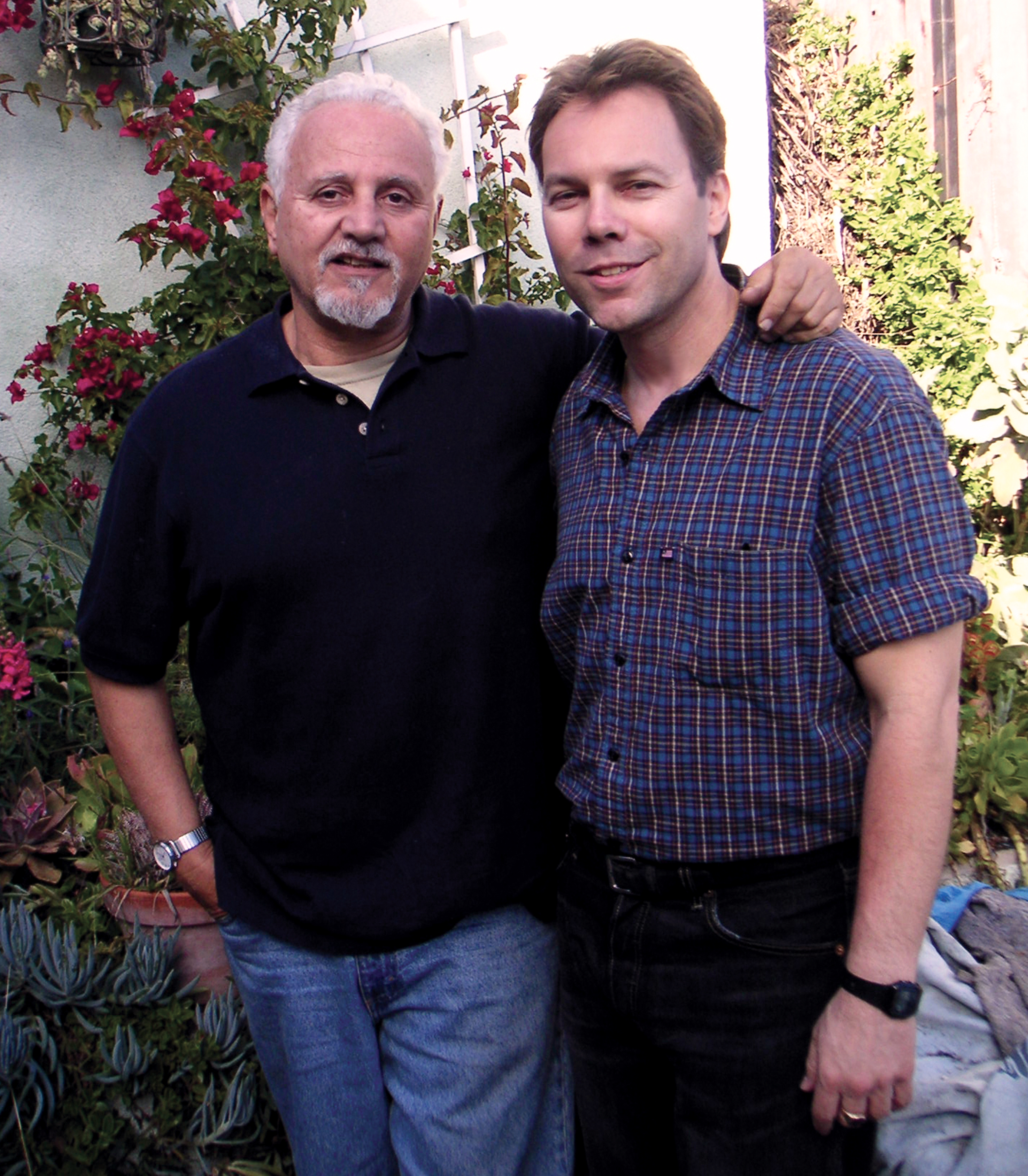
“Felice Picano: From a Distant Planet” by Ian Ayres


Felice Picano with Ian Ayres

Felice Picano with Ian Ayres

Antennae rise out of Felice Picano’s head. I blink and they are gone. Maybe I just thought I saw antennae. Reading about all those people who are convinced that “aliens walk among us disguised as humans” probably wasn’t a good idea before this interview. According to new research, however, alien-like forms have been found in pre-historic cave drawings. In fact, highly acclaimed scientists/astronomers such as Carl Sagan and Stephen Hawking believe in the probability of extraterrestrial life. Even the United States government, during a brief lapse in denying any knowledge of UFO crashes or alien autopsies, funded the SETI Institute (Search for Extraterrestrial Intelligence). And what about the huge stone faces on Easter Island, the mystery of Stonehenge, and the beauty of crop circles?

Perhaps it is not only to us Earthlings that Felice Picano is known as a popular cultural icon. I can’t help but wonder if other beings in other galaxies also know him as one of the famed Violet Quill Club — a group of the most important post-Stonewall queer writers that included Andrew Holleran and Edmund White. After all, cyberspace keeps proving that anything is possible. So Felice Picano may very well be recognized intergalactically as an award winning author of 21 books, including the best-selling novels Like People in History and The Lure — not to mention his founding SeaHorse Press, the premier gay publishing house in New York City, as well as co-founding the Gay Presses of New York, being involved with many early gay publications, including The Advocate, Christopher Street and The New York Native, co-authoring The New Joy of Gay Sex with Charles Silverstein in 1992, and all he’s done to create the gay literary genre.

Yes, Felice Picano’s authored some of the best-known novels of the past three decades, and his Tales: From a Distant Planet (French Connection Press), continues to be widely acclaimed for offering the “best time story novella since H.G. Wells” along with six powerful tales — all in his literate, ironic, accessible brand of gay-friendly mystery, science fiction, fantasy, supernatural, romance, crime, and psychological genres. But I can’t help thinking that the Felice Picano we know and the real Felice Picano are not of the same world.

Ayres:
Are you from a distant planet?

Picano: When I was in the sixties’ drug-and-free-love communes, my name was “Oh-Fel-You’re-So-Far-Out.” So I always just assumed I was from a distant planet, although none was ever specified. And I always pretty much felt I was from another place because I had a clearer vision into what was going on around me. So I don’t think the distant planet that I’m from has yet been discovered. You know, we’re still discovering planets beyond Pluto. Pluto, I thought, was interesting. But it might be beyond Pluto.

Ayres: Is it true that Ingoldsby in Tales: From a Distant Planet nearly drove the typesetter to suicide?

Picano: The typesetter. The poor typesetter. Yes. Ingoldsby is an interesting story — it’s a short novel — that I think is the newest twist on time travel stories. I don’t think anybody has written anything quite like it since the original time travel story of H. G. Wells. But it’s told all in documents. Completely in documents. There’s not one word of non-documented narration in it. Newspaper stories, letters, depositions to the police, more letters, bank accounts, journals. And naturally each one of these had to look authentic and as close to the original as possible. Thus the problem of the poor typesetter who struggled mightily —  but successfully! — to get it to work. And who did a wonderful job eventually. And I’m sure the state will be paying for his mental care for many years.

Ayres: What gave you the idea to write a novella using such a variety of documents and fonts?

Picano: On the face of it it’s an incredible story. So I wanted to make it as credible as possible. And the best way for making something credible is to produce documents. So that, for example — if you had just lied about something — if you could produce three documents showing you’re true — that you didn’t lie — people are going to believe you. So that was the idea. This was a story that had been with me for about ten years. I tried it originally as a screenplay, and it was kind of a lousy screenplay. I then tried it as a stage play, where it worked a little better. One reason being you have people right in front of you and they were more believable. But it still didn’t work. And I thought and I thought and I said, “How should I do this?” And then I hit on that idea. I’m very happy with it.

Ayres: And Ingoldsby is more than a time travel story. It’s more far reaching. It’s also political in many ways. Would you say it’s a story of gay liberation?

Picano: Well, on the face of it it’s the story of a horny twenty-two-year-old graduate student — straight graduate student — who in the course of straightening out his life, by bending it very badly in time, manages to achieve a large portion of gay liberation for somebody who never even knew that gay liberation was around. Who never knew that it existed, because it was before its time. So I think of it as a very sort of sly little dig at politics. At politics and our past history — how wonderful, you know, there are all these people who say, “Oh, the olden days used to be so wonderful.” But for many people they were not. If you were black, if you were extremely working class — for many women, children, and especially gays — that was a bad, very bad spot.

Ayres: In addition to your novella Ingoldsby, Tales: From a Distant Planet includes seven short stories of very different genres. You have a mystery. You have a thriller in there.

Picano: Mystery, thriller, Sci-Fi stories — several Sci-Fi stories. I write in all kinds of genres. And I pretty much write stories for myself. Most of these are not written for magazines. Very seldom will a magazine or a newspaper or a —every once in a while an anthology will call me up and say, “Oh, we need a story on so and so.” But I pretty much write all my stories by myself for myself. And then they sit around waiting for somebody to be interested in them.

Ayres: Where do the ideas for them come from?

Picano: They just come from out of nowhere. Completely out of nowhere. A dream. A couple of them came from dreams. I’ll have a dream. The next morning I’ll wake up and I’ll say, “Oh, that was weird. I wonder if that’s a short story.” And then I’ll write a short story.

Ayres: Did any of Tales: From a Distant Planet come from dreams?

Picano: Yes. “The Lesson Begins” came from a dream. Definitely. I woke up and I said, “Oh, I feel like I’m a conscious mechanism sitting on the planet Mars. Something’s happening to me and I don’t know what it is.” One of the tales was published years ago. In a collection called Contemporary Terrors that Ramsey Campbell put together. It was published in England. And the others, really, I never sent out to anybody or had anybody look at them. Partly because I was too busy writing novels and memoirs and non-fiction and other things. Like I said, with me my stories — I’ve been writing books now for maybe thirty-five years — and I’ve written about thirty-two stories. So it’s like one story per year. And among all of my works, they are the most private of my writing. Because, like I say, I write them just for me. Just to put it down on paper.

Felice Picano (French Connection Press)

Ayres: How did the first story, “The Perfect Setting,” in Distant Planet come about?

Picano: “The Perfect Setting” came about because of a good friend of mine. A painter named Jay Weiss. We were young starving artists together. When he started getting some success and, moreover, when I started getting some success screwed me over a painting. And this was my little revenge against him.

Ayres: Would you say writing for you is cathartic?

Picano: Yes. Sometimes. Yes.

Ayres: Was “One Way Out”? That story’s a mindblower.

Picano: “One Way Out” was another dream. It was one of these dream situations where you’re in a dream . . . and then you find out the dream is not a dream. That it’s instead a life situation, and then you actually kind of have the choice of what to do. Whether to deal with it as a dream or not. So I was sort of playing with that. The ability of the mind to do various things. To choose madness, for example. I mean, everybody thinks that if you choose sanity, that’s the right thing to do. And I say sometimes sanity is so insane that you have to choose insanity.

Ayres: Why insanity?

Picano: Well, to find happiness.

Ayres: Ah. Which is more important than sanity.

Picano: Which is much more important because sanity is, you know, a concept — just a social concept — whereas happiness is completely personal.

Ayres: How did “Food For Thought” come about?

Picano: I envisaged a ship full of people in the future — who are explorers — arriving on a planet and when they got there, the only life form was one of them hearing in his mind “giggle-giggle.” People giggling. Something giggling.

Ayres: You have a vivid imagination. [Felice laughs] Do you just sit down in front of the keyboard and you see things, you hear things in your mind and you just go with it? Or, how do you work, usually?

Picano: No, usually the idea is there first. And then I try to follow the idea. I try to follow through. But I really don’t know where the ideas are coming from.

Ayres: What about “The Guest in the Little Brick House”?

Picano: That actually came because of a place — the place that I describe, which was a little brick house. I used to visit friends who I know used to live in the west Village of New York and, in fact, that little brick house — which was a tiny little cottage, a one-and-a-half or two-room cottage — set in the backyard of a double tenement on, I think it was, West Twelfth Street. I always wondered what was going on there. One day I asked one of my hosts. I could see it from their back window. One of my hosts said, “You come here tomorrow afternoon at such and such a time. You’ll see that the actors Jason Robards, Jr. and Lauren Bacall are going in there and having an affair.”

Ayres: But it’s a ghost story.

Picano: I know, well, the story developed differently than theirs. Theirs was interesting but boring, you know.

Ayres: Next in Distant Planet comes “The Lesson Begins,” which really is out of this world.

Picano: “The Lesson Begins” is a science fiction story told by a machine that gains consciousness during the course of the story. It learns. The machine learns and becomes conscious. And then, at the end of the story, it teaches you. It was written around the same time that Stanley Kubrick was writing the original script for A.I.: Artificial Intelligence. At the end of the film — which I think is one of his and Spielberg’s best movies — there are no people left. And the one thing that has lasted is this little boy mechanism — this little boy computer-generated figure — who contains within himself all the best things of mankind.

Ayres: There’s something depressing about that.

Picano: There’s something depressing but there’s also something exhilarating about it, too.


Ayres: What’s exhilarating about it? Mankind didn’t survive.


Picano: Maybe mankind shouldn’t survive. [we laugh] But the best thing about mankind was presented in this little boy who was loyal and loving and devoted and cute. And the very superior creatures who meet him realize that he represents something very, very pure in the universe. And they treat him as well as he can be treated. And he was a creation of mankind. So, in a way, what I and Kubrick and Spielberg are saying is that man may be very flawed but our creations can be a lot better than we are. They can outlast us. Of course, our ego’s at work. [laughs]


Ayres: Well, they can outlast us as long as Earth lasts.


Picano: No, even longer. This one even outlasts Earth. He’s over on Mars, in my story.


Ayres: How did “Secrets of the Abandoned Monument” come about?


Picano: I wrote a big, epic, science fiction novel called Dryland’s End — which was first published in 1995 in the U.S. at the same time as a major book of mine called Like People in History — so it didn’t get much attention. It came out literally in the same month by a small press. Like People in History blew it out of the water. But it did have its fans. And, in 2003, I was approached by another company to republish it. And this time I was given a chance to write an introduction, do a glossary, and do the artwork and everything. And I did. I was very happy with the result. And that book has gotten a lot of attention. It’s gone into gay book clubs and things like that. In fact, this past summer I stared writing — and have finished writing — a two-hour television pilot for a TV series for Dryland’s End. And have producers interested in it. And that world spawned other stories. Some of which I’ve written. Not all of which I’ve completed. Well, it was for a sequel or two, too. But one of the stories that it spawned was “Secrets of the Abandoned Monument.” Because my idea was that we can be around pretty much the way we are — although speaking differently and with different social and community concepts — so far in the future that we don’t remember where we came from. So the basis of this particular story is that there is a group of people called “The Originists” who are looking for the origin of humankind. Which, in the story, has been lost at this point. Six thousand years in the future. And they find a planet in the area, which is odd. And which is sending out a beam to them, and they’re thinking this is maybe the place to go to. So an archeological team, consisting of two groups of people — one group of these Originists who are determined to find the original root, and a group of just regular scientists — go there to see what’s going on. And they find a remarkable place that has its own mystery and story that ends up being connected with early mankind.


Ayres: What’s behind their discovery that the civilization had been wiped out by a virus?


Picano: No comment. [laughs] I don’t give plot points. All I know is that a great civilization was wiped out. Greater than we’ve ever had.


Ayres: Since Ingoldsby is the finalé of Tales: From a Distant Planet, I’ve got to ask: What inspired it?


Picano: The origin of Ingoldsby was reading books on Frank Lloyd Wright. Frank Lloyd Wright, when he first started designing homes, did go in the area where he grew up and had his first commissions and everything, and there were big prairie school rambling houses, his first original ideas were sort of from the areas around Madison, Wisconsin. Which is a sort of dairy land, conventional, blue state area that has all this fabulous architecture. And I kept on thinking about a particular house that had been built up and the people were in it and that was the basis of the story. In that case, the house itself was the core of the story.


Ayres: Are you working on anything now?


Picano: I’m working on a memoir. I’ve been working on memoir of which I’ve half written about being a small press publisher during the ’70s and ’80s in New York City.


Ayres: That’s right. You were a small press publisher.


Picano: Yes. I’ve published a lot of important writers. Dennis Cooper and Robert Glück and Harvey Fierstein and all these people. So I have all these tales — some of which are just —


Ayres: Did you publish Torch Song Trilogy?


Picano: I published Torch Song Trilogy. Yes. Yes. Well, it wasn’t even a trilogy. It was just two plays. He was writing the third. But, anyway, I have a lot of stories. Some good and some just horrible stories about people — authors. Good trash stories about authors who are going to be eating their hearts out when the memoir’s published. [laughs] I’m telling dirt on people! I’m really telling dirt on people. It’s writers and publishers who screw around with me too badly that generally get it. Sometimes it takes twenty years but I generally get them.


Ayres: What kind of things have they done? Nasty things? Backstabbing things?


Picano: Astounding backstabbing things. For what reasons, I don’t know. In the memoir I present sometimes a choice of reasons but, the point is, I don’t know why people do these things.


Ayres: Why was Distant Planet published in Europe first?


Picano: Because the publisher’s in Europe. No, I’m teasing you. It’s also available in the United States. But a French translation of it’s going to be released in the Spring. And it’ll be translated into Italian, too.


Ayres: Do you have other books in other languages?


Picano: Yes. Thirteen languages. Including Swahili, Japanese, and Hebrew. The New Joy of Gay Sex in Hebrew.


Ayres: Do you do book tours in those countries?


Picano: I’ve done book tours in Japan and in Germany. Which were successful and a lot of fun, too. And I like that. I just really think that the European market is overlooked by American publishers and American authors. I mean, every once in a while we’ll get like a — I think Paul Auster is living here and Bruce Benderson is living here — but very few authors aside from — that I know of — aside from Edmund White come here. And I think that’s ridiculous. You know, I really do think that it’s an international community and we should be out and around. I happen to like traveling. I happen to like going around to places. And I also like meeting my readers. Which is one reason why I do book tours. I want to hear what my readers have to say. Sometimes they’ll tell you things absolutely directly that are startling. So meeting my readers is very good. I’m one of the few of several gay writers who write mainstream along with gay writing. And I write in different genres. I’m not afraid to write a love story. I’m not afraid to write a western, science fiction, mysteries, ghost stories, gothics. You know, all of it is part of it.


Ayres: Tales: From a Distant Planet brings together many of your different genres.


Picano: It brings together a lot of what I write. Yes. But a lot of the publishers — in the United States, especially, and in England to some extent, too — just really like to categorize you as one kind of writer so that their marketing people can easily market you.


Ayres: How do they market you?


Picano: It’s interesting because my big publisher in England — which is Little Brown/Abacus — they published Like People in History and The Book of Lies, which they published very large and very successfully — and then when my third book in the series came along called Onyx it was so utterly different from the other two that they wouldn’t publish it. So that book was never published in England. And in the United States it’s considered my best novel. So it’s not even published in England. Because it didn’t fit their marketing program’s version of Felice Picano.


Ayres: Do you feel that presses limit themselves by such marketing programs?


Picano: Absolutely. They limit me, too. They should pay less attention to their marketing departments, or their sales departments, and look at the work itself. Right now, in many ways, the tail is wagging the dog in publishing companies. But word of mouth still sells books, and movies, and plays, faster and better than any review, any advertisement, anything like that. It still does.


Ayres: Do you feel Tales: From a Distant Planet will especially appeal to the Sci-Fi community? Or will it have a broader appeal?


Picano: I hope it has a broader appeal. It’s not just Sci-Fi. Any group that picks it up first is good, though. But I think Distant Planet will get under everyone’s skin. It’s the type of book that’ll get under your skin.


An Interview with Ian Ayres

theoriginalvangoghsearanthology's avatarTheOriginalVanGoghsEarAnthology

Writer/Director/Producer Ian Ayres produces documentaries with an edgy honesty that is hard to beat. From The Jill & Tony Curtis Story, The Universe of Keith Haring, Five Roads to Freedom: From Apartheid to the World Cup and several others he has covered a wide array of subjects with clarity and taste. Most recently Ian directed Tony Curtis: Driven to Stardom. Featuring interviews with people who knew Curtis well (Mamie Van Doren, John Gilmore, Hugh Hefner, Harry Belafonte and others) along with film extracts, archive footage and rare photos that highlight his life and career, it gives fans a respectful glimpse into what made Tony Curtis a legend of the silver screen. This film premiered at the 7th Annual Jewish Film Festival in Los Angeles. It was an honor to sit down with Ian Ayres and talk about his body of work to date. Ian’s work can be found at…

View original post 4,318 more words

An Interview with John Lehr

DSCF0067RT,johnlehr


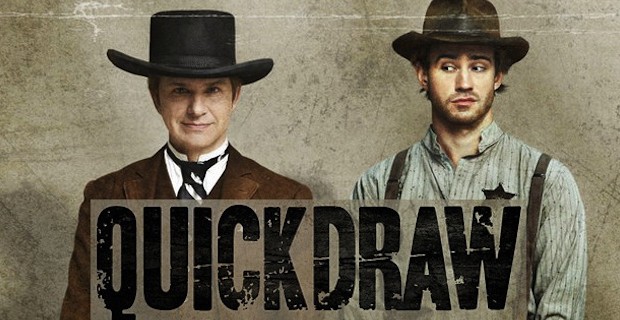
John Lehr has appeared on everything from GEICO commercials (as a caveman) to the series JailBait and 10 Items or Less (both of which can be found for free on Crackle). Most recently he has be found on the Hulu-original series Quick Draw as sheriff John Hoyle. The most impressively fully improvised, series offers up comedy Wild West style.

What was it like growing up in Kansas? Do you think your early environment fostered an active imagination early on?

My childhood was VERY Steven Spielberg (circa his ET phase). My brother and I were both latch key kids so we had a ton of freedom. However instead of using this freedom for imaginative play, we chose to blow things up, TP peoples’ houses, look at my dad’s Playboys and watch a TON of TV.

 Does imagination come in handy when doing improv as you often have? What do you love most that particular style of acting?

Yes. In all seriousness full on improv (which is what we do on 10 Items, JailBait and Quick Draw) is intense left brained stream of consciousness. It’s a fantastic experience when you can successfully switch off the logic/judgment side of yourself and let her rip. Although, when you do that, some pretty twisted stuff can come out.

What is it like working on a fully improvised show? What is the most challenging thing you face when filming that sort of thing?

The shooting process is unlike any other set. Nancy (my writing partner who directs all the show) and I write really detailed scripts but a) the scripts contain no dialogue and b) the actors never see the scripts. This creates a really easy going atmosphere even though what’s really going on is pure chaos. The most challenging part comes in the edit room when we have to glue it all together.

Before becoming an actor you taught elementary school. What was it like? What did you learn from that whole experience? Do you ever miss it?

I learned that it is HARD. It’s grueling, demanding, low-paying work and anyone who chooses that profession should get serious pay and the promise of a never-ending dilaudid drip. I certainly miss the fun parts but I just don’t have the guts for that work. I worked in inner city classrooms and later, when I moved to LA, I subbed high school in South Central.

How did you first find yourself involved in acting?

I loved Forensics in high school (speech not the science of dead bodies) and some theater but I had no intention really of going into acting. I was accepted to Northwestern University and intended to study education when my mom encouraged me to audition for the theater department. I got it but it was really the Mee-Ow Show (NU’s student improv show) that got me hooked on performing.

What led you to create the Quick Draw series? Do you think exclusive shows and content will help expand the variety of entertainment available to viewers?

Oh definitely. There are so many new distribution channels out there now. Hulu is unique in that it is not a network per se. People go there to watch TV shows they have missed. The fact that Hulu has some original programming is a bonus. We love the fact that we are not under the spotlight like a network show. People find us organically.

Nancy Hower (my writer/producer) and I had wanted to do a western for a while – we just thought our comedy would do well in a historical context. When Hulu approached us about developing something with them, it seemed a perfect fit. They loved it from the get-go.

qdtop-620x320

What has it been like working with the other members of the cast?

Fantastic. The show is filled with improv super heroes and ringers we have brought in from past projects. Allison Dunbar, Tim Bagley and Bob Clendenin all worked on 10 Items or Less (Bob also worked on JailBait). Nick Brown and Alexia Dox both appeared in a pilot we made in NYC last year and David Hoffman was in a pilot we made. Tash Aames appeared on a pilot we made for NBC. We are so lucky to have this level of talent on the show. Everyone is improvising all day long so your sides hurt from laughing by the end of the day.

Did you have an affection for the Wild West as a kid growing up? Why did you decide to set the series there?

Absolutely. I grew up in Kansas and my brother and I watched tons of westerns. I never expected to be working on one though! Nancy and I both love action and we thought the time passage would help our style of comedy so I guess it was meant to happen.

Do you think there will be a second season of Quick Draw?

We hope so. All indications are good but the official word will not come out until early November.

What do you enjoy most about working with Nancy Hower?

Ha! Everything. She is a god damned genius and I am speaking the truth when I say I would have absolutely no career without her. She co-writes everything with me, directs every episode and edits every scene. She is a brilliant renaissance woman who constantly blows my mind with her creativity and ingenuity. We love working together – so glad we found each other.

Do you have a dream project you’d most like to see into being?

I gotta say Quick Draw is pretty damn close to comedy nirvana for me. As a comedian I never thought I’d get to shoot people and ride horses and get paid! Hilarious.

Are there any little known things about you that your viewers might be surprised to learn?

I think the thing that surprises people the most is that all of the dialogue in the show is entirely improvised. Also there is a ton of historically correct stuff along with the comedy. For example, Cole Younger, the lead bad guy in the show, was a real outlaw from the 1800’s. Same with Pearl Starr (Hoyle’s step-daughter). There is a point where the whores discuss the value of a steam powered vibrator which really existed.

What projects are you working on at the moment?

We are waiting patiently for Hulu to pick up season two and have three projects in development. We’re set to pitch them along with our agents CAA.

Anything you’d like to say in closing?

Thank you for having me!

“The Meaning of Life and Love in Casablanca” by Jenean McBrearty

casablanca


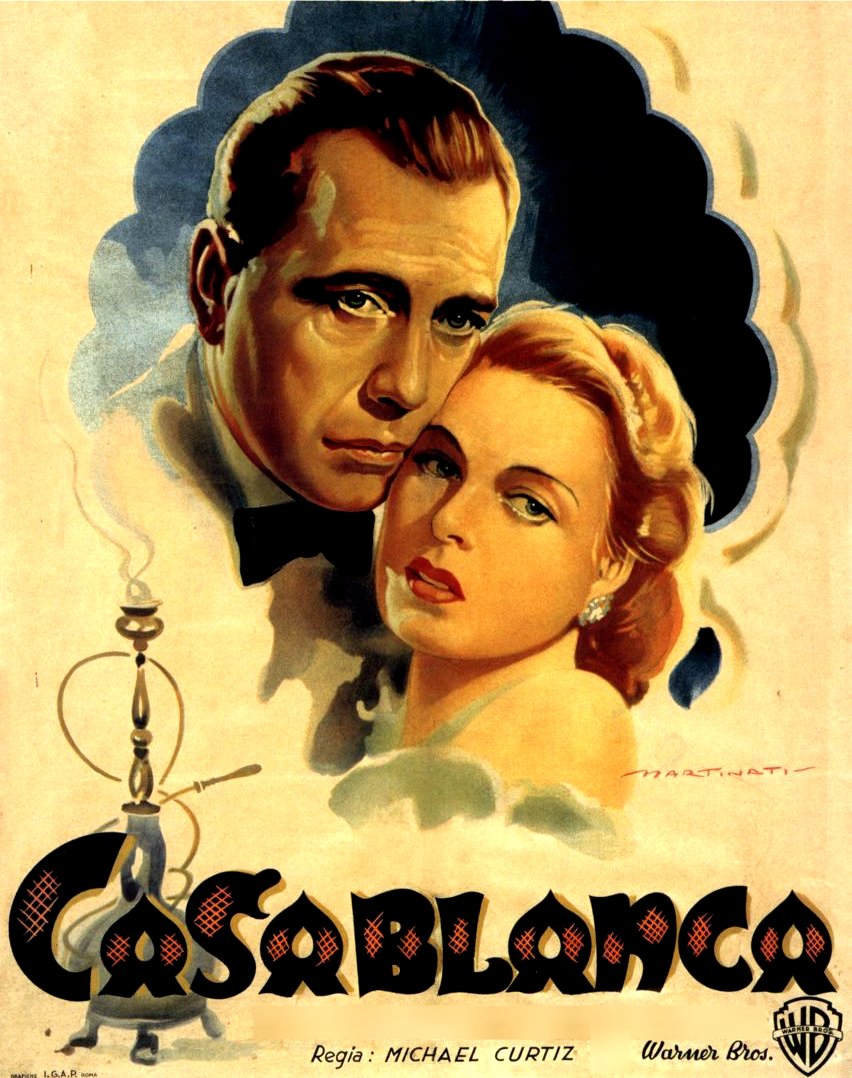
The Meaning of Life and Love in Casablanca


Rick told Ilsa

In the great scheme of things

Little people don’t matter

When the world blows up.

Little Ilsa leaves with Lazlo,

Leaves her heart in Casablanca,

Leaves as Mrs. Lazlo,

A patriot’s appendage.


No one on the movie set

Knew how it should end.

Can anything trump romance?

Transcend passion?

And be believed?

The plane soars,

A metaphor that answers

All questions with

An engine force of yes,

When the world blows up.


Greater love for men

Means giving up life for another.

Greater life for women

Means giving up love for another.

Each gender,

Fragile, tender.

Why must their lives blow up

All over the world?


photo by Pepper Jones

photo by Pepper Jones

Jenean McBrearty is a graduate of San Diego State University, and former community college instructor who taught Political Science and Sociology. She received the EKU English Department’s Award for Graduate Non-fiction (2011), and has been published in Main Street Rag Anthology—Altered States, Wherever It Pleases, Danse Macabre, bioStories, Cobalt Review, Dew of the Kudzu, Nazar Look, and Black Lantern, among a slew of others. Her novel, The Ninth Circle, was published by Barbarian Books. Her novel, Raphael Redcloak, was serialized by Jukepop.


New Book From John Gilmore, “On the Run With Bonnie and Clyde,” Separates Historical Fact From Pop Culture Myth

On the Run with Bonnie & Clyde (by John Gilmore)

New Book From John Gilmore, “On the Run With Bonnie and Clyde,” Separates Historical Fact From Pop Culture Myth

Release coincides with big-budget event TV miniseries “Bonnie and Clyde” airing simultaneously on A&E, Lifetime and History Channel

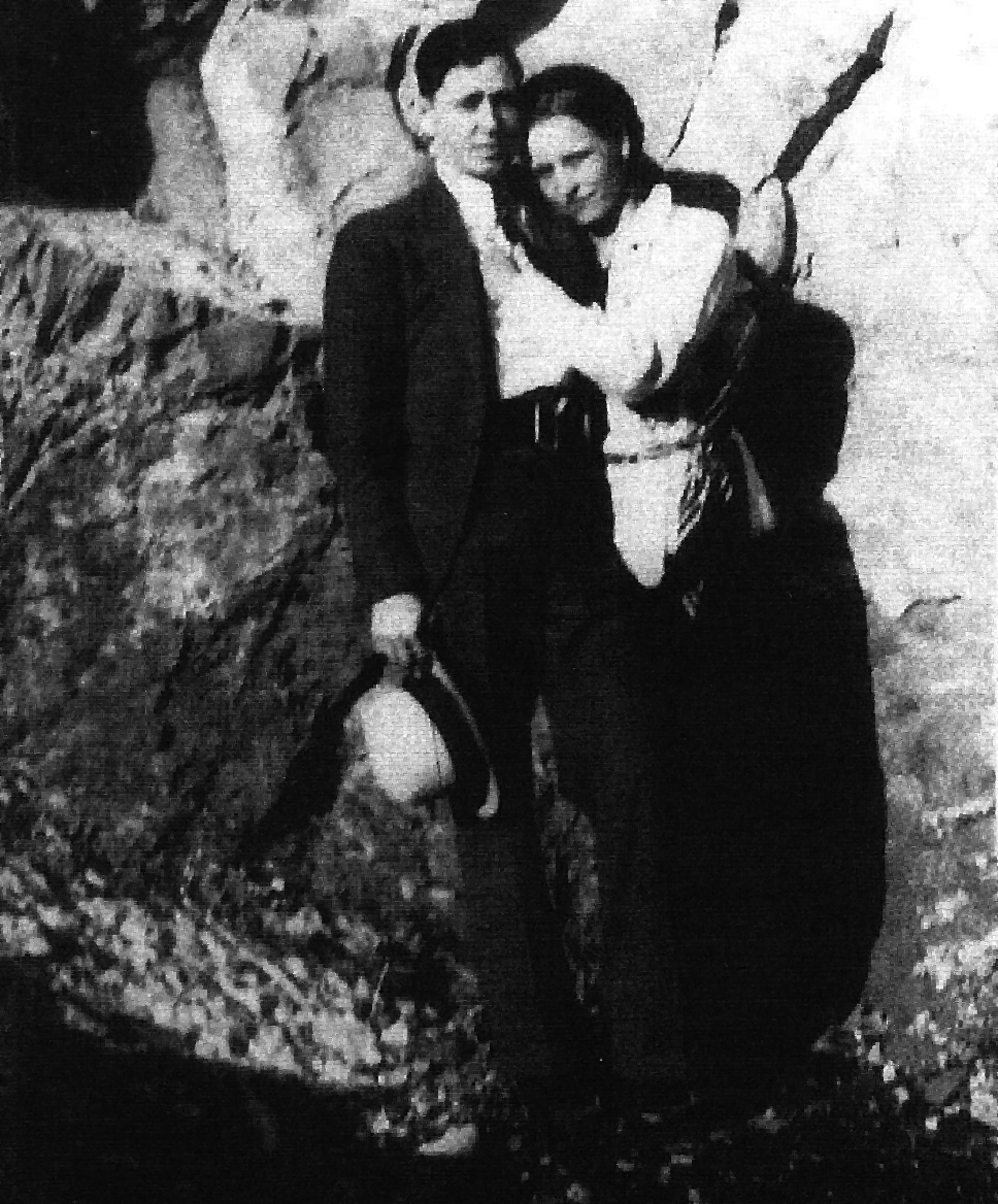
LOS ANGELES, Oct. XX, 2013 – Bonnie Parker and Clyde Barrow’s crime spree and grisly deaths have become the stuff of legend. And like all legends, much of the reality of the events has been glossed over with the passage of time. Author John Gilmore’s mission, to tell the real story of Bonnie and Clyde, has unseated the popular misconceptions that have held the public’s imagination. Gilmore places the reader squarely inside a succession of stolen cars on a dusty, two-year, devil-take-the-high-road spree of robberies, shoot-outs and murder—all the way to its infamous end in a torrent of bullets and blood. Gilmore delivers a captivating and factual tale of betrayal, demonization and bloodthirsty revenge. He exposes the demise of Bonnie and Clyde as an outright assassination—no due process, just a secretly mandated murder of Barrow and anyone unlucky enough to be with him.

Gilmore dispels the notion that Bonnie was an equal partner in crime. Instead, she was there to support the man she loved, and paid the ultimate price for that devotion. As verified by FBI and the State of Texas, Bonnie’s only crime was being an accessory to transporting a stolen car across state lines.

John Gilmore’s lifelong fascination with the Bonnie & Clyde case was spurred as a teenager when he had the unusual opportunity to see a coroner’s naked photo of Bonnie Parker. Gilmore’s father, an LAPD officer, was partnered with then-policeman Gene Roddenberry (later to become the renowned creator of “Star Trek”), who showed the younger Gilmore the seldom-seen and gruesome portrait. This disturbing recollection has now culminated in the publication of “On the Run with Bonnie and Clyde.”

“This book is a masterpiece of care, lyricism, joy and sadness in the midst of grief. Gilmore made me want to meet these people, to experience their personas, the auras that people put out. I was swept away . . . I couldn’t put it down,” enthuses Lois Banner, author and professor of History and Gender studies at the University of Southern California, about “On the Run with Bonnie and Clyde.”

In December, the small screen will be host to the newest interpretation of Bonnie and Clyde’s Depression-era saga. In an unprecedented three-network simulcast, A&E, Lifetime and the History Channel will air the event miniseries “Bonnie and Clyde” on December 8 and 9. Pop culture enthusiasts and historians alike will be interested in contrasting Gilmore’s narrative with that of the miniseries.

Clyde's first girlfriend, Eleanor Williams

Clyde’s first girlfriend, Eleanor Williams

Bonnie (left) with Clyde's sister, Marie Barrow

Bonnie (left) with Clyde’s sister, Marie Barrow

Bonnie's body arrives in Bienville Parish makeshift morgue

Bonnie’s body arrives in Bienville Parish makeshift morgue

Bonnie & Clyde in death

Bonnie & Clyde in death

Clydedeath1'

Last Flame -- Last Love; Bonnie Parker and Clyde Barrow on the run

Last Flame — Last Love; Bonnie Parker and Clyde Barrow on the run


Black Bayou, Louisiana, south of Shreveport.

Black Bayou, Louisiana, south of Shreveport.

About the Author

 With more than a dozen titles to his credit, John Gilmore (http://www.johngilmore.com) is the most successful author currently working with Amok Books (http://www.amokbooks.com). Previous titles include “Inside Marilyn Monroe,” “Laid Bare,” “Hollywood Boulevard” and “Severed: The True Story of the Black Dahlia.” Firmly rooted in the noir tradition, Gilmore’s themes include the dark current that flows beneath the modern fascination with celebrity. Author, playwright and journalist Gary Indiana says, “John Gilmore is one of America’s natural-born gifts to literature. His books aren’t just inspiring and wicked by-products of genius: they’re miracles.”

 Book trailer:

http://www.bonnieandclydeontherun.com

Contact:

Amok Books

info@amokbooks.com

John Gilmore, main speaker for 2013 Death Hag convention at the Pasadena Mausoleum. Photo: Brian Donley

John Gilmore, main speaker for 2013 Death Hag convention at the Pasadena
Mausoleum. Photo: Brian Donley

On the Run with Bonnie & Clyde (by John Gilmore)


Please stay tuned for the pending interview with John Gilmore on the subject of Bonnie Parker.

An interview with Dale Corvino

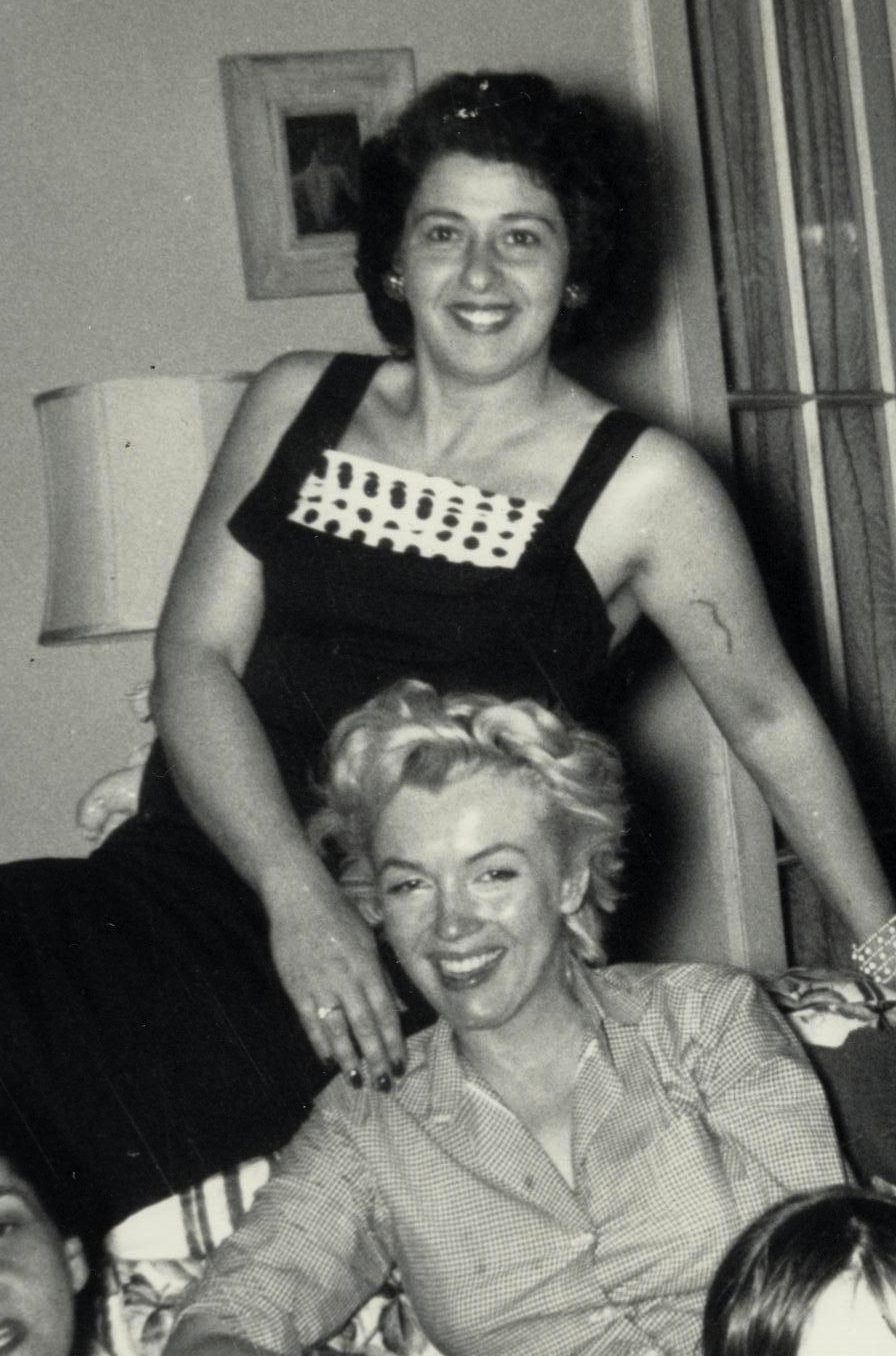
Helen  Rizzo & Marilyn Monroe

Helen Rizzo & Marilyn Monroe

Dale Corvino recently wrote the personal essay Marilyn Monroe, Baby Sitter which highlights his grandmother Helen Rizzo’s relationship with Marilyn and Joe DiMaggio for Salon.com. Dale operated a photo studio in DUMBO and worked for some of New York City’s largest real estate interests. For more on the article you’ll enjoy: http://www.salon.com/2013/09/26/marilyn_monroe_baby_sitter/

What was it like growing up in Brooklyn when you did?

I was born in Brooklyn only because my mom was very attached to her doctor, who had delivered her, was her pediatrician and obstetrician. They’d moved out to Long Island before I was born. I grew up in a postwar suburb, equally split between white collar and blue collar, Jews and Italians, living in tract developments built on reclaimed marshland. I felt alienated and out of place there from jump-start. It developed amidst the social upheavals and racial unrest of the late Sixties — a “White flight” enclave. I’ve come to see that this unrecognized dynamic, of self-segregating denial, was part of what alienated me.

What are some of your fondest memories of growing up in an Italian family? What would you say is the most important thing you learned from your family through the years?

Food. My grandmother ruled the kitchen, and taught me how to cook, but more importantly, she taught me to honor and respect the bounties of nature. The house I grew up in was on a creek. There was a mussel bed on one end, and a spit of beach on the other, where I’d rake clams. We caught crabs off the dock, too. My grandfather kept a kitchen garden in the yard. My grandmother prepared whole meals out of what we caught in the creek and what we grew in the garden.

Are there any little known things about you that you’d not mind sharing with our readers?

I’ve been writing and publishing under a pseudonym for a decade. Stay tuned for the reveal.

What do you love most about New York?

I challenge those who profess their love of New York to love her with their feet. Love her completely, too — not just the southern half of Manhattan Island. Walk across the Brooklyn Bridge to Weeksville. Hike up Broadway to Dyckman Street. Check out P.S. 1, then have dinner in Astoria.

What inspired you to write the Marilyn article for Salon? Are you surprised at the response it has gotten so far?

I wanted to share my family’s experience with Marilyn Monroe with the wider world, and add some nuance to her biography. I’m surprised at how overwhelmingly positive the response has been. Marilyn is an icon, and her fans are very protective of her. When I first floated this story, I had skeptics claim the photo is a fraud. I’ve had fact checkers calling me out for false claims. I did my research though, stuck to what I knew, and sought to verify my family’s recollections against the public record.

Do you think the day at the Amusement park you speak of in the piece offered Marilyn a much needed moment free from fame?

Yes, my grandmother gave me the impression that Marilyn’s dream of a life with Joe was a reaction to her growing fame. She wanted to raise children.

Did your grandmother Helen speak of Marilyn often? Did she ever mention what she was like as a person opposed to the star she became?

Sometimes at Sunday family dinners. When she told it to a crowd, it was just an entertaining story, one of many. We had a lot of storytellers in the family. When I’d ask her about it and it was just the two of us, her tone was different. There was true affection, a bright spark in her eyes, and grief for her lost friend. She couldn’t even talk about Marilyn’s death. She’d just choke up. She blamed Peter Lawford, to some extent.

Helen Rizzo

Helen Rizzo

Did your mother ever mention what it was she liked about Marilyn so much as a child?

My mother was six at the time, and doesn’t remember too much about the event. She remembers that she definitely liked Marilyn, and was fascinated with her hair. She remembers the scary experience of being mobbed by the crowds and rushed out of the park.

As an author what do you love most about the act of writing?

I need the solitude and the quieting catharsis of writing. As I find an audience, I love the interactivity. Writing being read results in silent, almost telepathic communication between reader and writer. Readers are in a solemn state, picking up the writer’s inaudible pitch.

What led you to write the remembrance of society decorator Stuart Green? What did you admire most about the man and his work?

I spent my twenties as his assistant, his draftsman, his companion, and his romantic obsession. I didn’t know his full story until after his death; he was brought up on keeping secrets. He created interiors for high profile New Yorkers — Ralph and Ricky Lauren, Anne Cox Chambers, Saul and Gayfryd Steinberg. He was unwittingly embroiled in the murder of John Lennon. His story is one that illuminates the cultural dynamics of American society. He had an impeccable eye for color, and a love of the sublime in nature.

What it is like to run a photo studio at DUMBO?

I had a loft for photo shoots and events in an industrial building at the foot of the Brooklyn Bridge, with views of the bridge, New York Harbor, Lady Liberty — and the World Trade Center. From those windows, I stared at the smoke trails from the WTC for that tracked over Brooklyn for days after the attack. Production companies stopped shooting in NYC after 9/11, so we turned to events, especially weddings. Hundreds of New Yorkers held their receptions in the space. It was healing, and incidentally saved my business. I’m still in touch with some of those couples.

Why do you think the imagery found in photography is often such a powerfully emotional experience for so many people? What do you personally love most about photographs?

Photography has been embraced by our culture so intimately. It’s enmeshed in tradition, ritual, and family history. A photo like the one at the center of this piece diagrams a moment in time, and colors it with light and dark. All these decades later, the photo invites me to imagine the scene in that photo booth — the emotions, the charge, the smells. However my imaginings may fail, they are rooted in a document of time.

Do you have a dream project you’d most like to accomplish?

 I’m on the second draft of a memoir. It’s back-burnered right now, since I’m facing deadlines and assignments for shorter pieces. It’s all one body of work, but the memoir is a big dream.

Anything you’d like to say before you go?

In tribute to Ginsberg’s holy rant, I hereby vow to not let my work become “the cowardly robot ravings of a depraved mentality.”

“The Anthropology of Memory” by Dane Cervine

The Anthropology of Memory

Death swallows all. The existentialists, particularly the French, understand. Still, there are the small rebellions. There is memory. Digging for the forgotten. Holding fragments in hand, lifting them into light.

So after Paris, I buy a used book cheap to remember the French existentialist Henri Michaux, who in turn remembers an Ecuadorian poet named Gangotena who was possessed of genius and ill luck—who died young, along with his poems, most of them unpublished, burnt up in a plane crash.

 No internet search will find them. No Library of Congress hold them. Even then, the great library at Alexandria burned, and some future viral plague may yet take every word now saved in the world’s great memory banks with it into oblivion. Of course, there’s always our own Sun’s eventual solar demise, against which all human arrogance, and every poem, will fail. Unless that beautiful arrogance find us, somehow, a home on another world, a younger world, where Henri and I may yet reside side by side in gold or titanium memory chips, or even subtler clouds of data. But the Ecuadorian poet’s poems are, despite all arrogance, despite love, forever lost. Except his name, Gangotena.

That he was a genius. That he had bad luck. That someone remembers.


Dane Cervine’s new book is entitled How Therapists Dance, from Plain View Press (2013), which also published his previous book The Jeweled Net of Indra. His poems have been chosen by Adrienne Rich, Tony Hoagland, The Atlanta Review and Caesura for acknowledgement and have appeared in a wide variety of journals including The SUN Magazine, The Hudson Review, Catamaran, Red Wheelbarrow, anthologies, newspapers, video & animation. Visit his website at: www.DaneCervine.typepad.com Dane is a local therapist, and serves as Chief of Children’s Mental Health for Santa Cruz County in California.


An interview with Richard Hescox

Lamia

Lamia


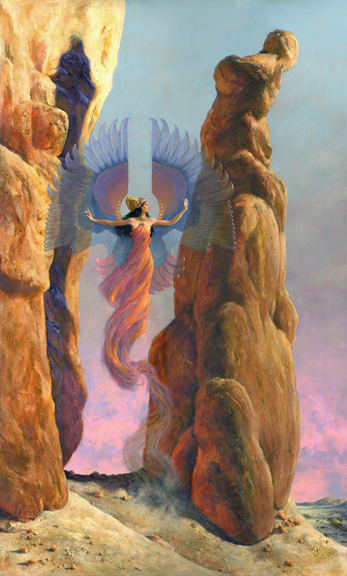
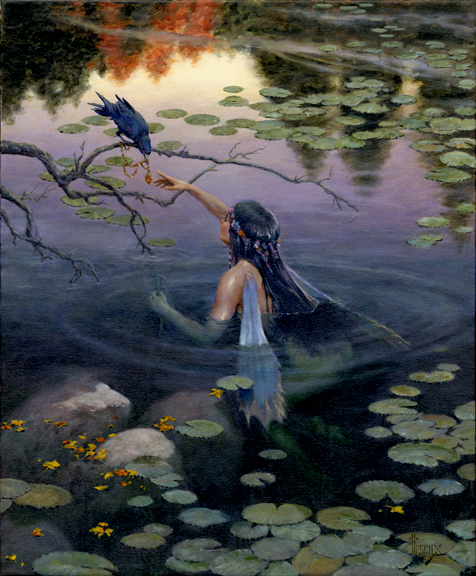
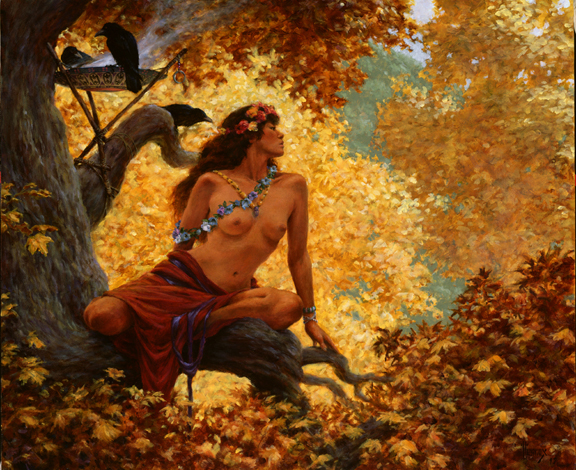
Richard Hescox offers up truly spectacular renderings of vintage and modern Science Fiction and Fantasy art. Richard has worked as a cover artist, background designer for animated films, advertising illustrator, conceptual designer, and art director. He has provided imagery for some of the most iconic characters of our time such as E.T., Halloween, The Dark Crystal, The Never-Ending Story, The Time Bandits, and Swamp Thing among many others. His paintings have graced the walls of the Society of Illustrators in New York, the Delaware Art Museum and the Canton Museum of Art. Fans of his work can look forward to his rich illustrations in the limited editions of George R. R. Martin’s Clash of Kings sometime in 2014.

Can you tell us a little about yourself? What were you like as a child? Did you develop a love of art early on?

I did. Of course my older brother wouldn’t let me draw in his coloring books because he said I scribbled and wouldn’t stay inside the lines.

I always enjoyed the art related classes in school. Fairly early I began to notice that (at least in my opinion) my drawing and imagery was better that the rest of the students. This was confirmed on rainy days when instead of outdoor recess we had to stay inside and draw. I would almost always draw dinosaurs, (my mania at that time) and often other kids would ask me to do a dinosaur for them because they could see that mine were better drawn. Getting recognition was very intoxicating to a shy boy.

Do you happen to remember the first things you used to draw most as a kid?

As I said, Dinosaurs. I wanted to be a paleontologist for many years but art finally won out. The earliest piece of my artwork I still have is a brick into which I carved a Woolly Rhinoceros in the style of cave art. My mother kept it for many years and it finally came back to me.

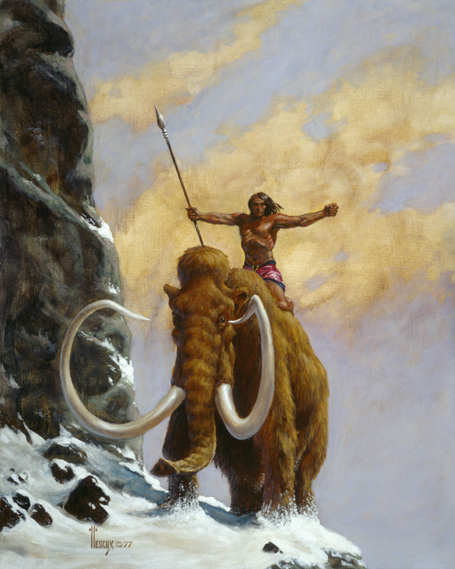
Kioga of the Unknown Land

Kioga of the Unknown Land

How did you first come to work in Science Fiction and Fantasy genres? What was it about them that appealed to you most?

These were the books I grew up reading. The pure and unfettered imagination made them fascinating and I remember developing clear visual images in my mind for each scene. I imagined those images and would think “If I ever became an illustrator for this book, that would be the image I would paint”.

When I realized that I could pursue my education as an artist and went to The Art Center College of Design, I settled down and did the type of illustrations that were being taught and I assumed I would illustrate the usual type of images after graduation. I had always loved and collected the science fiction and fantasy pictures by the great artists in that genre. One day an art student friend (who later became an animator at Disney) asked why I didn’t try to go in that direction myself? It suddenly occurred to me that it was a real option. When I started building my portfolio pieces I naturally tended in that direction and then began to apply to those publishers with Science fiction lines of books.

Do you enjoy creating images that offer society some much needed escapism and stimulation of the senses?

Magic and fantasy were much more real and connected to people in earlier times. Important life lessons were taught to the young through Fairy tales and even earlier by myths and legends. These lessons were introduced into the subconscious of the listener more deeply and effectively that way. In the modern age with scientific advancement and skepticism people seem to be missing this rich cultural education.

Science fiction and fantasy literature along with the associated artwork help keep this avenue to enlightenment open. To see its effectiveness just look at fans of Tolkien or even Trekkies.

In my more recent “Fine Art” paintings I especially try to touch this deep need in people for wonder and ethereal beauty.  I try to picture a world where the wide sweep of fantasy is expected to exist and to be marveled at. I avoid the more grandiose themes and concentrate on subtle scenes of mythical entities doing their, to us, mysterious activities.

Dragon Lord

Dragon Lord

Why do you think art has always been such a powerful force?

I like to think of art (all branches: literature, poetry, song, drama, music, sculpture, painting, etc…) as Hyper communication. Talking is basic communication. But make those words a poem and the concept embeds itself far more effectively in the listener. Graphic arts do the same. A talented artist can communicate a concept more subtly, and at the same time more powerfully to the viewer. The mark of good art is the amount and quality of communication that it effects (a test that too much modern art fails at).

What does it feel like to earn a living doing what you love?

It is a double edged sword. Yes, you wouldn’t want to do anything else, but at the same time you are so invested in your creations that when they don’t meet with the client’s or the public’s approval the hurt and disappointment is profound. It can even happen when you don’t meet your own expectations with a piece that just didn’t work out like you envisioned.

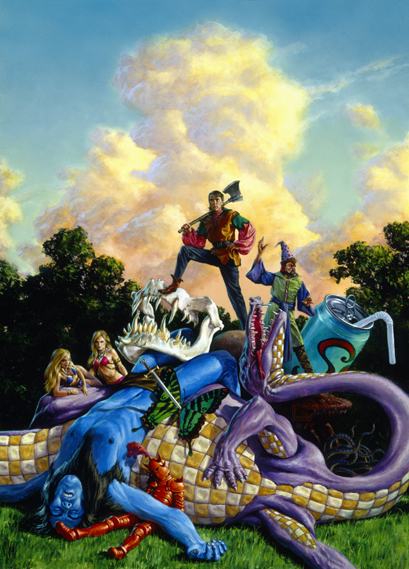
Jason Cosmo

Jason Cosmo

How did it feel when you first got paid for your work?

Just like when the other kids asked me for a drawing. Recognition that I had a talent that others could see.

What advice would you offer the artists of tomorrow?

Learn to draw accurately and well. Don’t shun the artists of the past because they really knew some things that are unfortunately ignored in much of today’s art teaching.

Guardian of the Horizon

Guardian of the Horizon

You have worked some with the characters for E.T., Halloween, Swamp Thing, The Never-Ending Story, and The Dark Crystal. At the time did you know they would become as iconic as they have? How does it feel to have worked on characters that are so beloved?

An unfortunate side effect of working on books or films is that you have to be so analytical as you read them or watch unfinished film segments that you can’t really appreciate the work as a whole. I am sometimes so intent on looking for the best image idea and recording useful visual details that I can’t see the flow of the story

Because of this I had no idea which projects would be hits with the public.

Do you ever miss having time to create projects that you personally want to create while having to work on commercial pieces?

The solution is to try to make each assignment look the way you would want it to, but the powers that be usually won’t let you. They are paying for it after all.

I have found time to do some of the paintings I really want to do and love. These are my “Fine Art” paintings. I enjoy doing them so much that I often use any spare time I have working on them.

Ancient Memories

Ancient Memories

What does it feel like to see your work on exhibit? Do you ever get nervous about that sort of thing?

Again, a double edged sword.  I feel proud, but then I hang around to hear any comments directed at the work. Most artists have some insecurity because their efforts are right out in the open (in a show or on a publication) and they know they are always being judged.

Who are some of you favorite living artists?

As I mentally go through the usual list of artists I answer that question with, I realized that all of them have just died in the last 5 or 6 years.

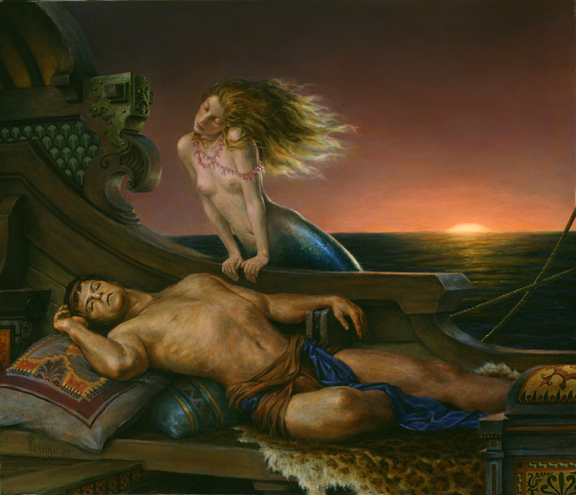
The Dreaming Sea

The Dreaming Sea

Do you have any one subject you like to cover more than others?

Beautiful and mysterious mythological women. That’s what most of my fine art paintings are of.

Do you have a dream project that you would most like to complete before your time is up?

Not really. I try to paint the images I most want to paint each time I start. I have been fortunate in being happily surprised with many of my completed pieces. At least the personal ones.

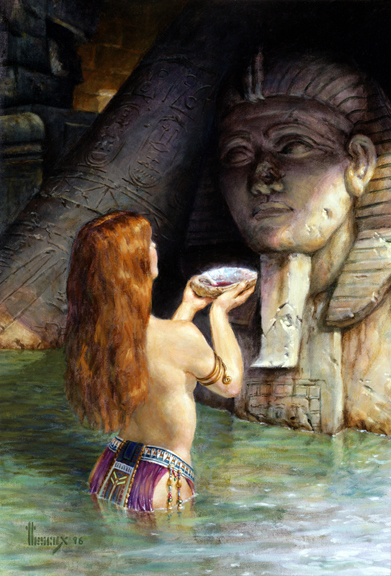
The Offering

The Offering

What are you feelings on death and such?

I try not to dwell on that subject except to figure how to put it off for as long as possible.

What was it like to be asked to illustrate George R. R. Martin’s upcoming Clash of Kings?

It was very flattering. George has the right to personally select artists for the Subterranean Press editions. For him to seek me out to ask was an honor and I have tried to justify his choice by doing the best illustrations I could. He had to approve every image himself so I feel I did a good job of matching his mental images. I spent more than a year on the project with over 70 images created.

Mirage

Mirage

Are there any little known things about you that your fans might be surprised to learn?

Aside from my birth on the planet Krypton, I really can’t think of anything mysterious about me.

What projects are you most excited to bring the world next?

I feel the most pleasure when I find that a painting I have done, and which I feel a huge aesthetic charge from, has also touched others in unexpected ways. The communication I strive for has to be felt by viewers of my paintings on a deeper than literal level. Therefore I am most excited about creating the next painting that achieves that.


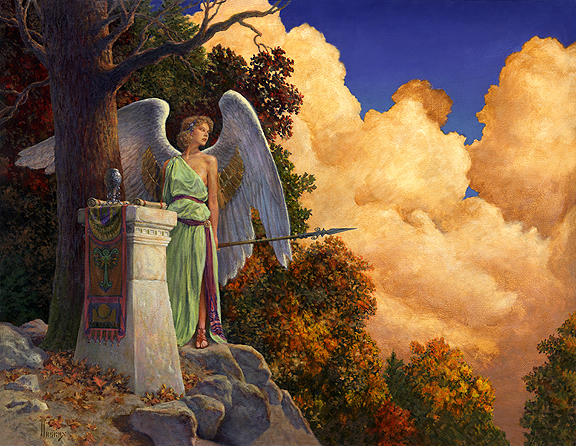
The Token

The Token

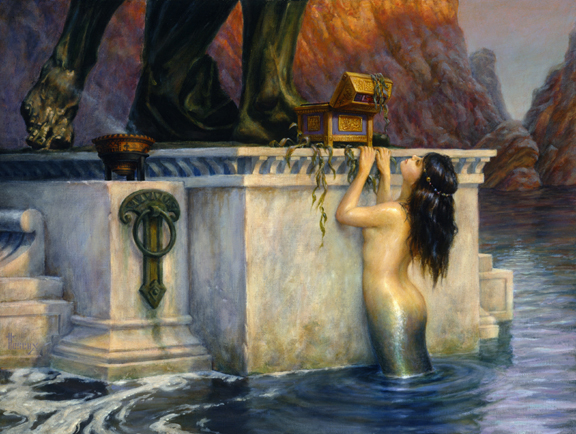
Throne of Gold

Throne of Gold


“The New Play” by Matthew Wilson

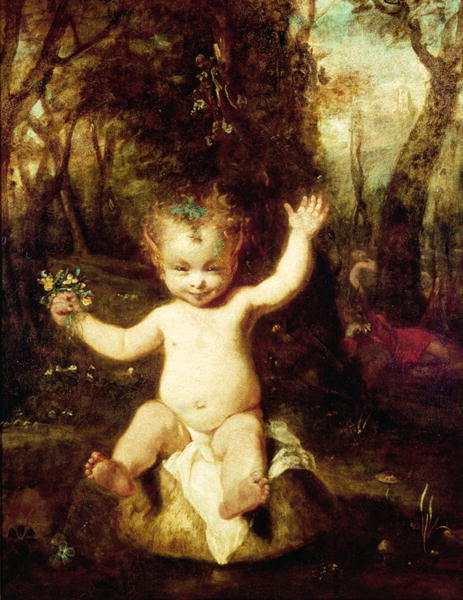
Joshua Reynolds, "The Puck"

Joshua Reynolds, “The Puck”

The New Play

Have you heard what they say?

How Shakespeares new play will start today.

I am quite excited about his last, his great,


the witches, the madness, the crush at the gate.

The mind of the man I am sure’s quite replete

of madmen and demons you find on the street.


What a collection of fools and villains he has in his head,

the greater number for the good of man are surely dead.

History shall call him the maker of monsters and whores


but an afternoon at the globe is better than chores

of which I’ve grown bored, so give me a play

Shakespeare and you shall have my penny. A slave for the day.


Matthew Wilson, 30, is a UK resident who has been writing since small. Recently these stories have appeared in Horror Zine, Star*Line and Sorcerers Signal. He is currently editing his first novel.