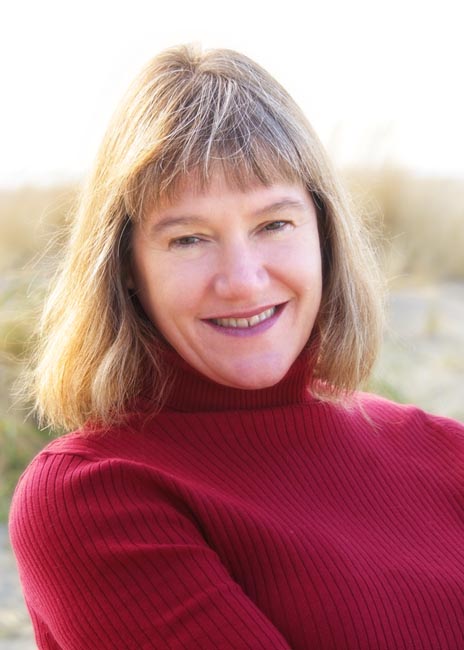
“Waiting for Pernod” by Mark Terrill

Walking up the rue du Odessa then walking back down again it’s tough to contemplate the parameters of transcendence when you’re looking for a bar, a bar in which a woman once whispered something into your ear, a bar in which Beckett once waited interminably for the barman to bring him a glass of Pernod. On the boulevard Edgar Quinet your shadow suddenly detaches, disappears into a film noir alley, leaving you in Sartre’s lonely ontology like a hapless fly in a chunk of amber. In the café some are seated, others are getting up and going away, some with a feisty truculence, some with a wavering kind of hesitation that distends the definition of time, while others are trying to appropriate the shambling remains of your subjectivity. And in the many stately plane trees on the other side of the square the red squirrels are dying of old age.


Mark Terrill #3


Mark Terrill shipped out of San Francisco as a merchant seaman to the Far East and beyond, studied and spent time with Paul Bowles in Tangier, Morocco, and his lived in Germany since 1984, where he’s worked as a shipyard welder, road manager for rock bands, cook and postal worker. He is the author of Bread & Fish (The Figures), The United Colors of Death (Pathwise Press), The Salvador-Dalai-Lama Express, (Main Street Rag), Superabundance (Longhouse), Laughing Butcher Berlin Blues (Poetry Salzburg) and several other collections of poetry, prose, memoir and translations.


“Moxie in the Dreamscape” by Jason Wayne Allen

Moxie in the Dreamscape

I’ve heard you can’t die in dreams. I’ve heard the shock always wakes you up. Oh sure, you’ll fall, but that dyskentic  kick or lunge and gasp for breath always sends you gasping on the surface of the third dimension , grateful and amused. Thank God, it was just a dream.

I am eyes darting, side to side in the severed head of Roy Orbison. I always take the form of Roy Orbison in my dreams, because I suppose my subconscious recognizes him as the epitome of cool. I don’t feel so cool now looking through dark sunglasses at my arm over here, my foot over there, and viscera scattered here and there. There is never blood in the dreamscape, just wounds and pieces.

I hear Moxie screaming and sobbing. He’s still working on Moxie. I don’t know what her father had against me–or us–but he told me if he ever caught me with her again he’d kill us both. Moxie’s father is a man of his word.  Right now, I hear him killing Moxie. I hear screaming. I am dead and haven’t returned to the surface. Moxie should also be on the surface now.

When the screaming stops I hear distant voices. Pieces of conversations from today and conversations from years ago play as a soundtrack,” Clear!” “I hate it when you cut yourself onstage,” “His lips are blue!” “I am so proud of you,” “I made a mistake,” I pick my ex-wife, Hannah’s voice from the din. “My father said you were unstable,” I’m sorry, I’m sorry, I’m sorry,” “Please,” gray faces and movements like holographs, or ghosts, above, below, and all around.

A mime stands over me with an invisible axe held above its head. Moxie’s father always takes the form of a mime, but he still speaks, “I told you, leave my daughter alone!” he says and plunges the axe into Roy Orbison’s head. I flinch for impact, and when I open my eyes I am seeing from two angles. One angle sees pieces of me and pieces of Moxie scattered about. The mime steps over the pieces as he walks away and fades into the background.  The other angle is eye to eye with Moxie’s severed head. Her jade eye darts from side to side, relaxes and locks with mine. If I am dead and never return to the surface, this is more Heaven than I deserve.

Couples always have cute, funny, or ironic stories about their first date. Moxie and I were holding hands before we’d ever spoke with a scarab hookah between us, blowing blue smoke. We drifted on a transparent boat in a pink sea of infinity, above and below us, all serenity. She was nude; I was in Roy Orbison’s suit. I pushed red hair from jade eyes and leaned into her. Our bodies mixed into one being, beyond sex, and before the climax I awoke and saw the empty bottle of Ambien and all around were scattered beer cans and liquor bottles. We hadn’t spoken a word but I knew her name was Moxie and I had to get back to her.

Life on the surface was over. My band had split up; divorcing Hannah was about akin to self-amputating a gangrenous arm, and moving back in with mom, and then…then the horrible job at Target! I was already an alcoholic, but I was drinking myself into the next day without sleeping. I was prescribed Ambien, and the doctor said never mix the pills with booze, I of course did, and a suicide attempt during a drunken debauch led me to Moxie in the dreamscape. I would go through the motions of my surface life, clock in, and clock out, kiss mom goodbye, back to work, back home, three Ambien and a few shots, and back to the dreamscape, drifting with Moxie. Essentially, the same dream, with different variations, from us making love on wispy clouds of cotton candy to us on our backs gazing at skulls that pin-pricked a maroon sky.

My tolerance for the sleeping pills started to build and I had to take more, drink more, and when I did make it to the dreamscape in Moxie’s place was the mime. He never formally said he was her father. I just knew. Once in the dreamscape he tried to kiss me, and I denied him. Another time in the dreamscape I asked about Moxie and was told to leave her alone or he’d kill us both.

Here I am forever gazing into Moxie’s jade eyes as voices and movements undulate and morph, above, below, and around me. I single out my mother’s sobbing. I single out Hannah’s voice, “I’m sorry, I’m sorry, I’m sorry,” “My father said you were unstable.”

Telepathic I love yous pass like Morse code between our eyes, “I love you, love you, love you…”


Jason Wayne Allen  has published stories in various horror, bizarro, and transgressive fiction publications and anthologies, appearing digitally as well as in print. He is currently part of the editing staff at Strangehouse Books. Jason Wayne is Southern by the disgrace of some dark god, but currently resides in the Midwest. jasonwayneallen.wordpress.com

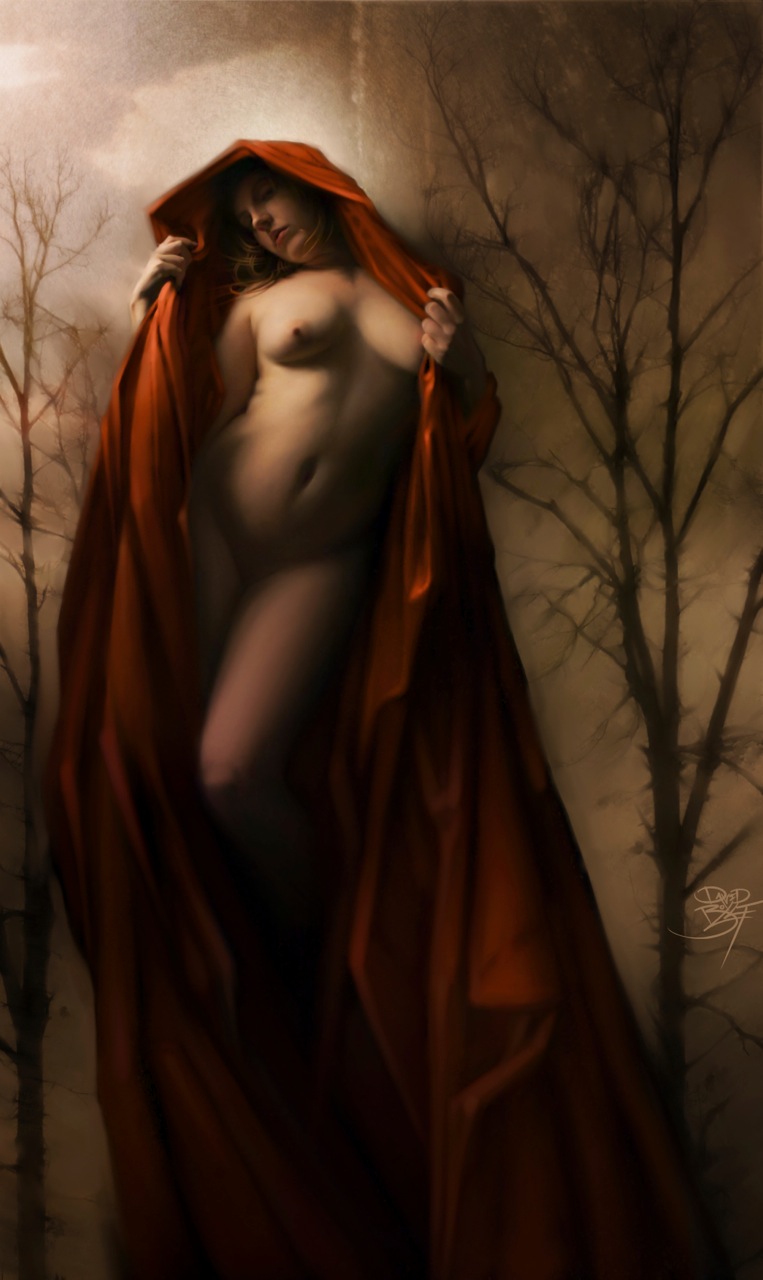
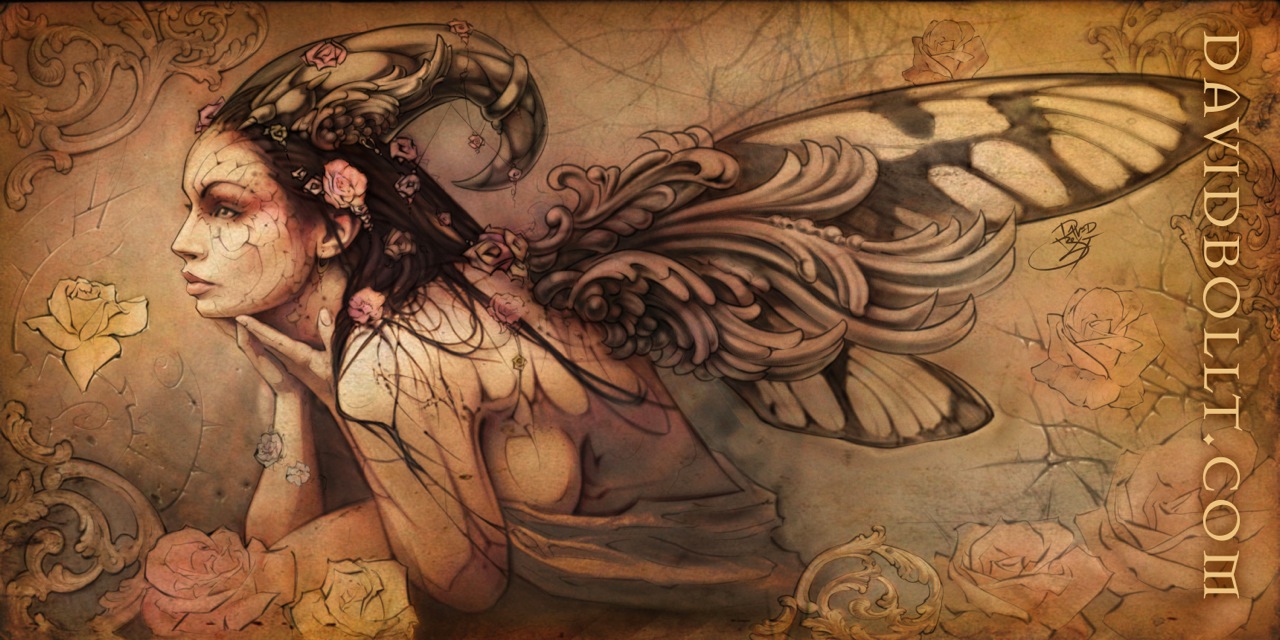
An interview with David Bollt

DavidBollt

David Bollt was a child prodigy who began producing art at the tender age of seven. By his teens he was creating art for various rock bands worldwide. Following countless magazine covers and posters Bollt developed a loyal fan base that has been expanding ever since. His work in the field of Tattooing has also solidified his reputation as a master of the trade. David has been appearing in books and magazines leading a conversation about beauty, art, creativity and consciousness. Now, he is passionately advocating a positive message that aims to change the way the world relates to human beauty. With a clear vision of appreciation, he is helping transform how people see themselves and each other. His recent project Model Society features some of the world’s most talented models, photographers, and artists. The elegantly sensual site celebrates the beauty of the human form in all its forms Be sure to check out Model Society at: http://www.modelsociety.com And visit his personal website at: http://www.davidbollt.com

What were you like as a child? What first led you to want to be an artist?

I was mostly serene and quiet. I liked to have time to sit and be with my imagination. At night though, this was often scary for me as I had a tendency to imagine ghosts and monsters. I remember the day I decided I would be an artist. I was probably five or six and was playing a with a kid in the neighborhood who wanted to draw. It was the first time I ever sat to do that and it changed my life. Landscapes full of monsters and adventures opened up for me. With nothing more than a pencil and a piece of paper, suddenly anything was possible. I realized that all the dark creatures of my imagination were of my own creation, or at least I had some sense of control over them. From that day on I knew I would spend my life as an artist. From that day on I was dedicated to exploring imagination through art.

You were designing covers for rock bands by your teens, did you always have a love for the genre? What did it feel like to see your work featured on merchandise from some of the most prolific musicians of our time?

I love it! I’m a musician myself and I always related to creatives of all types. Music and visual art go together beautifully. As a teenager I remember listening to music while looking at an album cover. The experience of the songs along with the artworks seemed like one thing. It was like the art would invite me deeper into the music. It has always been a thrill for me to create artwork for bands. It did not matter if they were starting out or well established, either way I just enjoyed the process.

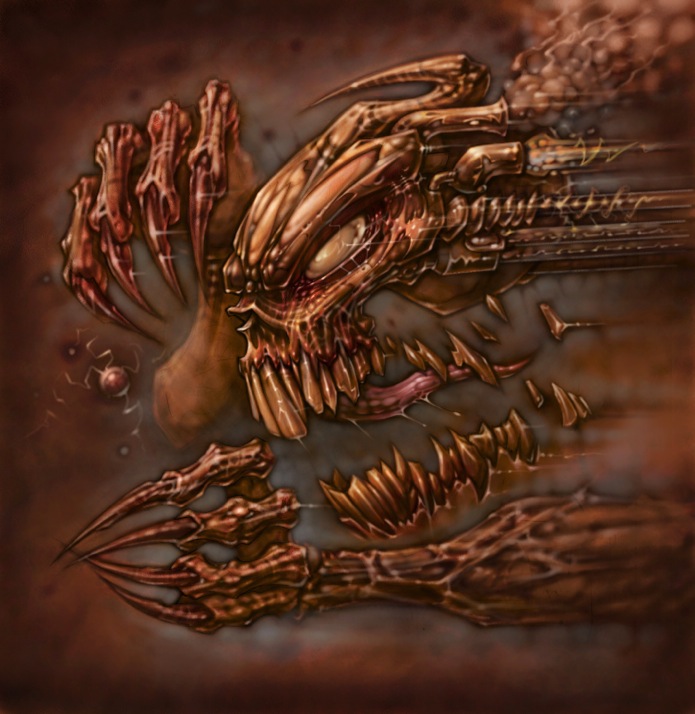
brutal mastication

Are there any of those works that stand out most in your mind?

I’ll never forget going to a Queensryche concert and taking a friend back stage to meet with the band. I had been working with the drummer (Scott Rockenfield) for months creating a line of custom drum graphics. When the band came on stage, I got such a thrill seeing Scott rocking on a set of drums with my artwork. I turned around and saw en entire stadium of people moved by the music. The entire line of drum graphics went on tour with more bands than I even know about. It feels good realizing that the images have been part of such a powerful and diverse musical experience for so many people.

Why do you think music and art have always been so…well suited to one another?

Because they both are purely creative expressions. One is a journey of hearing, the other is a journey of seeing. They both can tap into emotions and imagination. They both can inspire us and fill us with a sense of wonder.

You also took an interest in the world of tattoos. What do think people find so appealing about wearing art on one’s skin? Do you have any yourself?

We are mortal creatures. Our lives are temporary. People often think of tattoos as permanent, but they are not… they only last as long as we do. I think of tattoos as a way to celebrate this mortal journey with images that have meaning for us. They become a part of us, a part of our life story that we can carry with us until the end. No matter what happens they will always be with us until we die. In a world where there are few things we can count on, I think people like to have something they can depend on. I have some tattoos that mean a lot to me. I feel like I have earned them.

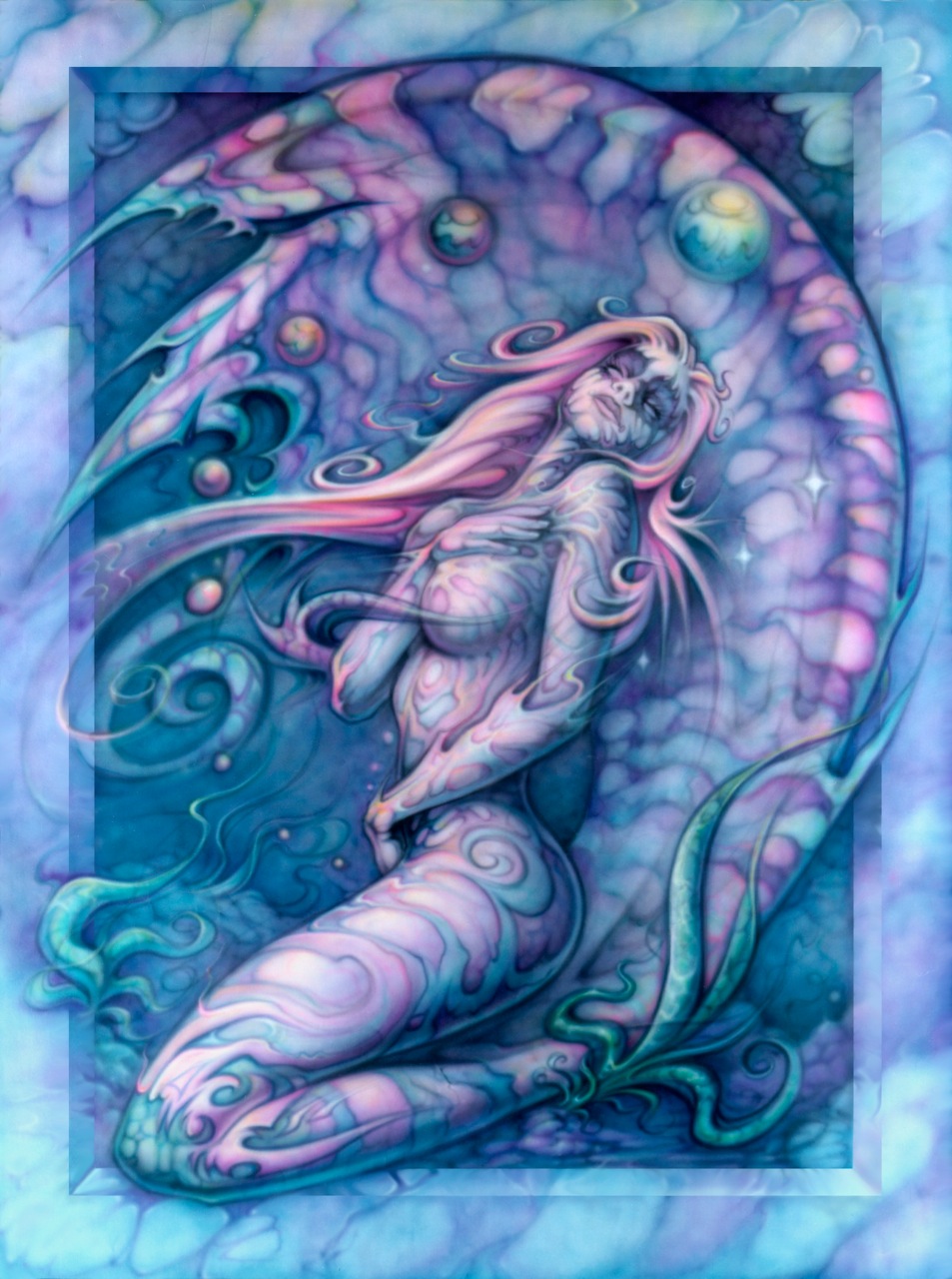
mermaid

Who are some of your favorite artists?

Michalangelo, HR Giger, Simon Bisley, P. Craig Russel, Becksinski and Mucha are the first that come to mind, but there are dozens, even hundreds who have inspired me and who have helped me shape my own artistic vision.

Is there any one subject you love to work with most in your work?

I love exploring the human figure. I think of our humanity as a miracle. I’m amazed every day that this amazing organic creation is the home of my thoughts, feelings and ideas. I think of the human body as the source of all beauty, because it is the home of our consciousness. It is our conciseness that brings beauty into the world by seeing things as beautiful. I am endlessly fascinated by this. In particular, the female form is deeply inspiring to me. I find it so incredibly elegant and graceful. As a man, I think of my natural reaction to this beauty as the force that brings new life and new awareness into the universe. It’s a spiritual practice for me to celebrate this in my art.

Can you tell us a little about Model Society? Do you think the human body as a work of art in and of itself has been somewhat diminished by modern societies ideal of what beauty…is?

Model Society is a social network for the very best models, photographers and artists in the world who create images of models as true works of art. I created Model Society with the desire to restore human beauty to it’s rightful place as a subject of fine art contemplation. I don’t like that beauty is used to manipulate us and that nudity is associated with porn. There is nothing more beautiful and natural than our naked humanity. I want to give people a place to celebrate and enjoy what we are, presented as fine art. Every individual has their own concept of beauty. I want people to feel free to love what they love, and be attracted to whatever they are naturally attracted to. If people could free themselves of shame, they would see far more beauty in themselves and each other. If we learned to simply love what we love, and enjoy what we enjoy, then it would not matter what culture or society has to say about it. AND, I think it’s likely that culture and society would have a far more inclusive expression of beauty if people made choices for themselves as to what they find beautiful.

one thousand sins

How do you think the art world’s view of the human form has changed most through the ages?

There are fashions that come and go. But I think it’s misleading to characterize beauty like this. No two people will even find the same things beautiful in the same way, just as no two snowflakes (that have ever fallen) have been the same. There is an opportunity for each and every one of us to look at the world and ask ourselves “What does beauty mean to me? What do I find beautiful?” People put way too much attention on what other’s think. It’s a waste of time because we can never control a person’s or a culture’s perceptions. The only perception of beauty we can every truly know, explore or heal is our own. And… I think I understand why people concern themselves with what others think. We all want to be accepted and loved. Instead of rejecting what culture projects, the opportunity is to create the world we want to live in by accepting and loving ourselves and each other. Part of that is accepting and loving what we each individually find beautiful.

What do you think makes a person most beautiful as an individual?

The thing that makes a person beautiful is my ability to see them as beautiful. There is only as much beauty in the world as any one of us is capable of seeing. Beauty does not exist outside of us. We create beauty, just as we create ugliness and judgement… it all occurs inside of us as we make assessments and interpretations. There is no beauty where there is no pair of eyes to experience it. Beauty is not a set of attributes for me to define. If I tell you what makes someone beautiful (inside or out), then I’m doing the same thing that people accuse culture of doing. We are all responsible for our own experience of beauty. We are all responsible for our own judgments of each other and ourselves.

Have you been surprised by the public’s response to Model Society?

I get messages every day from people who tell us that Model Society has given them the opportunity to see human bodies as beautiful… for the first time… without shame. I’m deeply moved and inspired by this. Model Society is here to help people wake up from the lies and hypnosis that would have us think of ourselves and each other as anything other than being perfectly beautiful. I am gratified that so many people have been moved by these amazing works of art. Many people are taught that nudity is shameful. When they have an experience of beauty that is finally free from these painful ideas, they are often moved to tears by the amazing miracle that they suddenly see in themselves and others.

spring

Do you enjoy creating a project that reminds people to love their own body, however they may find it?

I’m pleased whenever people have a deep experience of beauty. No matter if someone sees beauty in themselves or in someone else, they are creating beauty. It’s really true (on a deep level) that beauty is in the eye of the beholder. It’s the ONLY place that beauty actually exists. Accepting beauty in others is part of accepting beauty in ourselves. If I can’t embrace someone else’s body as beautiful I probably can’t embrace mine as beautiful.

How can other artists, photographers, and models join Model Society?

Simply go to the website and fill out an application. We are looking for model, photographers and artists who create images of models as true works of art. https://www.modelsociety.com/becomeamember.aspx/Register

What do you like to do when you aren’t working?

I like to draw. I love spending time with my amazing fiancé (who inspires me every day). I like to spend time with my dogs and I like to savor beauty in the world all around me. I love making music and connecting with people form all walks of life. I’m very curious about people and enjoy talking to them to uncover their own unique perspective on the world. I find people beautiful and I enjoy the contemplation of beauty… so I truly enjoy connecting people.

aria sticker

What projects are you most looking forward to showing the world next?

I’m looking forward to slowing down with all the administration and busy work associated with my projects so that I can put my attention back on what I’m best at… making art. I look forward to creating some new paintings and digital images. I’m feeling incredibly inspired and can hardly wait to see and share all the art that is ready to burst out of me.

Is there anything you’d like to say before you go?

Thanks for your interest in my art and in Model Society. (smiles)

“Apocalypso” by Howie Good

Apocalypso

I wasn’t born with issues. I acquired them the way fish acquired limbs in order to walk on land. You didn’t know me back then. There were many laws, but few arrests. The news always seemed to be showing funerals. Blue was a different color. Prospective employers shook their heads when I told them I was self-taught. The motions of time got harder and harder to understand, like babushkas who drank a fifth a day. Perhaps I didn’t need friends. Perhaps what I needed were accomplices. A man I had just met offered me an unsolicited piece of advice: “Go fuck yourself.” I hurried off as if eager to try.

130320-111440

Howie Good, a journalism professor at SUNY New Paltz, is the author of the forthcoming poetry collection  The Middle of Nowhere (Olivia Eden Publishing) and the forthcoming poetry chapbooks The Complete Absence of Twilight (Mad Hat Press), Echo’s Bones and Danger Falling Debris (Red Bird Chapbooks), and An Armed Man Lurks in Ambush (unbound CONTENT).

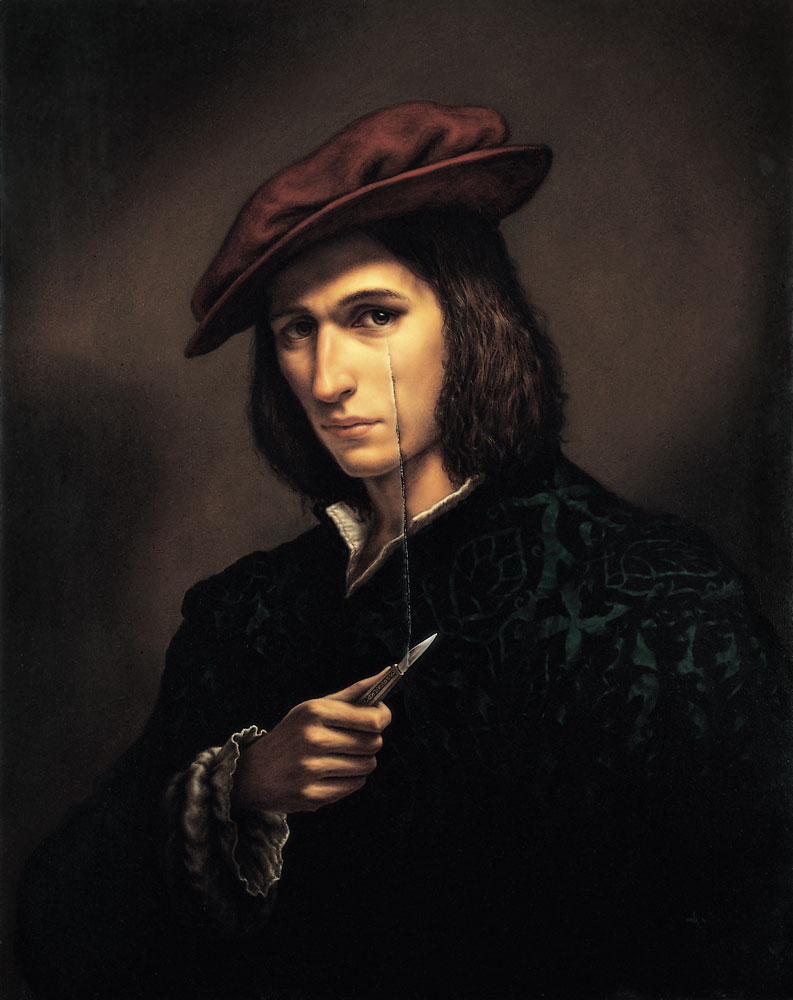
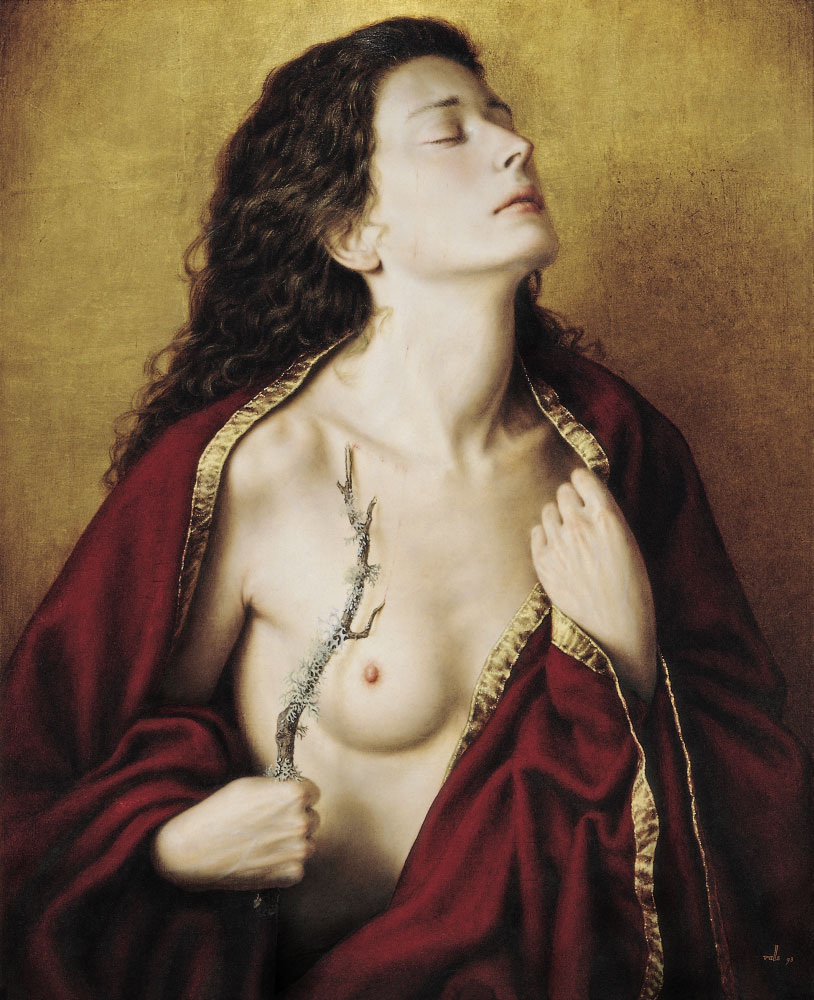
An interview with Dino Valls

"DRAMATIS PERSONAE" Egg tempera, oil and gold leaf / wood 170 x 122 cm. 1996

“DRAMATIS PERSONAE”
Egg tempera, oil and gold leaf / wood
170 x 122 cm.
1996


What was it like growing up in Spain? When did you first begin to notice your love of drawing? Do you happen to remember what you used to draw most often back then?

 My youth passed in an interesting period of the history of Spain, with a strong boost in a feeling of freedom, very stimulating for creativity, although in arts, the dominant informalism wasn’t the best climate to develop my personal interests in painting.

I always liked to draw, maybe because my father also liked it. Pencil, color pens, ink, watercolor, charcoal, pastels… different techniques to draw anything, sometimes copying plates of old painters, or inventions.

What was your earliest influence?

 I started to visit exhibitions and museums in my city, to see art books… I had no direct teacher to learn, so my reference has been the whole History of Art, extracting what is the common essence of the artistic expression all along the history of mankind. And regarding the conceptual content of my work, the depth psychology, and the Jungian analytical psychology.

What led you to first try your hand with oils?

 There was a certain prevention to my start with oils, my father knew my passion for drawing, but he feared that a premature beginning into oil painting, a technique more difficult, could produce discouragement and distancing from my hobby, so he advised me to wait until I improved my drawing skills. But my learning and development were fast and surprisingly easy to me. Even so, I did painted a lot, getting more and more ability. I have to recognize that I had a strong liking for painting but never thought to professionally be an artist, in fact I started my studies of Medicine the same year that I started to paint with oils.

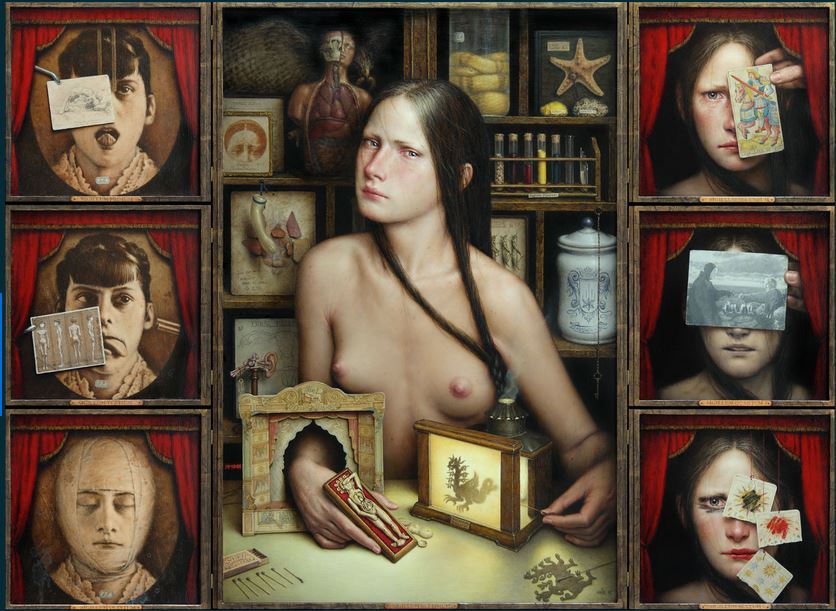
"DIES IRAE" Oil / wood Polyptych 7 pieces: 74 x 100 cm. 2012

“DIES IRAE”
Oil / wood
Polyptych 7 pieces: 74 x 100 cm.
2012

What did you find most challenging when you first started learning to  work with those?

 To learn to work in sessions, to be patient, and always thinking that what you are painting is the previous layer to the following other(s).

What advice would you offer others who wish to learn on their own?

It’s very hard, you need a lot of self-discipline, and to be very critical. And be convinced that anyone is “self-taught”, it’s absolutely necessary to learn how other masters did, and in this way until the moment in which you feel you have a complete control of the technique, so that allows you to adapt or modify your knowledge to your own way of working, or develop new ones. The only advantage that I see is avoiding the strong and persuasive influence of one only teacher, in a moment in which oneself still hasn’t formed your own artistic personality.

You also have a degree in Medicine and Surgery. Does that training and the knowledge of anatomy in particular come in handy in your painting work?

 Of course the knowledge of the deep structure of the human body is very useful for my painting, but I think that there are other elements in the studies of Medicine more important for my work, especially in the creative or conceptual contents.

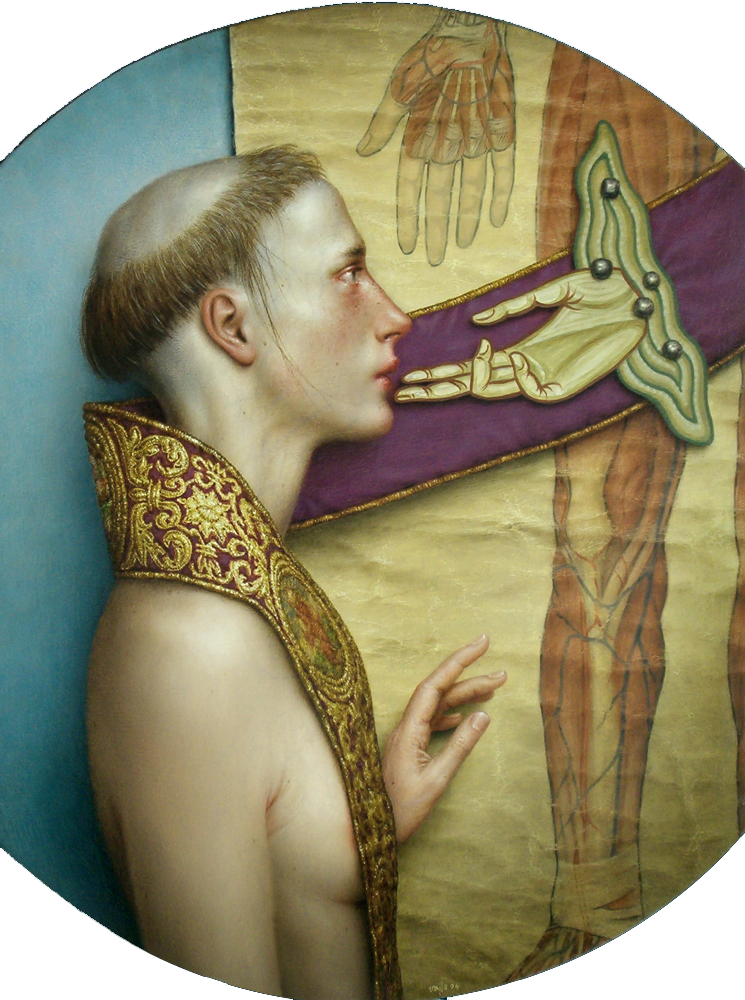
"TENEBRAE LESSONS" Oil / wood 78 x 94 cm. 1993

“TENEBRAE LESSONS”
Oil / wood
78 x 94 cm.
1993

What did people around you think of your decision to be an artist as opposed to the medical field?

 During my career, I also painted a lot, and started to show my works in some collective exhibitions, receiving a very good response, wining some awards, and called by galleries of Madrid to prepare individual exhibitions. Even so, I wished to finish my studies and only after getting my licentiate degree, I decided to work only as a painter and not as a doctor. My family and friends trusted in me and supported my decision, helped by these first successes and knowing my sensible character and prudent determination, although always thinking that Medicine did lose a dedicated surgeon…

What do you love most about painting?

It’s a pleasant way to go deeply into the dark basements of the mind, to explore the collective unconscious. It’s a lonely mystic work of self-knowledge.

Some of your works seem to feature the same model. Why do you enjoy working with that particular subject?

The characters that I paint are imagined and idealized persons which embody some archetypes of the unconscious. All of them have a similitude because they are invented and follow that ideal expression and features. I never use real models. My ability to achieve an adequate verisimilitude, of course has been increasing during the years of work, but my early decision not to use real models, not for persons nor settings, allowed me to create more easily imaginary worlds, and project more directly an inner deep content. Which is much more difficult if you have to look for and find real models and settings.

"DE PROFUNDIS" Oil / canvas 92 x 73 cm. 1989

“DE PROFUNDIS”
Oil / canvas
92 x 73 cm.
1989


Why did you decide to work with tempera? How does it differ most from the work you had done previously?

In the early nineties, I studied the ancient techniques of oil glazes on tempera, and then started to use them because of the fast drying of the first layers, its brightness, and the inimitable colors that this technique achieves when you work after with the glazes of oil. Progressively, I’ve developed my personal way, by adapting this one to my preferences, seldom using the laborious preparation of the egg or casein tempera base.

What do you like to do when you aren’t working?

 I don’t believe in these moments. You are always working, even when you aren’t in front of a painting. I love music -but I always paint listening to it-, When I’m not painting I read and study…

Any little known things about yourself you’d not mind sharing with our readers?

I already do: look at my paintings.

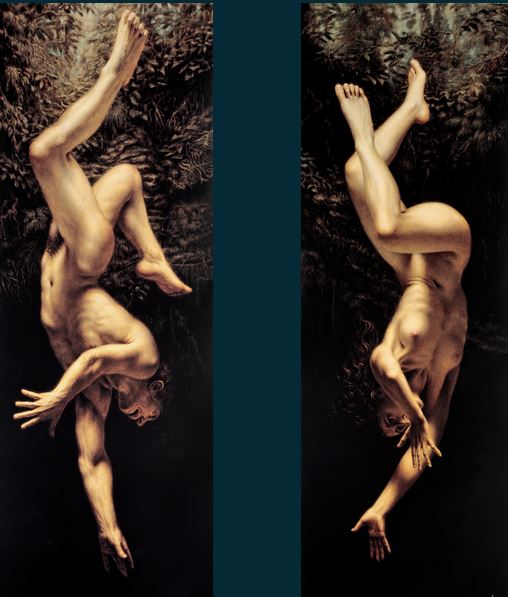
"THE CREATION OF TZADE (צ) THE CREATION OF AYIN (ע)" Egg tempera and oil / wood Dyptych: (2x) 140 x 49 cm. 1992

“THE CREATION OF TZADE (צ) THE CREATION OF AYIN (ע)”
Egg tempera and oil / wood
Dyptych: (2x) 140 x 49 cm.
1992

Do you have a dream project you’d most like to see completed?

To live many other lives to develop many other forms of art I’d like to make. As this isn’t a project, I hope to see one day all my works together in an exhibition.

Anything you’d like to say before you go?

Gaze at my paintings with your nape, with the eyes closed…

"COLLECTIO" Oil / wood 35 x 35 cm. 2011

“COLLECTIO”
Oil / wood
35 x 35 cm.
2011

For more information on Dino Valls please see: http://www.dinovalls.com/  You can also see our piece with more examples of his work at: https://theoriginalvangoghsearanthology.com/2013/05/19/the-art-of-dino-valls/


“Vulture like Blackbirds” by J.J Hastain

blackbirds


Vulture like Blackbirds


You know that you have become an integral middle of concealed yet sacred geometry when, rather than explaining by address or driving directions, you begin to tell your friends to just move toward the endless blackbirds circling above your cave. The birds are there day in and day out, gyrating, ascertaining uncertain floods in your pelvic floor, so why not invite your friends in by way of that fact? Blackbirds can whirl like vultures, obsessively enfolding a spot below them, keeping that spot forever in their stare. There are organic forms of portals and channels and those forms of organic are dark.

Because it is possible to bow to places that have not yet been reached, the work is to sense many different pressures as pleasurable. In my cave, where neural ducts spread like bramble, I engaged in a regular practice of making diodes and doilies. I worked to turn any first sun into subliminal (not secondary) strength. The dark birds remained above me like clockwork. Was I their most chthonic temptation? A cock-bearing clock tower, frothing as it turns its back on time?

Bio6J.J Hastain is the author of several cross-genre books including the trans-genre book Libertine Monk (Scrambler Press), Anti-memoir a Vigorous (Black Coffee Press/ Eight Ball Press) and The Xyr Trilogy: a Metaphysical Romance. J.J’s writing has most recently appeared in Caketrain, Trickhouse, The Collagist, Housefire, Bombay Gin, Aufgabe and Tarpaulin Sky. J.J has been a guest lecturer at Naropa University, University of Colorado and University of Denver.

“Commemoration” by Lisa Dordal

Commemoration


I. CHRISTMAS PAGEANT


At twelve, I played Mary

in a community Christmas pageant.

I saw you at the service, people said.

I saw you with your baby,

riding your donkey. A real donkey,

led by some boy. Older boy.

Fourteen at least. I don’t remember

his name or if I even knew it

at the time. Just that I couldn’t look at him.

Couldn’t look straight at him without

blushing and lowering my eyes.

Everyone said I made a great Mary.

That I did a great job being

the one God descended upon. No,

not descended upon. Entered.

That I did a great job being the one

God entered. And who

afterwards called it holy.


II .CHRISTMAS PAGEANT REVISITED


The boy is important, the visiting poet said.

Immensely important. The center of the poem,

he said. Her desire for him is the center of the poem,

the dramatic center. Her desire for him is

what this poem is about. This much is clear: She desires him.

The girl riding a donkey desires him,

the boy, the dramatic center. You need to build him up more,

he continued. Give him a name, good looks, maybe a touch of acne.

Help us to see him, to see the real center of this poem.

To see into the center; to see inside her

desire. Help us to get inside –

inside the blushing and the lowering.

Tell us how blue his eyes are, how dark his hair,

how straight and perfect his

nose. We need to see him. The center of her desire.

Unless, of course, you are striving

(striving!) to create an aura of mystery – an illusion of mystery –

like you would if you were talking about, say, God.


Unless, of course, you want the boy to be mysterious

in the same way a deity is. Maybe even the girl.

He said this last part parenthetically. (Really, he did.)

Unless of course….


Unless of course you, you, just don’t get it.

That there is nothing mysterious here. Nothing of the

element of religious deity in the story of

a god who descended upon, entered, a woman, a girl,

and with this, the world. Entered and created a world filled

with immensely important boys

who would grow up to be immensely important men,

who would grow up to be the dramatic center of every girl’s life,

grow up to be the desire of every girl who would become every woman,

who would become, be becoming to, every man,

who would become, yes, become, come, come not out of choice,

not out of desire, but fear. Fear and trembling.


Unless, of course, you call that love.


 (This poem first appeared in the Journal of Feminist Studies in Religion, p. 121, V. 26, N. 1, Spring, 2010.)
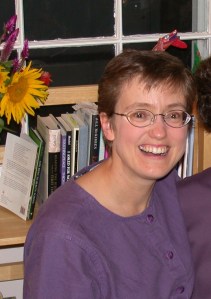
Lisa Dordal headshot


Lisa Dordal holds a Master of Divinity and a Master of Fine Arts in poetry, both from Vanderbilt University, and currently teaches part-time in the English Department at Vanderbilt. Dordal’s poetry has appeared in a variety of journals and anthologies, and her chapbook, Commemoration, is currently available from Finishing Line Press. She lives in Nashville, Tennessee with her partner, Laurie. For more information, please visit her website at http://lisadordal.com.


The Art of Dino Valls

" ARS MAGNA" Oil and gold leaf / table 184 x 122 cm. 2010

” ARS MAGNA”
Oil and gold leaf / table
184 x 122 cm.
2010

"Nigredo" Oil and gold leaf / table 62.5 x 48 cm. 2010

“Nigredo”
Oil and gold leaf / table
62.5 x 48 cm.
2010

"ACU PICTA" Oil and gold leaf / table Polyptych 6 pieces: 150 x 120 cm. 2004

“ACU PICTA”
Oil and gold leaf / table
Polyptych 6 pieces: 150 x 120 cm.
2004

"PANGE LINGUA" Óleo / tabla 53 x 40 cm. 2004

“PANGE LINGUA”
Óleo / tabla
53 x 40 cm.
2004

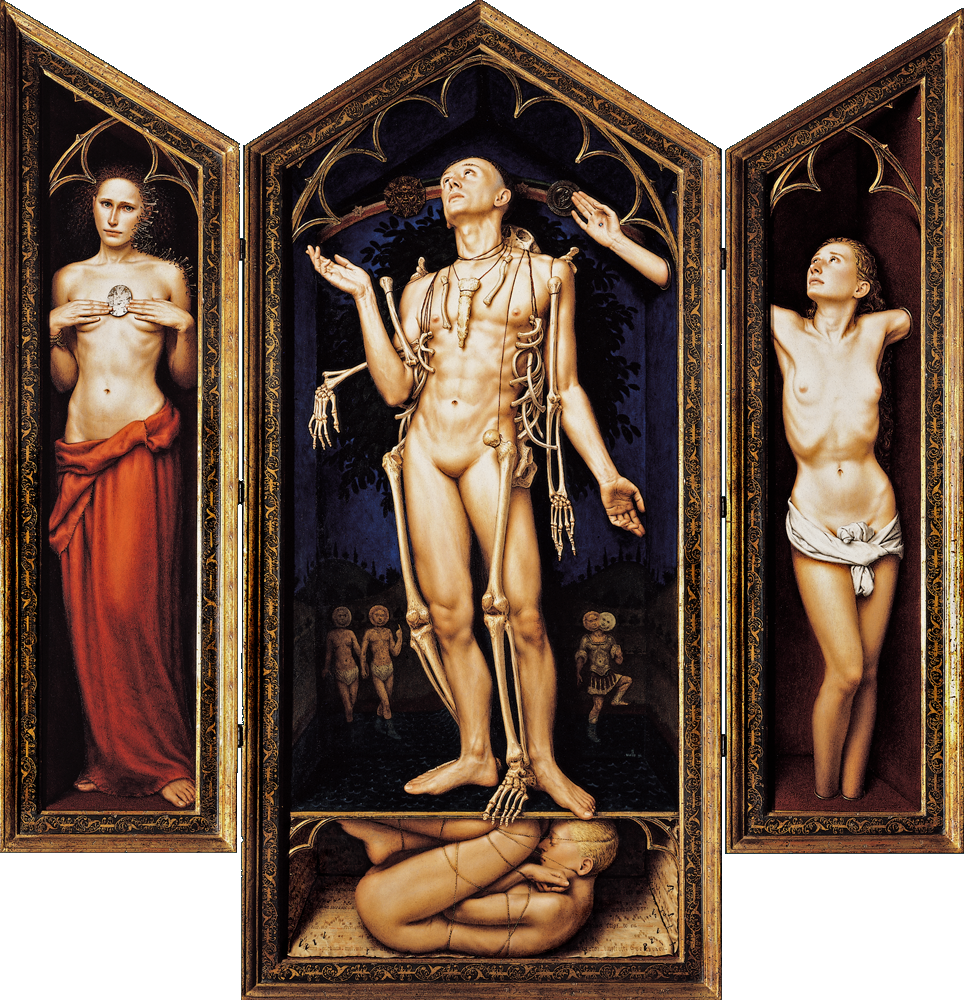
" Arbor Vitae" Oil / board Triptych: 160 x 126 cm 1994

” Arbor Vitae”
Oil / board
Triptych: 160 x 126 cm
1994


"Necessitas" Oil, gold leaf and silver / table 130 x 100 cm. 2009

“Necessitas”
Oil, gold leaf and silver / table
130 x 100 cm.
2009

"PASSIO" Egg tempera and oil / wood 72 x 58 cm. 1993

“PASSIO”
Egg tempera and oil / wood
72 x 58 cm.
1993


"SOLVE ET COAGULA" Temple de huevo y óleo / lienzo / tabla 165 x 122 cm. 1992

“SOLVE ET COAGULA”
Temple de huevo y óleo / lienzo / tabla
165 x 122 cm.
1992

For more information on Dino Valls please see: http://www.dinovalls.com/


“Earth Day” by Kari Wergeland

Earth Day

I face the line on Earth Day,

my forty-seventh birthday,

and mourn for the athlete’s body, the dancer,

the woman who could hop from rock to rock

without losing her balance;

who once thought about becoming a figure model

for a group of Impressionists looking for curves,

long lines, shiny hair, and smooth skin;

who ran in the sun, the rain, and the wind,

in the Truffle Trot and the Butte to Butte;

who never stopped to consider

how it would have to end

when she was forced to look for gentler ways:

Reuse the Past, Recycle the Present, Save the Future.


Now this line irritates her like a sliver.

She limps along next to it, fretting

over how some throw in the towel

when they reach the other side.

A mysterious landslide

just comes tumbling down

and smothers the green shoots that once bloomed each year.

She wonders if the earth will crack open right here,

releasing hot friction between two giant plates

like the sore places in her ankles.


That’s when she decides to stand on the line.

Step on a crack. Break your mother’s back.

She paws at it forcefully.

She flashes her red cape,

listening closely as the crowd cheers—

as the moment balances in the air.

Inhale…exhale…inhale…exhale…inhale…

She exhales right over it,

trying to learn how far she can walk in a day,

singing again after all these years.


Previously published in The Ballad of the New Carissa and Other Poems.

kari2web

Kari Wergeland is the author of Voice Break, as well as The Ballad of the New Carissa and Other Poems. In addition, she wrote a children’s book review column for The Seattle Times, which ran monthly for 11 years. Wergeland recently earned an MFA in Creative Writing from Pacific University. She works as a librarian for Cuyamaca College in El Cajon, CA, and lives part-time on the Oregon Coast. For more information, please refer to her website: kariwergeland.wordpress.com.