“In the Garden of La Villa del Lupo” by Turner Mojica

“Turner Mojica has skills as a writer. His fiction is lucid and engaging, strong on narrative line and sense of place.” – Jack Ketchum

In the Garden of La Villa del Lupo

For Rebekah Zoe

turnerrebecca

“A mighty pain to love it is, and ’tis a pain that pain to miss; but of all the pains, the greatest pain is to love, but love in vain…” – Abraham Crowley 

A big brown spider stretched out on a branch and looked at his work with the utmost satisfaction.

A radiant spring sun rose from behind the hill and bathed the garden in light that was wet with dew. The intense perfume of the sea and the scent of mandarin blossoms floated on the morning breeze. The branches and leaves brushed lightly together spreading soft music down the cliff and down along the waves.

The spider’s perfect web sparkled suspended in nothingness. Its silky threads undulated to the rhythm of the sea below. Closing his eyes, he could hear the song of birds, the drone of bees and the scattered flutter of butterflies.

He absorbed the sweet harmony of his garden which was bustling with life. The brown spider lay on his branch and looked down at his creation, admiring the perfect symmetry of crisscrossing points and lines. For the first time in his life, he wished that his work would be preserved and not be ruined by the prey that would fall eventually into his trap.

At that moment, the big brown spider felt a sudden movement on one of the adjoining branches across where he lay in the sun. He then stepped back instinctively into the shadows and stared carefully to see what it was.

It was a little red caterpillar speckled in yellow and green.

“Hey spider, I love your web!” she shouted crawling towards him smiling. She had seen a shaft of sunlight that had fallen upon his eyes which sparkled like emeralds in the dark.

“Thank you,” he replied uncomfortably and suspiciously. He reluctantly crawled out towards her.

It was strange because no one had ever spoken to him before.

The big brown spider didn’t have any friends. He had only enemies who were afraid of him and his terrible webs. They had never had any appreciation for the time and effort, as well as talent that it took to weave one of his beloved operas. Incredibly, in front of him there was now a delightful, defenseless and delicious little caterpillar who was speaking with him about his recent accomplishment!

“I love the pattern that you’ve chosen,” she said puffing her henna-colored hair away from her big honey-colored eyes. “It’s amazing how the morning light captures the iridescence in the silk you’ve used today.”

The spider couldn’t believe his ears! Today? So she’s familiar with my work? He cleared his throat and responded, “well, it’s actually the effect of the dew on the web at this time of day of course, as well as the…um…the thread that I’ve chosen…the adhesive is more reflective and visible,” he said creeping further out from the shadows.

 The little red caterpillar came across the branch she was on, moving with a sultry mesmerizing rhythm onto the spider’s branch for a better view.

Now they were side by side.

She picked a mandarin leaf and began chewing as she spoke. “So, do you usually…mmmchomp smack chomp begin this orb web design by first…chomp, wow…mmm this leaf is fabulous by the way!”

“Thank you.”

“Excuse me,” she said gulping and gently wiping her mouth. “Do you usually start by laying the radiating spokes and then the encompassing frame threads?” She swallowed and sat closer to him. Her shiny hair reflected the deep turquoise blue of the sky.

“Very good, as you can see it’s very basic. I guess you could compare it to sketching out geometrical forms which are present in everyday nature, like the sun as it sets on the horizon for example, then extending a little bit of ‘poetic license’. It’s forming patterns that ultimately express emotion.”

“Wow.”

The spider could feel her soft red hair on his legs but he didn’t move away. He actually felt comfortable talking to her and he didn’t notice the group of red ants that marched down the closest palm tree. A few of them stopped briefly, looked twice confusedly then continued on.

“Now, I’ve seen that you make a temporary scaffolding spiral that links the radii from the inside out,” she pointed with her delicate hands, her nails were a tipped with mother-of-pearl, “but I just can’t seem to grasp how you complete everything so flawlessly.”

“It’s really quite simple, what I do is finish the design that supersedes the scaffolding spiral with a permanent sticky capture spiral laid from the outside in, then I basically cut the scaffolding down when I’m done.” he said proudly.

“From the outside in?”

“Yes, that’s correct…and finally,” he continued, “I merely adjust the hub that tunes the stays and completes the form which in turn can support my weight on my aerial perch.”

 “That’s a-mazing!”

“Thank you. I am glad that you like it,” the big brown spider said staring into honey.

They paused.

The breeze made everything dance.

“You truly are an artist!” she exclaimed suddenly, startling the spider.

“This is as beautiful as the sun that’s rising this morning. I mean what good is a sunrise or a sunset for that matter without the things that reflect its light, like the sea for example or your wonderful web? I mean, it really catches the light, don’t you think?”

The spider was speechless.

“It’s like just looking at the sky. You really can’t tell just how blue it is without a few white clouds against it can you?”

He nodded his head in agreement.

How could this little red caterpillar read every line of poetry in every thread that I had meticulously spun?

Days and then weeks went by. The smiles and laughter shared between them soon grew from friendship into love.

Spring turned to summer and the mandarin blossoms fell, giving way to giant glowing orbs of fruit, that swelled one by one, coloring the trees with their juicy flesh. Soft sunlight fell and shimmered silently flickering through the branches.  It was hard to see the villa behind them but easier to see the sea.

The big brown spider had found a hole higher up in the trunk of the tree. He turned the former bird’s nest into a multiplex of rooms for the both of them, using only simple silk and the deadly sticky thread when needed to keep his designs together. It was the little red caterpillar that suggested mixing the silk with pollens and floral pigments to give his palette a wider selection of vibrant colors.

In the garden, he also found seashells and colored glass pieces that had washed up from the occasional storm, putting them to good use in his designs. With a perfect view of his web from the outside, he was also careful to hunt only at night and repaired the damage before she awoke when the sun rose again. The red caterpillar knew his nature from the beginning but she never said a word. She just accepted him for who he was and appreciated his discretion. She adored the tiny decorative tapestries that he laced for her inside their home, true dedications to their love. There was one in particular of a brilliant sunset, a mixture of crimson and cadmium with a single green ray that sprang out like a blade, like in those final moments before the sun sank into night. Within that single ray he had written:

 “Natural law is that love is lawless and infinite.”

Together they spent lazy afternoons counting ships on the horizon, sleeping in the hot sun, and then relaxing embraced by the shade. They watched the other animals from above, hand in hand, completely in love. During the evenings they told stories and listened to the symphony of the garden and of the sea. They often danced and dipped under the stars.

One morning as the spider repaired his trap he noticed that the caterpillar hadn’t come out for her breakfast of leaves and dew which he had gathered for her, as was his morning routine.

“Amore”, he called.

There was no answer.

He wondered what was wrong and left the web to check on her. Inside, he pulled back the silk curtain to the bedroom and saw that she was still in bed.

“My Muse, are you ok?”

Sunlight illuminated the room.

The bed was hot and damp. Her fever burned dark red across every part of her skin. Her red hair was matted down and wet. Her forehead glowed with beads of sweat.

“Oh my God, baby what’s wrong?”

She slowly opened her eyes into tiny slits and shed a tear. “I’m sorry darling but I don’t feel well, the pain is terrible, I feel like I’m dying.” She closed her eyes again.

“Baby, is there anything I can do?”

 “No, no thank you, I’m just a little thirsty that’s all.”

“Ok, I’ll be right back.”

When he returned, she had fallen into unconsciousness.

Night after night had passed and he stayed by her side. She wouldn’t awaken. Her breathing was shallow but constant as was her pulse. Occasionally she would dream. Sometimes she would snore, then laugh, then cry in her sleep.

I wonder what she’s dreaming?

He would just lay next to her feeling helpless, caressing her face. The spider was consumed with worry, keeping constant sleepless vigil and fearing the worst. Each day that had passed seemed longer than the one before. He spoke to her as she slept, remembering every beautiful detail of everything that they had said and done since the day they had met. Spiders didn’t show their feelings, but he told her how much he loved her and how his life had changed forever because of her.

The big brown spider soon grew tired and slowly, ever so slowly, each green eye closed one by one as he fell into a deep, deep sleep with her hands in his.

Suddenly, he awoke to the crash of thunder as a violent flash of lightning zigzagged, ripping across the sky.

She was gone.

Another bolt of lightning smeared the colorful room in black and white. The brown spider ran frantically through the house, searching every chamber and every corner, shouting “Amore!  Amore!”

The was no answer.

How long have I been asleep? What have I done? Where is she?

Outside the wind whipped the rain against the spider. It came in slashes and blows across his face and body. While the storm roared, he gripped the branches tightly and continued his search. As the black sea pounded the shore below, he saw that branches through the garden were being torn apart from the violent assault. He looked at his web, something was different. The brown spider squinted through the darkness and fought his way down.

 At the center of his web he saw, not the body of one of his many prey but a dark-colored cylinder that flashed with silver every time lightning  struck. The spider swiftly and carefully ran to it, bouncing and thrashing on the sea of tattered silk. He then quickly cut it away throwing it across his back.

In the shelter of their home, he inspected the container. It was a pod of sorts unlike anything that he had seen before. Inside he could hear the faint beating of a heart. The rhythm and cadence of the music that came from within was unmistakable. He knew that his little red caterpillar was trapped inside. For a moment he was filled with tremendous joy that gave way to uncontrollable desperation.

“Amore!,” he screamed. “Don’t worry, I’ll get you out. It’s all my fault! I never should have fallen asleep!”

The big brown spider scratched, clawed, beat, and banged against the coffin. He tried for hours to open it, but it was no use. Exhausted, bleeding, and bruised he wept in frustration.

It was the first time that he ever cried.

The tempest passed and dawn arrived as if the battle between night and day had ended. The first rays of light cut through the room where the spider lay. The coffin glowed. On the surface the spider could see his reflection.

He didn’t recognize himself.

Feeling tired and defeated, he stepped outside into the doorway and surveyed the destruction. The garden was flooded and littered with debris. Trees had snapped, branches were in splinters, and only the spider’s mandarin tree had remained unscathed. Every mandarin lay scattered on the ground as rivers of mud poured down the hill carrying most of the fruit slowly down the cliff into the sea.

He walked down to see what remained of the web. Nothing was there. Just a view of the polluted beach below and the villa that stood behind him.

Brown.

Even the sea was brown.

The big brown spider felt empty, knowing full well that it wasn’t a hunger that gnawed inside of him but rather a longing for his love that lay trapped inside that shell.

He accepted that there was nothing that he could do but wait. If there was anything he knew how to do it was just that.

 To be patient.

He lay his silk and flew to the closest tree for a different view of the garden, thinking that it would do him some good to get a change of perspective. He flew to another and then another. The sun rose higher and white light poured from the sky cleansing the landscape. By midday, the ants were already back at work rebuilding their communities. The familiar drone of worker bees sounded and every insect had regained purpose in that moment. Birds filled the air running back and forth in flocks while the butterflies flew in their lovely calculated patterns.

The brown spider saw that not every tree had fallen. The older ones had made way for the younger ones sacrificing their bodies to protect the others from harm. Many of them still had their fruit that glistened like goblets raised and cheering. He lay for a moment in the warmth of the sun.

Hope.

The spider ran home bursting with it. Hope. He launched himself from leaf to branch to blossom rushing home.

As he approached his mandarin tree he saw a group of butterflies scatter in a girandole of colors while another trailed slowly and awkwardly behind them.

He wondered why they had dared to venture so close to his tree. Everyone was afraid of him, except for his little red honey-eyed caterpillar.

When the spider walked through the entrance he collapsed. The chrysalis had broken and she was gone. He searched everywhere for her  venturing deep into the garden. The big brown spider went to every anthill, hive and lair. Many of the creatures were terrified to find his presence outside of their doorway. All of them were left perplexed by his inquiries. And some responded in disbelief, “Oh my God, you mean it’s true?…I had heard rumors but I never thought that you could ever love anyone!”

The spider even asked other spiders on the far reaches of other gardens as well as scorpions that tried to engage him as he searched. They were left dumbfounded by his unwillingness to fight.

He found nothing.

All he wanted was to know that she was alive, to know that she was ok, and to know that she still loved him. But she was gone and there were no answers to his questions.

He examined the shattered chrysalis and wept.

 The brown spider didn’t venture outside again. The passing days brought sadness and the passing nights brought loneliness. He missed her so.

He replayed the details of her illness and the moments after her first and last disappearance but there were no solutions. What happened? Could someone have taken her? It was definitely possible, he only had enemies. Or maybe she left me? Was it something I said or did? Was it because of who I am? Did she meet someone else? Had she planned this from the beginning?

The sadness soon passed and his suffering turned to anger and then to rage. He exploded and tore their home apart, destroying everything that reminded him of her. The beautiful memories together dissolved into thoughts of betrayal.  He fell in the doorway sweating and panting after the incessant destruction.  In the corner of an eye there gleamed a shard of polished glass. Holding it at an angle, he peered though it and then held it under the sun. The light intensified and smoke came from the end of the solid beam, falling heavily upon the table that they had shared. Within moments the point burst into flames and his home quickly caught fire.

He watched from a distant branch as smoke coughed from the hole and flames licked from every window which he had carved for her. When the moon rose, thin ribbons of smoke tiredly reached and disappeared into its soft light. His anger grew even stronger.

That night the spider began work on a special web.

Laboring only after the sun had set, he weaved and cut, and tied and spun, and jumped across space daring death to take him.

But it never did.

In the end he had created the largest, strongest, and most beautiful web that he had ever made.

But only he could see it.

Not even the sunrise nor the sunset could reveal the beauty of complex three dimensional patterns which linked together seamlessly.

It was perfect.

Before he could inspect every stay to make sure that they were secure, his first victim was already tangled in the trap. A fly buzzed and screamed for mercy.

He crawled closer.

“Please don’t, please, please!” the fly begged.

“Shhhh,” he gestured, “You’re wasting your time. I show no quarter.”

“I’ll do anything, please…I have a family.”

“Oh, you will do something for me and for your family.”

He was driven by the fly’s helplessness, listening to his pathetic pleas.

It gasped and sobbed.

The big brown spider stared into its large red eyes seeing the million reflections of his own monstrosity. Anger raged though his body. He saw his own suffering now a lifetime ago.

“Anything, please, anything.”

“I want to hear you scream,” he whispered.

The fly wriggled and screamed as the spider tore off his wing.

“I wasn’t even finished inspecting the stays you little shit,” as he tore off the other and flung both of them below.

He laughed as he tore off each leg.

The torture lasted for hours, then he slowly ate its body leaving his head for last. It was alive until the very end.

When the screams and gurgles stopped, the big brown spider’s laughter echoed through the garden. Yet he was not satisfied. He waited outside of the scorched entrance of his home under the cold moonlight awaiting his next prey.

In the first weeks, the victims came in waves, sometimes in swarms, and each time he tormented and tortured them. He cleared the web of every trace. Stacking their cocooned bodies in his charred lair, dismembering and eating them at will. Their suffering alleviated his own. He discarded the carcasses that began to pile at the bottom of the tree. Night and day he was lulled to sleep by the agony of his captives.

One morning a baby swallow was tangled in his trap. The young fledgling, not yet keen in the ways of the world fell victim to the big brown spider. He ate him slowly, like a wolf already full, tearing his feathers, then his flesh, as his mother watched helplessly. Then he picked his teeth with its broken little bones. The spider left the tiny bloodstained feathers on his snare for the whole garden to see what he had become.

 Although dreams of the little red caterpillar continued to plague him every night, he often awoke screaming her name, he did not turn back from his purpose. The terrible chorus of his victims did not stop him from his revenge against the love that escaped him. Wherever she was. She may have very well died that horrible night and that coffin may have been the product of his imagination.

But she was inside!, I felt her inside of it!

It was useless to think of the past.

He was a spider after all. How could she have ever loved him.

One rainy afternoon he lay in his darkened chamber when he heard a familiar voice amongst the pitter patter of drops that fell into a downpour like gravel from the swollen sky. He looked out and saw a single butterfly struggling in the net. Ignoring it, he turned back and began breakfast. The brown spider heard a voice and looked another time. Perhaps he was hearing things again?

Was it her out there somewhere?

It wouldn’t have been the first time that he heard her voice.

He stared out again. There was no sign of his little red caterpillar. There was no hope anymore.

When the rain had stopped, he descended onto his infamous creation. He then saw the bright wings of his beautiful victim, shimmering like a fallen rainbow. Butterflies had become his favorite meal.

They reminded him of that dreadful day.

The big brown spider came slowly from behind it and silently injected his venom into the back of its neck. He then turned and stared into its eyes, hoping to catch a glimpse of the terror that lingered within. It was then that he had recognized the honey-colored eyes of his red caterpillar.

His only love.

In that instant his cold heart stopped.

“I’m sorry,” she tried to say, her mouth covered with sticky thread.

“It’s you!”

The spider tore her wings free and wiped her mouth, holding her close to his body suspended in the clearing sky.

She smiled and caressed his face.

“I wanted to surprise you, that day I saw you sleeping and climbed down to the net,” she was growing drowsy from the poison that pumped through her body, dissolving her insides. “I was changing so but the storm came…silly…you saved me…” she began to whisper.

He listened with tears in his eyes.

“I was changing…then you were gone…and I tried to fly…” she said.

“That was you…clumsy you learning to fly? Oh my God it was!” he said holding her head.

“Yes, it was me.” she laughed. “I was so…happy that I flew over the hill…they helped me…the others…gardens everywhere…so pretty…and the ships remember when we used to count them? And then I fell and hurt myself…”

She was fading slowly and he could do nothing.

“I came back…as soon as I…I could fly…again…I missed you…I love you…your web so…incredible, I wanted to get closer, to come home…” she stared blankly into his eyes and said, “I…blue…sky…”

The spider cried in deep terrible gasps as he held her lifeless body.

As the sky filled with deeper impenetrable blue a single white cloud passed. He gently took her body into their home and lay her on the floor near the entrance.

The big brown spider never forgave himself for what had happened.

Every now and then sobs, screams, and manic laughter echoed though the garden. For years no one dared to venture near that mandarin tree. Those who did never came back.

Until finally one day the screams were heard no more.

And from that day on, there was peace in the Garden of La Villa del Lupo.

64023_569403846439874_690880077_n

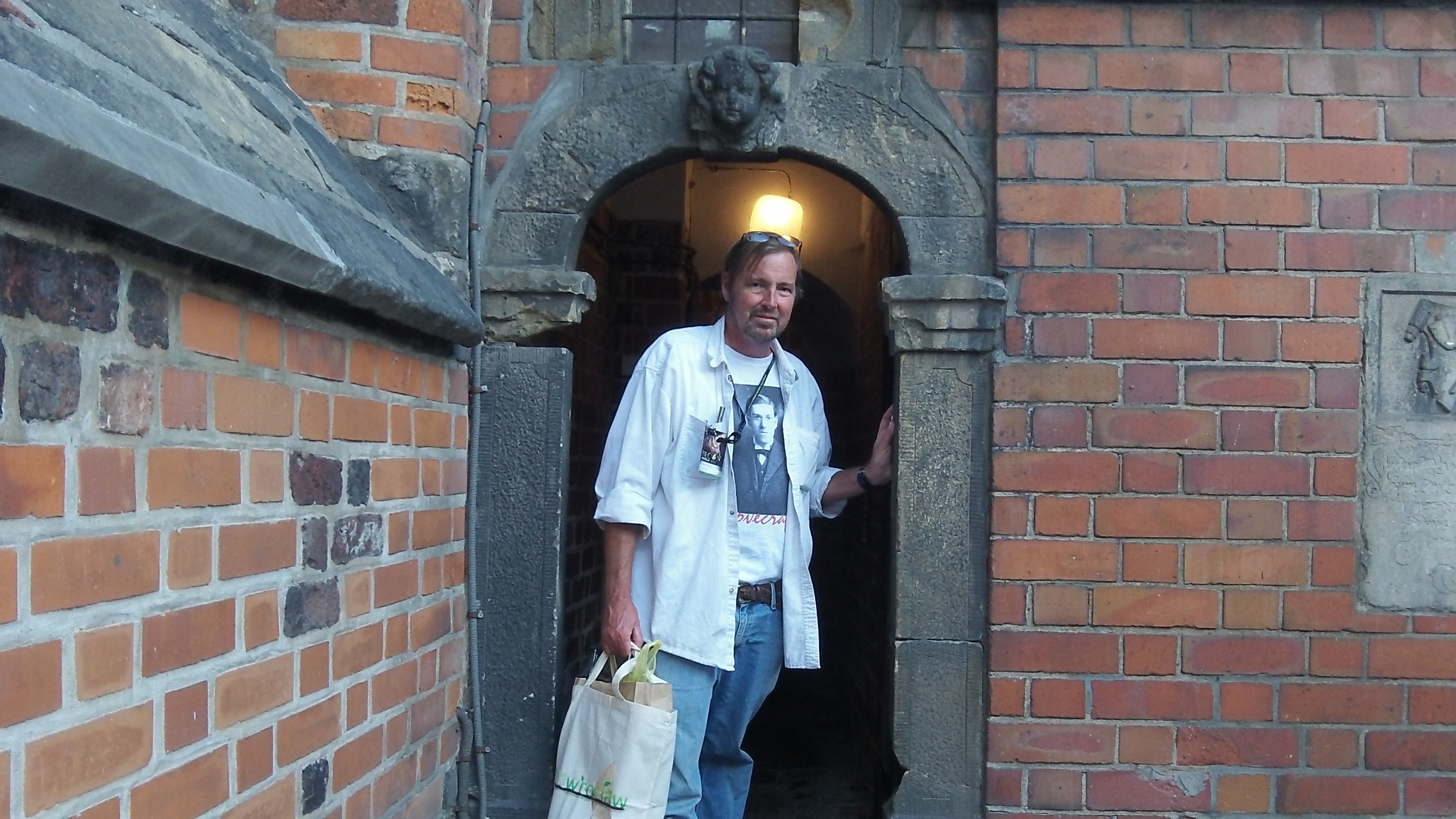
Turner Mojica was born in San José, Costa Rica and after his family moved to the USA, he was raised in Washington DC.  The son of an Irish-American father and a Costa Rican mother with Basque heritage, he decided to follow his parent’s sense of adventure and moved to the Amalfi Coast in Italy in 2000. Mr. Mojica began teaching communications seminars in several private schools and universities throughout Italy, and consulted small businesses, law firms, and PR firms, local government agencies as well as philanthropic organizations in Southern Italy.

Realizing that Milan was the business center of Italy, he moved there where he lived for several years, consulting in the
fashion and entertainment industries. In late 2007, he cofounded, The Americani, LLC, a branding, PR and advertising network. About the same time, he co-founded the Milan-based fashion consulting network, “Fashion Affaire”, which serves most of the world in sourcing the goods and services needed to produce fashion garments. In 2008, he began brand consulting for Beatrice Models International relaunching the legendary modeling agency.

Never forgetting his passion for literature, art, culture and film, A. Turner Mojica is also the branding force behind Jack Ketchum, who Stephen King describes as “on a par with Clive Barker (Hellraiser), James Ellroy (L.A. Confidential), and Thomas Harris (Silence of the Lambs). The only author creating more important work is Cormac McCarthy (No Country for Old Men)”. These efforts have also included the making of five Jack Ketchum books and stories into feature films, including Red with Brian Cox (Troy, Bourne Supremacy) and Tom Sizemore (Heat, Saving Private Ryan).

He also works with multi-platinum, Oscar, and Grammy nominated producer Ronnie King (Mariah Carey, Tupac Shakur, The Offspring).

http://www.theamericani.com/

An interview with Ramsey Campbell

76141_107570536076426_2001209523_n

Since first gaining recognition for his work in the 1960’s Ramsey Campbell has been widely praised as the one of the leading authors of horror, labeled by some as an equal to Lovecraft himself. He has worked in dark fantasy, thrillers, and science fiction as well, with his work winning countless awards. Ramsey is a lifelong president of the British Fantasy Society.

His newest works include the novella out now, The Last Revelation of Gla’aki, the new collection Holes for Faces due out in August, and the forthcoming novella The Pretence due out this Fall.

http://www.ramseycampbell.com/

What were you like as a child? What would you say are some of your fondest memories from that time?

I suppose they would mostly involve my mother. When I was younger we drew pictures together, played word games and board games and cards and ball games, the last of which must have been a trial for her, since she’d suffered a prolapsed womb at my birth. She encouraged me to write and to finish what I wrote. Her favourite film, to which I accompanied her dutifully on each reissue, was Gone with the Wind, though often when she revisited a favourite old film or book her disappointment would convince her that someone unspecified had changed the text (Edgar Wallace novels, which proved less surprising than when she had first read them, were among the commonest offenders). At home we listened to radio shows together – plays and serials and comedies, though she never liked Spike Milligan’s “Goon Show” with its gleeful explosion of taboos – or simply sat by the fire and read (sometimes the same authors: Patricia Highsmith, Ray Bradbury, Cornelia Otis Skinner). I was always enthralled when she told me her memories: of Father Young, a Catholic priest who used to scuttle after her and her sister in Lon Chaney’s latest role; of working at Rushworth’s department store in Huddersfield where eventually she became a buyer and where her assistants used to confide all their problems to her; her years at the Ministry of War Transport, and the Christmas Day she had been working there alone while a man prowled the deserted street outside; her chaste love affairs which she always terminated; her pet dogs, one of which another dog-owner had kicked to death; the plots in great detail of films she’d admired, The Barretts of Wimpole Street, the Mamoulian Doctor Jekyll and Mr Hyde, the Claude Rains Phantom of the Opera… It was her way of sharing herself, which she did with a very few people – too few.

Do you remember what your very first favorite story was?

There were many I enjoyed, but the first I vividly recall looking forward to rereading and did indeed enjoy at least as much the second time round – I would have been nine or ten years old, I believe – was Conan Doyle’s The Lost World. Its sense of awe and wonder lingers still.

As someone one who had a relative that struggled with mental illness what advice would you offer other that might be dealing with a similar situation?

I fear not much from my actual experience. “It will end eventually”, perhaps, and a sense that other people have been through it and survived.

What do you think is the most important thing you learned from the experiences you had with your family early on?

That one’s perception of reality (or, in this case, my mother’s) need not be the same thing as objective reality. I was three when I realised this – specifically, at the end of a fierce argument my parents had, ending at the front door. This contained nine small panes of glass, reaching from chest level to the top of the door. My father blocked the door from outside as my mother tried to close it; presumably they were struggling for the last word in the argument. My mother’s hand went through one of the panes. I remember her dripping bright red blood and crying out that he had deliberately closed the door on her hand. The sight of blood except for my own has distressed me ever since. A neighbour – Gladys Trenery from next door – looked after me while her husband took my mother to hospital. I suppose they humoured her to calm her down, but then I thought they were accepting her version of the incident. Since my father had fled, I tried to set the record straight. What did I know about it? I was only three years old. I don’t think it’s fanciful to relate one of my recurring themes – the difference between perception and reality – to this. I don’t think I ever accepted my mother’s belief throughout my childhood that various radio programmes and newspaper cartoons were about her or addressed to her by some of our neighbours in disguise.

Do you think society’s view on such matter has improved much with time?

I don’t know that I’m qualified to judge. It seems commoner to hear that mental illness is a disease just like any other. Too often it appears to be used as an excuse, absolving the patient from making moral choices and taking responsibility for their actions. A bookseller friend of ours was murdered by a lunatic who wanted vintage postcards John had collected. Our neighbour opposite is a member of a string quartet, one of whom was stabbed to death by a schizophrenic in the street. The chap who lives next to him was attacked by another such person who used to live in a so-called care home (minus any care) next door to us – the victim was confronting him for stalking the chap’s teenage daughter. All these people were treated as not responsible for what they did. Perhaps I’m biased by all this, but you can see why I write some of what I write.

Did you develop your love of film early on? What are some of your favorite films?

I suppose I really fell in love with the cinema when I was nine – my first viewing of This Island Earth, the first time I was overwhelmed by the intensity of colour in a film. (The DVD confirms my memory.) Serious filmgoing began for me when I was fourteen and could pass for sixteen so as to watch any number of the films I’d read about and seen illustrated in Famous Monsters of Filmland. But that quickly led elsewhere – I encountered Bunuel’s Los Olvidados as support for Bert I. Gordon’s The Cyclops, and it was a revelation (I’m sure I owe to it some of the combination of urban grit and the uncanny in my tales). Other films had an influence around my mid-teens too – Last Year in Marienbad in particular.

As for favourite films – well, my list has changed over the decades, but a few are firmly ensconced. They include Les Vampires (Feuillade), Perfect Day (Laurel and Hardy), Make Way for Tomorrow, Bringing up Baby, La Regle du Jeu, Singin’ in the Rain, Sansho Dayu, Vertigo, Touch of Evil and Night of the Demon.

Do you think the film industry of today is lacking in imagination when compared to the early classics?

Not when we have directors such as David Lynch (half a dozen of his films genuinely terrify me), Michael Haneke, Ben Wheatley, Richard Linklater, Abbas Kiarostami, Todd Haynes, Martin Scorsese and quite a few others.

Why do you think the world has always enjoyed things that fuel the imagination and offer a bit of escapism?

Well, they aren’t necessarily the same thing. If we had no imagination I think we would have no souls (which isn’t to suggest that the latter are imaginary – I’m hoping not). I think things that enrich the imagination are a basic human need. Escapism – I forget who pointed this out, but while we may escape imaginatively into the fantastic in art, we aren’t usually escaping from anything by doing so. In any case I think fantasy in all its forms – horror fiction certainly inc;luded – can throw a different light on reality and allow us to renew our experience of it.

What do you love most about the art of writing?

Surprising myself. Whenever I’m writing a first draft in particular I always want to write something I didn’t know I would until I got to it. It’s an edgy process but works for me (so I keep telling myself).

You have written often of the supernatural. What are your feelings on such things? Would you say you are a believer of things we cannot explain?

I grow more agnostic as I age. I do think the house we live in is haunted – mostly the guest room up here on the third floor next to my workroom. Here’s the most spectacular incident:

My wife Jenny and I had discussed befriending the room by spending the night up there together. During one of my attempts to let her sleep without my snoring I wakened at about two in the morning to discover that she’d decided to try the experiment. It was only when I opened my eyes and reached for her that I realised the silhouette next to me, its head on the other pillow, wasn’t Jenny. I tried for a very long time to move and cry out. Apparently I achieved the latter. In our bedroom on the floor below Jenny heard me make some kind of protest, but I’ve often exhorted her not to wake me if I’m having a nightmare, because I believe these dreams contain their own release mechanism, and I resent being taken out of them before the end. Jenny headed for the toilet on the middle floor, and when she returned I was still making the noise. Perhaps I was dreaming, in which case it had to be the longest nightmare, measured in objective time, that I’ve ever experienced. It consisted purely of lying in the bed I was actually in and trying to retreat from my companion. I admit to never having been so intensely terrified in my life. After minutes I found myself alone in the bed. I made myself turn over and close my eyes, but had a strong impression that a face was hovering above mine and waiting for me to look. Meanwhile, downstairs, Jenny felt an intruder sit beside her on our bed.

Are there any little known things about yourself that your readers might be surprised to learn?

Not if they’ve read my non-fiction, which is as openly autobiographical as I can make it whenever it needs to be.

How do you feel about being labeled one of the best authors in the horror field? Did you ever imagine when you wrote your first piece that it would lead to such notoriety?

I’d say people have been very kind. When I wrote my first pieces – the Lovecraft imitations, which were the first tales of mine eventually to be published after all the necessary revision – I didn’t even expect to be published.

Can you tell us a little about your latest releases The Last Revelation of Gla’ aki and The Pretence?

Gla’aki is a return to my Lovecraftian roots – an attempt to scrape away the conventions I employed in my first book and get back the visionary quality of Lovecraft’s greatest work. I’m not claiming I achieved it, just saying I tried. Pete Crowther of PS Publishing actually proposed it, and I’m grateful to him. The Pretence is also a novella, on the theme of coming back home from abroad and finding things strangely changed.

You are also releasing your newest collection Holes for Faces in August. What can your readers expect from this one?

I tried to sum the contents up like this: uncanny dread, and disquiet and terror, but also poignancy and comedy of paranoia. One theme runs through all the stories: youth and age.

Do you still get excited when you release your work to the public?

Apprehensive, more like – fearful I’ll be revealed as never having known what I was doing, or if I was, folk will see it wasn’t very good.

Is there any one subject you’d most like to cover in your work that you have yet to?

Not that I’m aware of. I don’t suppose I will be until it presents itself – that tends to be the way for me.

Do you have a dream project you’d most like to see come to completion before your time is up?

To write a tale that achieves the sense of awe I find in the best of Blackwood and Machen and Lovecraft. Meanwhile, the omnipresent Pete Crowther has proposed an interesting project that would occupy me for years – we’ll see.

How do you hope to be remembered when your time does come?

To have been worthy of the best traditions of the field and to have brought something of my own to it – I’ll make a claim for comedy of paranoia. But the most I think my stuff deserves is to be remembered as at best an honourable failure.

Is there anything else you’d like to say in closing?

That horror fiction at its best is a literary form, as legitimate as any other, with a considerable tradition. I hope to see more writers working in it on the basis of being aware of that tradition – many are.

“Word Painting” (for Yoko Ono) by Ian Ayres

Word Painting

                                           (for Yoko Ono)

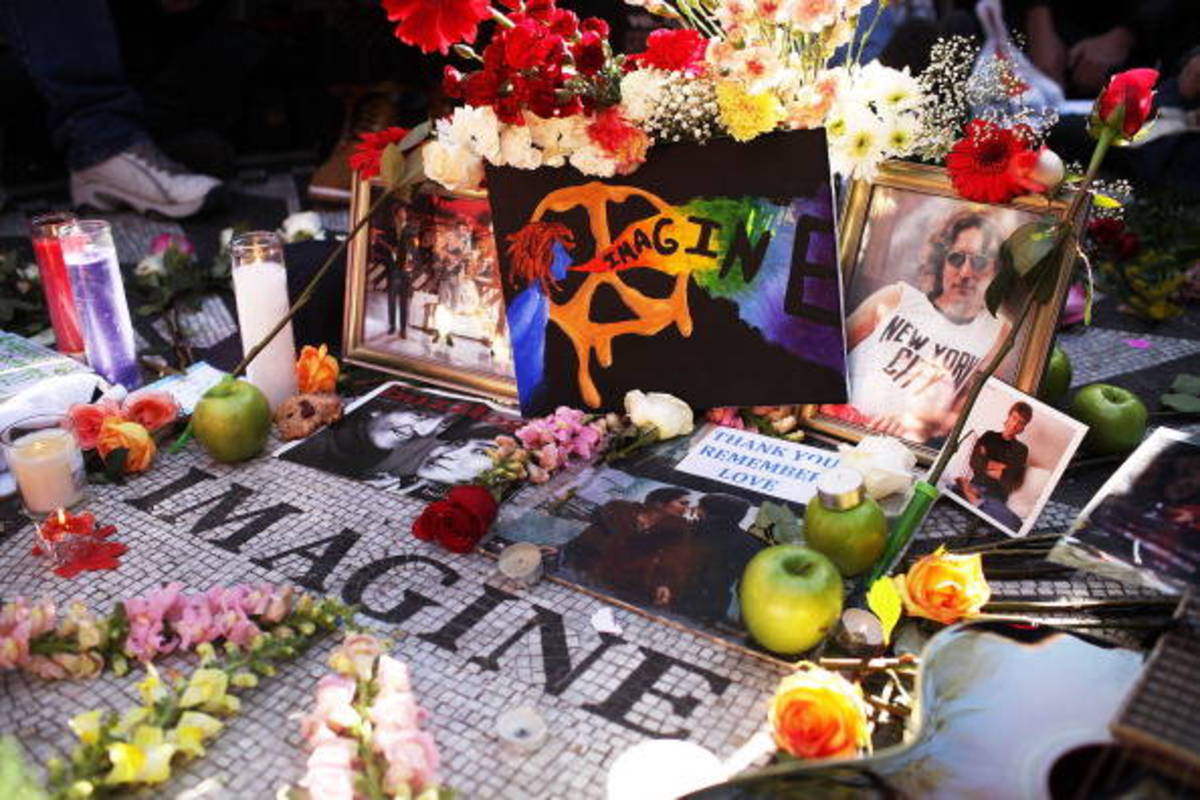
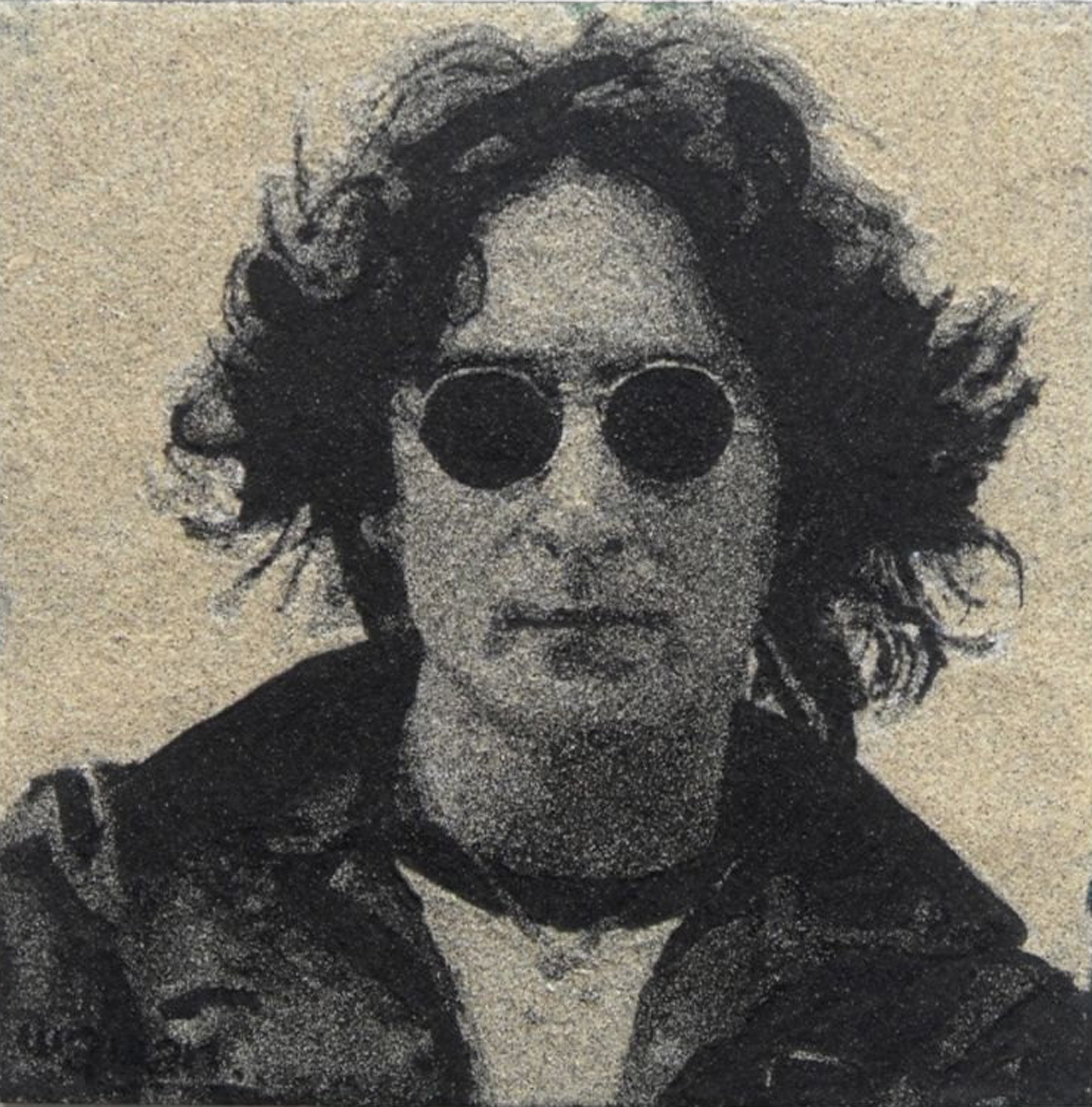
Sand Painting of John Lennon

It’s all heartache

Until you let go

Then it becomes one

Continuous Now

And there’s a void there

No future, no past — just Now

Alone with one gone

*

As glasses fall

Cracking thin ice

A double you torn

Ending Beginning

Yes screaming No

Caught in blood

His empty chair

*

Moments

Without permanence

Each syllable, an instant

An is as was

A silent guitar

All there is

*

Wind blowing

A sand painting

Of hours and colors

Scattered to bring

Strawberry Fields

Into Now


Imagine(StrawberryFields


This poem for Yoko Ono was written in Strawberry Fields in Central Park, NYC. Looking up at the Dakota, Ian saw Yoko staring out of a window and rituals of unfixed sand paintings inspired him. “Word Painting” is published in Private Parts: The Early Works of Ian Ayres.


“Eyes Left” by Jack Ketchum and Edward Lee

Happy Hour at the World Cafe.  69th and Columbus.

At 4:30 after work that was where we came.  Neal from his studio and John from behind his camera over at ABC and yours truly from She Who Must Be Fed — otherwise known as Microsoft Word.  Pretty much every day.  There were other regulars who’d come and go but we three formed the core of it.  We’d stand there talking at the bar, drinking and munching trail mix with Neal feeding the juke a couple dollars now and then to keep the blues and country flowing and so that John wouldn’t start in with his goddamn Frank Sinatra.

You had to be careful with John and Sinatra.  He’d play a whole CD and sooner or later he’d be singing along.

And we watched the ladies, of course.

Today was Neal’s day On Point.

Eyes left,” he’d say.

That was what we did.  Stake our claim on the liquor industry, tell jokes and bitch about life in general and listen to sweet blues and watch the women walk by along the hot summer sidewalk.  We’d been doing it for years.

The only difference now was that some of the women were dead.

The women.  They’re the first best reason to love summer in New York City.  The sidewalk outside the big plate-glass window on Columbus brought along an endless procession of them — almost as though they were walking by just for us, just for the appreciation radiating out from inside.  Sure, I know what you’re thinking.  A bunch of horny sexist pigs.  Reducing women to the sum of their sexual parts.  But it’s not like that at all.  At least not for me.  For me there’s a kind of reverence to it.  All that beauty and diversity.  All those blessings to our little lonesome planet walking around in shorts and tanks and halters.  I’m serious.

You ask me, the best that fifty-one per-cent of the human species has to offer can be found right here in the City.  L.A. just can’t hold a candle to it.  Neither can Boston or San Fransisco.  You don’t believe me?  Come over to the World Cafe some time and sip your Bud and keep your eyes on that window.

Of course it’s a little different now.

You can mostly tell the dead by the grayish look to the skin or of course if they’ve been mutilated in some way but from the distance of bar to sidewalk not by much else.  You might notice that the hair had little sheen maybe.  That the sun didn’t catch it right.  But you had to get up close to see the clouded eyes or the blue fingernails and you didn’t usually want to get that close.  If you did, that was what your sidearm was for.  And none of us had shot one in a long time, male or female, old or young, and didn’t care to.

The dead walk briskly in Manhattan, just like everybody else.  Thing is, they have no place to go.  The law protects them now, at least to some extent, but they’re not allowed to work jobs or have careers.  They get foodstamps, welfare, public housing.  I pretty much always felt sorry for them.  Sure, a small percentage get out of line now and then, would rape somebody , mug somebody, rob a liquor store.  But no more than the living.

Most of the bum rap they got came from the cannibalism thing.  That’s what the crazy ones would do, kill regular folks and eat them.  There was a lot of hysteria over that at first.  That’s when the mayor revoked the Sullivan Law and passed the concealed-carry ordinance.  But once the Army retrieval squads rounded up the crazy ones you didn’t hear much about cannibalism anymore.  Hardly ever.

Fact is, the dead don’t seem to fuck up any more than the living.  It’s a simple, primitive prejudice against a minority, nothing more.  Sure, you wanted to be careful, just like you wanted to be careful of  a lot of things and people in New York.  But I’d stopped carrying my own gun a long time ago.  A lot of us did.

Still, it was a kind of like a game with us, a bar contest.

Seeing who could pick out the dead ones.

“Eyes left.”

This one sure wasn’t dead.  Chestnut hair tied back long and gleaming, tan shoulders glowing in the sun.  Curve City too, if you know what I mean.  The silky dandelion-print dress seemed spun onto her.  Low cut and no bra.

“Jesus,” said John, “are those nipples or fuckin’ spark plugs?”

John could be crude but he had a point so to speak.  Her nipples were extremely elongated and hard, like they wanted to spike through the fabric.

“If they’re spark-plugs,” Neal said, “maybe they need to be re-gapped.   Know a good mechanic?”

“Notice that nipples are back this year?” I said  “For a while you hardly ever saw them.”

John nodded solemnly.  “It’s a good thing.  It’s a godsend.”

Then she was gone and two pretty smiling Goths walked by dressed in black, chrome nubs glittering in their vampire-red lips.  It’s eighty degrees out there and they’re wearing black.  They were holding hands.

“You gotta love this town,” I said, smiling.

We turned back to our drinks and talked about Tom Waits on the juke.  Neal had seen him fall off his piano stool in Nashville.  Whether it was part of the act was still open to question.

“Eyes left.”

John let out a low whistle.  “Can you say chest fruit?

“No, but I can say mammiferous,” I said.  “Can you?”

“What she needs,” said Neal, “is an exemplary and thorough breast examination, care of Dr. Neal, to be promptly followed by regular pants-sausage injections on a daily basis.”

“What if she’s a vegetarian?” said John.

“Then I’ve got a plantain that’ll change her life.”

“You guys are terrible,” I said.

“Listen to him,” John said.  “We’re terrible and he’s standing there cross-legged.”

Then it was back to the drinks and talk again.  Cigarettes had gone up nearly fifty cents.  Rent control was once more being threatened in the legislature.  ABC grips were considering a walkout.  The usual New York bullshit.

Then, “Eyes left,” again.

“Call it,” John said.  “Dead or alive.”

“Alive,” Neal said but then his squint grew narrower.

I knew she was dead before she was halfway by the window.  “Dead,” I said.  Easy on the eyes at first, sure.  But then you caught the autopsy staples showing in the gap between the top of her jeans and the bottom of her peach blouse.  She glanced in at us and you could see it in the eyes.

“The winner!” said John.  “Anna, get this gentleman another Dewar’s on me and another Heiny for myself.”

“What am I,” Neal said, “chopped liver?”

“And a plate of chopped liver for Dr. Neal of the exemplary breast exams.”

These guys.  I mean, you can’t take them anywhere.

Anna knew us all pretty well by then though and poured refills for everybody.  No chopped liver made an appearance.  We drank.

“Gustavo told me a story last night,” Neal said.  “About those apartments over the flower shop.  Hey, where the hell were you two guys last night, anyway?”

John shrugged.  “I was home doing the Sunday Times crossword puzzle and listening to ole Blue Eyes.  What, you go out every night?  I had to work today.  Not everybody’s an artiste and makes his own fuckin’ hours.  Some of us gotta work in the morning, y’know?”

“I was on the computer,” I said.  “Online from about ten to midnight.  They did another Dead Chat last night.”

Neal made a face.  “Why do you bother with that shit?”

“He’s a voyeur,” John said, “of the dead.”

“No, I just like hearing what they have to say.  And let me tell you, they have some stories.  When they start writing novels I’m really fucked.”

“Eyes left.

We looked.  “Hubba hubba,” Neal said.

A real head-turner.  Tall and sleek with mile-long legs walking along like a runway model in this sheer off-the-shoulder top and flowing organdy dress.  Lots of jewelery and fiery red hair.

The redheads always get to me.

Behind us Anna laughed.  “You perverts!  She’s dead!

She was right.  When she turned her head you could see the long unhealed gash along the side of her throat.  Like somebody had tried to cut her head off but didn’t quite make it.

John groaned.

“So much for hubba hubba,” I said.

Neal ordered a plate of fried calamari and Anna went to place the order with the kitchen.  We watched her too.  Anna was quite a looker herself but way off bounds.  You didn’t mess around with your bartender.

“So?  Like what?” John said.

“Huh?”

“Those stories you were talking about.  These Dead Chats.  What’s so fuckin’ interesting?”

“Okay.  Take this guy last night.  Ninety-two years old, starved to death in his own apartment.  Got out of bed one morning, got dressed, wanted to take a leak but his bedroom door wouldn’t open.  He starts yelling for his nephew, who lives with him.  Nephew’s only sixty-four.  No answer.  So the old guy opens his bedroom window, takes a four-story piss, then goes back to pounding on the door and yelling for his nephew.  Who still doesn’t answer.”

“Where’s the nephew?”

“I’m getting to that.  So this poor guy’s trapped in his bedroom with no phone and no food and nothing but a John Grisham novel to keep him company.  Can you imagine that?  He’s trapped in there for a week with John Grisham.  So finally he just lies down on his bed and dies.”

“So then he comes back, right?”

“Right.  And you know what they say.  Sometimes they’re stronger than when they were alive.  So he pushes at the door and this time it opens.  What’s been blocking the door is the nephew.  He’s dead on the floor from a heart attack.”

“How come he didn’t come back like the old man?”

“No brains.”

“Say what?”

“See, the nephew had a plate in his head from a war injury.  So when he fell down behind the heart attack his head slammed into the radiator knob.  Pops the plate right out of his skull along with half of what’s inside.  Rats made short work of whatever was left.”

John laughed.  “I dunno whether you call that good luck or bad.  For the nephew I mean.”

“Got me.  Depends on your point of view, I guess. Most of them seem pretty content, though.  At least they’re walking around.”

Eyes left!  Quick!  Man, is that one hot dish or what?

John and I looked.  Then gagged.

“Yeah, one hot dish of ground chuck,” John said.

“Prick!”

She was roadkill in a sundress, probably pushing three hundred pounds and all of it rot.  One eye was gone and so was her lower lip.  At least she’d done her hair up nice.  Neal was having a good old time though, laughing at our expense.

“Now that’s what I call a wood-killer,” John said.

I had to look away.  “Jesus, I bet she leaks, leaves a trail of drippings.  There oughta be a law against the ones like that.”

“The dead aren’t toxic, remember?”  Neal said.  “Nobody knows why but they’re not.  So there’s no reason there should be a law, you bigot.  Come on, now.  The dead are people too.”

He was mocking me.  I probably deserved it.  I could get a little preachy sometimes on the subject of the dead.  There were laws to protect them these days and I agreed with those laws.  A lot of people didn’t.  But sometimes it got to be a little much even for me, seeing the really maimed or rotten ones like this.  I once saw a guy walking down Broadway carrying his guts in front of him in a wicker basket.

Wasn’t pretty.

“You were saying something about Gustavo and last night?  Something about the flower shop?”

His calamari had arrived in front of him and Neal was nibbling the batter off a piece of squid to expose the grey-black tentacle.  That wasn’t pretty either.

“Oh, yeah.  Last Saturday he’s sitting here in the bar tossing back a few tequilas and notices a couple of squad cars pull up over there.  They don’t have their lights on or anything but he just happens to notice them and while he’s talking up some woman beside him he keeps an eye on them.  Comes from growing up in Spanish Harlem — you watch the cops.  Anyway, they’re no sooner out of their cruisers when the old lady who runs the flower shop comes out and she’s yammering away and keeps pointing up to the third-floor apartment over the shop.”

“That apartment’s been empty for years,” John said.

“You bet.”

“So what happens next?” I said.

“The cops — four uniforms — go up into the apartment and they’re in there a while.  The old lady’s still outside wringing her hands and looking like she’s gonna have a heart attack right then and there.  So Gustavo says fuck it, leaves his drink on the bar and walks over and asks the lady what’s going on and the lady tells him that she keeps hearing this loud banging sound coming from upstairs.  She’s spooked.  The apartment’s wiring’s bad and nobody’s supposed to be up there.  She’s too scared to check it out herself so she calls the cops.

“Finally they come back down, and three of them are carrying kids wrapped in blankets.  Little kids.  A few minutes later an ambulance arrives.  Turns out the kids are a year old, two years old, and about three years old — two boys and the oldest one’s a girl.  Their parents went dead two days ago, OD’d on heroin and then came back with brains so fried they were totally retarded, wandering around and jabbering and bumping into walls.  But that’s where they were living, in the old apartment over the flower shop.  Squatters, sneaking in and out at night.”

“So they died.  And came back…?”
“Five days later.  But for those five days…”

“Oh shit.  Nobody to take care of the kids.  They’re lucky they didn’t starve to death.”

“Right.  And the apartment’s a total shithouse.  Gustavo talked to one of the cops and I guess it was pretty grim.  Garbage all over the place, clothes and dirty diapers and human shit all over the floor.  The three-year-old told them that they were drinking out of the toilet bowl.  Sinks hadn’t worked in years.”

“What’d they do with the parents?”  John said.

“Dead junkies walking?  Took ‘em straight to the ovens.  Can you believe it?  Stuff like that happening right across the street?”

“So what was the banging sound?”

“Huh?”

“The banging sound the old lady heard.”

“Oh jesus, yeah.  The three-year-old was whacking cockroaches with a hammer.  That’s what they ate.”

My stomach went sour.  John was shaking his head.  But it was just another case in point as far as I was concerned.  Some people were total fuck-ups, alive or dead.

Even after the roaches-as-babyfood story Neal still had the munchies.  He ordered two more sides.  Oysters on the half-shell and grilled octopus.

I ordered another drink.

I guess we were all getting pretty tanked.  The ass-end of Happy Hour was long gone and it was getting dark.  We listened to Jagger singing “Midnight Rambler” on the juke.  The bar was filling up.  Now that the sun was going down most of the action was coming in.  Down at the end, Madeline was sitting with her current squeeze and we heard her laugh at something he said, the same phony laugh she always used on them, a lawyer’s laugh, dry as a ten-page brief.  Madeline drank zombies.  She thought that was pretty funny.

“Be honest,”  John said.  “You ever make it with one?”

“With a dead woman?”  I shook my head.  “Never.  But Burt did.  You know Burt, he’ll fuck damn near anything.”

Neal laughed.  “Burt?  That psycho’s so perpetually horny he’d probably fuck this plate of octopus.”

“Better finish it quick then,” John said, “case he comes in.  Burt say it was any good?”

“Said it was damn good, actually.  Wasn’t what he expected, her being dead and all.  I guess it got pretty lively.  Of course he had his Colt under the mattress just in case.  He said they’re not cold inside the way you’d think.  More like room temperature.”

“Stands to reason,” John said.

“Get one at high noon this time of year, I bet she cooks,” said Neal.

“But what about winter?  Be like sticking your johnson in a Slurpee.”

“It’d be different, that’s for sure.”  He shrugged and sucked down an oyster.  Then his eyes bugged and he swallowed fast.  “Eyes left,” gentlemen,” he said.  “I mean really left!”

We looked.

“Christ in a coffeeshop,” John said.  “She looks like…she looks just like…”

…Daryl Hannah,” I said.  “Oh my god.”

And for a moment I thought the tall willowy blonde peering in through the window really was Daryl Hannah.  The resemblence was utterly uncanny.  The long wild hair, those thick parted lips, that graceful neck, those big bottomless eyes.

Neal damn near knocked over his scotch.

“She’s looking right at us!” he whispered.

She was.

I was loaded enough to shoot her a smile and raise my glass.  Neal and John just gawped at her.

“Know what, fellas?  I’m not sure she’s looking at us,” John said.  “I think she’s looking at you, slugger!”  He slapped me on the back.  Hard.  Scotch spilled.  Ice tinkled in the glass.

But he was right.  It was me she was looking at.  Our eyes held for a moment.

And then she was gone.

John slapped me again, easier this time.  “Don’t take it too hard, old buddy.  You know the babes.  One minute you’re Mr. Chick Magnet, you’re fucking Fabio for a second, and then…”

“Chopped liver,” said Neal.

“That’s right, chopped liver.  Maybe she caught one of your two grey hairs.  Thought you were old enough to be her daddy.”

“I am old enough to be her daddy.”

“Nah,” said Neal.  “She took one look at our man here and realized he was out of her league.  That she’s outclassed all the way.  Huffed off probably to pout about it.”

“No she didn’t,” said John.  He was looking over my shoulder.

“Huh?”

“She didn’t huff off.  She’s coming in.”

I turned and there were those eyes on me again, directly focused on mine like lasers coming toward me.  There was something deliberate and almost predatory about the way she walked.  The designer jeans were so tight they looked sewn onto her hips and legs.  Long, long legs.  Daryl Hannah legs.  I get my share I guess but I knew I didn’t deserve this.  God was either smiling or laughing at me.  I didn’t know which.

She stopped directly in front of us and her gaze took us all in.

“Who’s got the balls to buy me a drink?” she said.

“Why does it take balls?” I said.  First thing that came to mind.  The scotch speaking.

“Because after a couple I might be more than you can handle.  When we go back to my place, that is.”

I guess we all came pretty close to losing our drinks through our noses on that one.

Bar-tramp, I thought.  Either that or a prostitute.  Though I’d never seen a whore who looked as good as she did.  But when they came onto you that hard, you knew something was wrong.  Ordinarily it was an instant turn-off.  Not with her, though.  Not with some Daryl Hannah look-alike.  With this one it went the other way.  You just had to play it through.  See where it went.

“You sure know how to make an impression, lady,” John said.

“Thanks.  I’ll have a Hurricane.  Who’s buying?”

I was.  I introduced her to John and Neal and told her my name.  She shook hands like a man, hard and abrupt.

“And you?” I said.

She laughed.  “You care about my name?  You guys really give a damn about my name?  Come on.  That’s not what you care about.”

The smile softened it some but she was still being an asshole.  Haughty, arrogant, maybe buzzing on something stronger than a Hurricane — whatever the hell that was.  Maybe even crazy.  In a bar you got used to seeing them now and then.

She asked what we did for a living.  Another turn-off under most circumstances, asking right off the top that way.  But we told her.  Artist, cameraman, writer.  She didn’t seem particularly interested or particularly uninterested either.  Just seemed to take it in.  Normally you tell a woman you’re a writer the next question is what do you write.  Not with this package.  She nodded and drank and pretty soon the first one was gone so I ordered her another.

Her long slim fingers plucked at a piece of Neal’s grilled octopus and she swallowed it down.  Didn’t ask.  Just took.  Her privilege.

John offered her his bar-stool.  She said she’d stand, thank you.  And that was fine with us because leaning on the bar the way she was her breasts were straining one way through the tank-top and her butt the other.  In those jeans it was a sight to see.  She was beautiful.

I didn’t like her one bit.  But she was beautiful.

Her blonde hair glowed, a lucious fog about her head.  She smelled like musk and roses.  Her eyes were so damn bright they seemed to blur like neon whenever she moved her head.

Men are from Mars, they say.  And woman are from Venus.  War on the one side, love on the other.  Well, sometimes that’s simply not the case.  Sometimes it’s the woman who wants a conquest sexually speaking.  Wants sex the way a man will.  Doesn’t care to be wined and dined, doesn’t want to hold hands in the park and get flowers on Valentine’s Day, couldn’t care less for kissy-face and all that lovey-dovey bullshit.

She wanted what we wanted.  You didn’t see it every day.  It was intriguing.

“I know what you’re thinking,” she said to me.

“Huh?”

“I know what you’re thinking.  You do play the game, don’t you?  Most of you guys do.”

“What game?  What am I thinking?”

Her entire face seemed to give off light.  “You’re thinking, ‘is she or isn’t she?’

I just looked at her.  I didn’t know what the hell she was talking about.

“Is she or isn’t she what?” John slurred.  By now he was piss-drunk.

Her gaze scanned us.

“Is she or isn’t she dead?”

She reached over for Neal’s cocktail fork and no! I thought as she buried the fork into the wide-open palm of her left hand, slamming it through like a ball into a baseball glove and suddenly I could see the tiny pitchfork tines sticking out the other side.

No blood.

She didn’t even flinch.

She just kept looking at me.  And smiled.

“Fooled you, didn’t I.  All three of you.”

I think we breathed then.  I know what we must have looked like, open-mouthed, staring down at her hand while she pulled the fork out again and tossed it on Neal’s plate.  There were still a couple of oysters there.  She held her hand up and turned it, showing us the bloodless punctures.

“Fooled us?” Neal said.  “Ma’am, that’s an understatement.”

What you have to realize is that for us this girl was a fucking bombshell, and I don’t just mean in the looks department.  If anybody in this freaky city were experts on telling the dead from the living we figured it was us, or at least that we were well into the running.  And we didn’t have a clue — not with her.  She was right.  She’d fooled us all completely.

“Your skin,” I said, “your hair…?”

“Diet supplements.  Magnesium, Vitamin E and Potassium mostly.  Some of us are learning.”  She sighed.  “Okay, boys, who wants to blow this pit-stop and get on with it?”

“Wait a minute,” I said.  “If you’re dead, how come you’re drinking…whatever the hell it is you’re drinking and…?”

“Eating octopus?”  Her eyes narrowed.  “You believe everything you hear?  What?  We can’t go into bars but you can?  We don’t like a drink now and then?  You buy into all those moronic stories about how we can’t eat anything but human flesh?  Isn’t that the same thing as saying all Irish are drunks, all blacks like watermelon?  I’d hoped you guys were a little more evolved than that.”

I saw her point.  She was whitebread just like us but now that she was dead she was different too, she’d slipped into a new minority group — and one we little understood.  So who were we to make judgements about her?

“It’s a different society now,” I said.  “We hear things about you, you hear things about us.  I guess the only way any of us is going to get it right is to talk to one another.”

“Oh, gee, isn’t that sensitive,” she laughed.  “Get real.  You don’t want to understand the dead any more than we want to understand you.  There’s plenty of what I guess you’d call common ground though.”  Her eyes went to my pants.  “ Isn’t that what this is all about?”

She was putting it right on the line.  I wondered why the living so rarely did that.  Why we always played these goddamn games.

“I hear you,” I said.  “You call it.”

The next piece of octopus she picked off Neal’s plate she seemed to swallow whole.

“Okay.  Who’s going home with me?”

The question was for all three of us but she directed it straight at me.  Those eyes again.  A beautiful, perfect dead girl’s eyes.

“Who wants to know what it’s really like…to do it with someone like me?

I finished my drink and called for the tab.  “She’s not beating around the bush,” I said, sounding a whole lot more confident than I felt.  “Gentlemen?  Neal?”

He shook his head.  “I’m a married man, boys.  No can do.”

“John?”

His face went blank.  You could practically hear his brain ticking off the countless possiblities, all the pros and cons.  Then he stood up.

“I’m there,” he said.

We paid and followed her to the street.

It was hot that day but the night seemed hotter still.  The streets were more crowded than usual, a forced march of barhoppers searching out liquid relief.

“If you don’t mind my asking,” I said, “how did you…?”

“Die?”  The question didn’t faze her.  “Brain tumor.  Simple.”

I wanted to ask her more.  It was common wisdom that it was the brain that mobilized the dead and that destroying it was how you put them down for good.  So it stood to reason that any damage there, like a tumor, would at least cause some dysfunction.  But she was functioning perfectly.  I wondered why.

I didn’t ask, though.  Too clinical, too damn anti-erotic.  And we were moving along at the fast pace she set for us like a couple of slightly woozy dogs trotting behind their mistress.

Booze, beauty and forbidden sex.  It’ll make a dog of you every time.

“Can you believe we’re actually doing this?” I whispered to John.

He shot me a look and a grin.  “Well, yeah!

“I dunno…something’s not right.”

“Hey.  You’re the one who’s always mouthing off about how the dead should have equal rights.  So what about equal shtupping rights?  She wants some action, we’re the guys who’re gonna give it to her.  And she’s the one who asked for it.  So what’s the problem?”

It made sense, I guess.

He nudged me.  “And if she gets froggy?  Relax.”  He flipped up the front of his shirt and I saw the snubnose stuck in his belt.

“Come on, guys,” she called over her shoulder.  Her voice lilting like a song.  “I mean, exactly who’s dead here?”

She lived in a split rowhouse up on 89th and Amsterdam.  Welfare housing.  Not exactly a total dump but pretty damn close.  Her high heels tapped up the stairs.  You could smell piss faintly in the dimly-lit stairwell — did the dead still piss? — and half-erased graffiti swirls decorated the walls.  Nothing to deter us.  Not when you could look up and see that Class-A butt riding up and down in those jeans.  We were beyond the point of no return now.  That primordial toggle in the male brain had been switched to the on position for the duration.

She unlocked triple deadbolts.  It looked like somebody’d smeared shit on the door.  I hoped it was just more bad graffiti.  Then she opened the door and switched on the lights and stepped inside.  For a moment we just stood there.

“You gotta be shitting me,” John said.

Inside it looked like the Presidential Suite at the St. Regis.  Whatever that might look like.  Russet wall-to-wall carpet, long sable couches, finely crafted Hepplewhite furniture and one of those fifty-inch-screen tube tv’s in the corner.  Some pretty high-end art hung from the walls and the curtains could’ve been Byzantine tapestries.

We stepped inside.

“Some joint,” John said.

Our hostess didn’t respond.  She just stood there appraising us while we moved into the room and looked around.  I finally stated the obvious question.

“I thought that…that the dead lived on public assistance.”

“Only because that’s all that people like you will allow us.”

“Come again?”

“Hey!  What’s this ‘people like you’ bullshit?  You invited us here, remember?” said John.

“True.  I don’t have to appreciate your politics though, do I.”

“No, you don’t.  Though my buddy here’s a liberal Democrat.  But how about you cool it with the big bitch attitude, okay?  Be nice.”

She nodded, smiling.  “Okay.  Back to the subject.  You wanted to know how I can afford all this, right?”

“Yeah.”

She slipped the tank-top up over her head.  Underneath she was naked.

And perfect.

“How do you think?” she said.

John groaned.  “Ah, I should’ve known.  A fuckin’ hooker.  Hey, are we fuckin’ morons or what?”

“That’s not the deal,” I told her.  I was seriously pissed off.  “You came on to us and all we did was go along.  We don’t pay for it.”

“You will tonight,” she said.

She slipped a big semi-auto out from behind the phone stand by the door in less time than it takes me to swallow.  The gun had a long black can on the end of it.  A silencer.

She pointed it at John.  “And Johnny,” she said, “don’t even think about pulling that little pea-shooter in your belt.  Between your shirt and your beer-gut that thing’s been harder to miss than what passes for your dick.  Thumb and forefinger, champ.  Take it out and drop it on the floor.  Slow.”

John hesitated.  She cocked her gun.

“If you don’t, I’ll punch so many holes in you you’ll whistle when the wind blows.  Count of three, tough guy.  One, two…”

He parted the shirt, reached down and dropped the gun to the floor.

“Now wallets.  Toss ‘em over here by my feet.”

We did that too.  You didn’t have to have a doctorate from M.I.T. to figure out now how she’d furnished her apartment.  She wasn’t a whore, she was an armed robber, luring guys to her apartment and then ripping them off.

dead armed robber.

And we knew what she looked like.  And we knew where she lived.  She wasn’t letting us out of here alive.

John looked at me and I looked at him.  And I thought we were saying something a whole lot like goodbye when she fired the shot into his chest.  The silenced report sounded like a single light clap of hands.  He went down like a wall of mason blocks.  She’d hit him directly in the heart, blood arcing a yard up out of the bullethole.

I watched the arc dwindle.  To nothing.

“I hope you sad fucks have some decent credit cards.”

Now the gun was one me.  She was enjoying this.  Her nipples were as long as thumbnails.  I wondered if she’d always been this way or if the tumor had turned her vicious.

“Listen,” I said.  I was shaking.  “We can work this out somehow.  We can…”

“Shut up.”  She fired two more rounds into the side of John’s head.  The side of his skull blew off and brains like old clotted oatmeal flecked with red were suddenly all over the floor.

I understood the russet carpet.

“Wouldn’t want him to come back.  Would we?  The world’s a better place without that drunken troll.”

All I could do was stand there expecting to die in seconds.  I couldn’t move.  I felt stupid and slightly sad, like I’d lost an old friend.  And not John, either.

“So now me?” I managed to say.  “Just like that?”

She laughed.  “You mean, ‘after all we’ve had together?’  Not necessarily.”

She was holding the gun almost lazily — like you’d hold a phone receiver you weren’t exactly going to use right away.  But there was a good ten feet between us.  If I went for it I’d be dead on the floor right next to John.

“You can’t get out,” she said.  “The door locks automatically, the windows are barred and you can yell and scream all you want to but let me tell you, the neighbors won’t complain.”

Of course not.  The neighbors were all dead, like her.

“So what do you mean, ‘not necessarily?’”

She shrugged a smooth bare shoulder.  “Whether you live or die depends on you.”

My stare told her I didn’t get it.

“I see assholes like you every day.  We’re not even people anymore, to you we’re not even human.  We’re nothing more than a bunch of animals.”

“That’s not true.  Yes, there are tons of bigots out there.  But I’ve been trying to tell you all night long.  I’m not one of them.”

I was pleading for my life, not my principles.  And she knew it.

“Sure you are.  You’re no different.  Liberal Democrat, my ass.  The proof is the fact that you’re here in the first place.  You goddamn guys, you all think it would be a riot to have sex with the dead.  Something to laugh about, something you can brag about to your buddies.  Well guess what?  Here’s your big chance.”

She ran her finger down the gunbarrel.

“And if you do a real good job, I won’t kill you.”

It was crazy.  It made no sense.  It was what we’d come here to do in the first place and now she was turning it into some kind of weird life-and-death challenge.  But could I believe her?

What choice did I have?

Strangest thing was, I knew I could do it.  Even with the gun in her hand.  Even with John dead on the floor.  I could put the blocks to her then and there.  I looked from her mouth to her breasts and was I hard already.

Maybe death and fear are aphrodesiacs.

I took off my shirt and dropped it to the floor.  I slid off my belt and dropped that too.  “All right,” I said quietly and took a step toward her.  She started to laugh.

“You should be so lucky!”

Now I really was lost.

“Not with me, you jackass.”  She reached for a door back near the drapes that opened to a block of darkness.  “Mom?  Billy?  Come on out.”

Their stench preceeded them.  I could barely breathe.

“Mom burned up in a car accident,” she said.  “My brother Billy drowned in the Hudson.  But they both came back.  I take care of them now.”

They shuffled across the room, knelt awkwardly at John’s body.  The woman had no face at all, just char.  Her body looked like a skeleton covered with blackened bacon.  The boy’s flesh was mostly green and hung slack now that he’d lost his floaters’ bloat over a naked ribcage that seemed stuffed with meatloaf.  Two eyes gleamed from a mottled blood-pudding face.  And what we’d heard about the dead — that they were sometimes far more powerful than they’d been in life — was true.  Effortlessly these two palsied ruined creatures opened John’s gut and pulled things out of him and then for a while there were nothing but munching noises until she broke the silence.

“Mom likes it hard and fast,” she said.  “But not too hard.  You know, pieces could fall off.  You’ve got to be careful.”

The faceless thing looked up at me through black clotted eyes and did something with its mouth that might have been a smile.  I could see the crisped breasts, the scorched sex between its stick legs.

“And Billy’s gay.  Try to get him off with your mouth, otherwise he’s gonna put the whole thing up your ass.  Ouch!”

Already its cock was getting hard.  The glans looked like a spoiled green tomato.

They both began to crawl in my direction.

“You’re the one who wanted to have sex with the dead,” she said.  The gun was cocked and pointed at me.  “So get to it.”

She kept her promise — she obviously didn’t kill me.  So I guess I got it right.  They keep me in the back room now with Mom and Billy, shackled.

I hear her bring in other guys all the time.  None of them last long.  I hear a pop and that’s the end of them.  So far I’m they’re favorite.  I figure she must have singled me out after all that evening at the bar.  And the sex?  It’s horrible, sure, it’s hideous.  But it’s better than being their next meal.  You’d be surprised what you can do if it means staying alive just one more day.

But their appetites are…awful, tremendous.

My only hope is that Neal’s out there somewhere looking for me.  Looking for his buddies, John and me.  That he’s got the cops onto it, maybe.  That somehow, against all odds he’ll find me.  That maybe one of these days she’ll slip up, make a mistake — she’ll go by the World Cafe again and Neal will be On Point that day at the big plate-glass window watching the ladies go by in their short summer skirts and tees and tank-tops and see one who looks just like Daryl Hannah.

Eyes left.

Meantime it’s winter now.  The City’s cold in winter.

And it’s very cold in here.

Copyright (C) 2001 by Dallas Mayr and Lee Seymour.

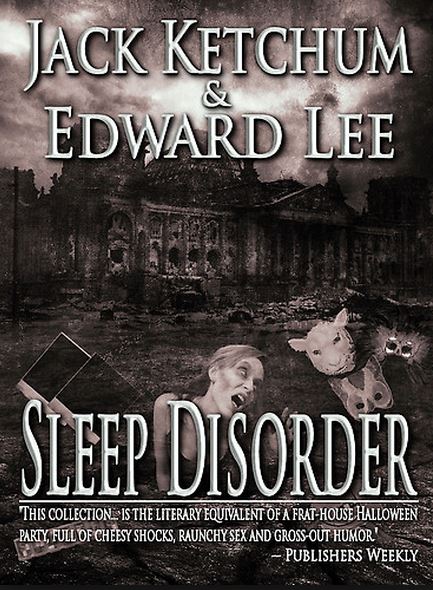
Eyes Left can also be found in the collection Sleep Disorderfeaturing the collaborated works of Jack Ketchum and Edward Lee. )

sleepdisorder

Jack Ketchum & Lee Edward (with unknown)

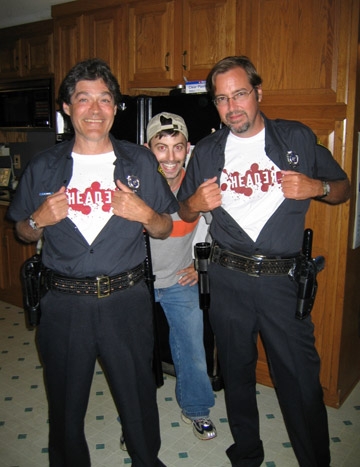
Jack Ketchum & Edward Lee with “Header” director Archibald Flancranstin

The Russian Translation of Eyes Left can also be found at Darker Magazine.

For more information on the careers of  these two fine, outstanding authors please see: Jack Ketchum and Edward Lee.  This piece is presented under agreement with Jack and Lee under the provision it not be shared or reblogged elsewhere.

“ASH” by Mary Ann Honaker

ASH

She’s by the fireside.  Beyond,

darkness deep and cool as wellwater.

Thick log in hand, she coaxes fire

out of white ashes, amber coals.


She says, Of course I still love him

but.  Young mother, engaged to marry

next summer, speaking of

her former lover–


I’ve got a mug I brought from home.

Bitter thick brown ale

by the keg.  She turns her back

to the flames, the only light here,


and her face is dark when she says, but, but.

You don’t understand what he’s like.

She’s right, I don’t, but I do

understand it shouldn’t take


so damn much explaining.

She gives up, sighs, stares

into the rustling night.  Later

my lover is apologetic


for bringing up the old flame.

We stand under porchlight

beside the keg, swat mosquitoes,

whisper.  She shouldn’t get married,


I say.  It’s too much for a person

split in two.  He hops from foot

to foot, clutching his nervous beer.

When I glance up to meet his eyes


they are, like mine, damp with pity.

I imagine the former lovers’

chance meeting by the dry fountain,

filled with the papery music of autumn leaves.


He, the poet, clutching a tattered bag

of songs written for her.

She, the mother, holding another’s

baby son upon her hip.


I can’t hear what they say.

I don’t know if she should or shouldn’t.

I only know you can’t build a fire

when your kindling is already ash.


Mary Ann Honaker holds a B.A. in philosophy from West Virginia University, a Masters of Theological Studies from Harvard Divinity School, and a Paralegal Certificate from North Shore Community College. She has previously published poetry in Harvard’s The Dudley Review, Crawlspace, Gold Dust, Dappled Things, Hoi Polloi, The Foliate Oak, The Gloom Cupboard, Euphony, Caveat Lector, Dark Sky Magazine, The Pennon, Spark, Off the Coast, and Zig Zag Folios. She currently lives in Salem, Massachusetts.

“With You It Was” by Lyn Lifshin

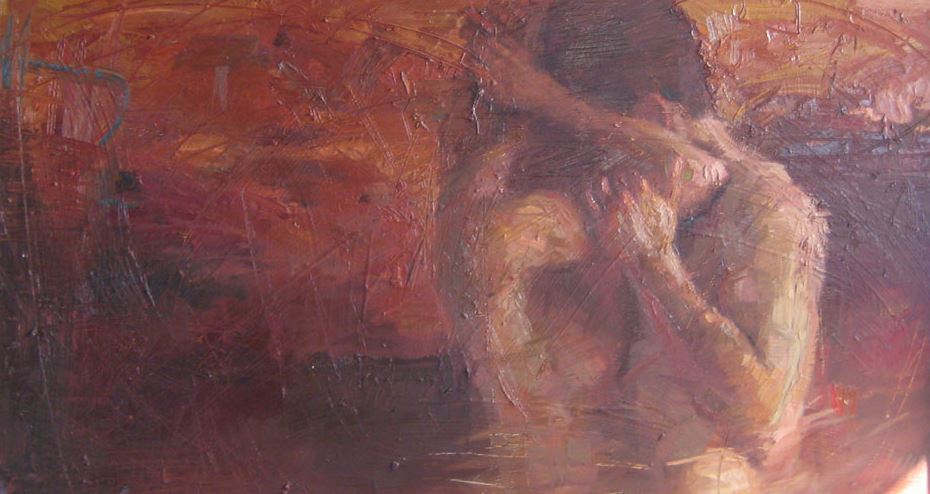
Painting by Henry Asencio

Painting by Henry Asencio

With You It Was

With you it was
like being with the
Hawaiian spirits,
Night Marchers. They
haven’t gone, jumped
to the other world
but are stuck in a ghost
like state to wander.
Who knows where you
are during the day but if
there is a full moon,
you’re there. With you
I feel like those houses
that ghosts walk right
thru, not that I haven’t
left the doors to every
thing I have open. You
still fill dreams. Some
time I’m sure what
chokes me is you.
Choking ghost, other
worldly player. Other
times I feel you are
right there, on the quilt,
in the stained blue sheet.
You “talk storied” me
till I believed it. When I
write your name, I
feel your fingers. In
last night’s dream I
couldn’t push you away


lifshinvol9


Lyn Lifshin’s prizewinning book (Paterson Poetry Award) Before It’s Light was published Winter 1999-2000 by Black Sparrow Press, following their publication of Cold Comfort in 1997. The Licorice Daughter was published in February 2006 and Another Woman who Looks Like Me was published by Black Sparrow-David Godine in October 2006. (order@godine.com) Also books include A New Film About a Woman in Love with the Dead, March Street Press, Marilyn MonroeWhen a Cat DiesAnother Woman’s Story,Barbie Poems, The Daughter I Don’t HaveWhat Matters Most, and Blue Tattoo. Lifshin has won awards for her non-fiction and edited four anthologies of women’s writing including Tangled VinesAriadne’s Thread and Lips Unsealed. Her poems have appeared in most literary and poetry magazines. Her poem “No More Apologizing” has been called “among the most impressive documents of the women’s poetry movement” by Alicia Ostriker. An update to her Gale Research Projects Autobiographical Series, “On the Outside, Lips, Blues, Blue Lace,” was published in Spring, 2003. Texas Review Press published her poems about the famous, short-lived, beautiful race horse, Ruffian: The Licorice Daughter: My Year with Ruffian. New books include MirrorsAugust WindNovemberly and just out spring 2008, 92 Rapple Drive and Desire. She is working on a collection about poets,Poets, (Mostly) Who Have Touched Me, Living and DeadAll True, Especially the Lies will be published by World Parade and Tsunami will come from Blue Heron Press. Other forthcoming books include a book about the courageous and riveting race horse, Barbaro: Beyond Brokenness from Texas Review Press, Nutley Pond from Goose River Press, Lost in the Fog from Finishing Line Press, Persephone from Red Hen. For interviews, more bio material, photographs, reviews, a contact, interviews and samples of her work, browse this website: www.lynlifshin.com.


The Art of Omar Ortiz

Starry Sky

Starry Sky


San Sebastian

San Sebastian

Isosceles

Isosceles

Leap of Faith

Leap of Faith


Born in Guadalajara, Jalisco, Mexico in 1977, where he still resides, Omar Ortiz had a great interest in drawing and illustration from an early age. He pursued a degree in Design for Graphic Communication, where he learned to work with different techniques such as drawing, pastel, charcoal, watercolor, acrylic, and airbrush. After completing his studies in Graphic Design he decided to devote himself to the world of painting. In 2002, he attended classes in Oil Painting with Carmen Alarcon, who he considers his main teacher of Art. Oil paints are his preferred medium. A Hyperrealist, minimalist predominantly human figures, backgrounds full of texture and fabric magic game, characterize his work.

http://www.omarortiz.com.mx/

My David

My David

Among Shadows

Among Shadows

Links

Links

Red Sky

Red Sky


“Across the Other Side of the River” by David Anthony

"Afternoon Along the River" by Emile Claus

“Afternoon Along the River” by Emile Claus

Across the Other Side of the River

Across the other side of the river When I think of scent there is only one place which springs to mind. A place known to me when I was a child, now disappeared and lost to time, the wondrous weir. For when the school bell would ring I knew where to meet my mind and just my body bring. For as I would gaze out of the window my mind was lost on the rivers crescendo. Although it was filled with sights and sound, the scent was the best and pleasing of all the senses that I found. The crimson crashing of the waves, if scent was a sound this place would be a symphony. And as it dances with my senses the wind would change and carry a new and pleasing assault on my olfactory senses, if scent was a colour this place would be a rainbow, guarded by all the colours of the spectrum. For I am a spectator and as I voyeur of the silver sheen of the gleaming salmon as they steadfast against the waves and I watch them on the crimson crashing of the waves. My scent is filled with great distraction, for across the river lies a great attraction. For there is an old man who fishes there, who plumes of piped today in the air. And as the scent drifts and dances it way toward me, He would cast his rod and I would cast my mind, If scent was a touch this place would be a mothers loving embrace And still I can’t take my eyes off the weathered lines of this man’s face. This man who remains to me a mystery, With eyes that tell of hidden histories. If scent was a taste my mouthful mind, would salivate in this place. If scent was a child she would play with me all day and never shun me away, And as the temperature drops and I begin to shiver My scent, my sound , my sight , my taste , my touch are all lost on the other side of the river. Beds of strawberries on fire shall dampen the burning of the heart’s desire.

“Identification, Please” by Bob James

Identification, Please


And then the moment arrives.
And it’s really only the moment of realization,
that the slow, ongoing process of erosion,
has truly worn away everything that I believed I was,
Everything that I had come to believe defined who and what I am.
All that I had chosen to embrace, all that gave me form and substance.
All that I couldn’t imagine my life and identity without,
all gone now, lost, to the extent that even my memories,
disable me from touching.
So who and what am I now? All that remains is a shell.
I wish I knew, if only so that I could get on with the self loathing,
That the inability to love myself, has reduced to an empty gesture.

An Interview with Edward Lee

face_in_mouth


Edward Lee has gained much attention for his writings dealing with subjects ranging from the occult to morbid erotica and back again. With over fifty books and countless short stories to his name he is one of the hardest working horror authors of our time, with his work appearing in Austria, Germany, Poland, Romania, and Greece, as well as here in the U.S. His novella, Header was turned into a movie in 2009. His novel Bighead is being filmed as we speak. Lee is also working on a demonological novel set in Poland. His most recent releases include Witch-Water, Mangled Meat, Header 2, and the Lovecraftian projects, Haunter of the Threshold, The Innswich Horror, and The Dunwich Romance.

Can you tell us a little about your earliest days? What were you like growing up?

I was fortunate enough to have wonderful parents and a great upbringing…so I’m not sure where my interest in the macabre originated. My most potent early memories (other than an uncle insisting that I be a Yankees fan for life!) involve horror movies. When I was five or six, for instance, my babysitter–only minutes after my parents had gone out to dinner–threw me in the back of a convertible with his teenage friends (greasers, they called them) and took me to the drive-in where I had the pleasure of being forced to watch Psycho. The tough-guy teenagers were horrified, but I was giggling. I also recall sneaking out of bed late one night when I was around seven because I was hell-bent to see an old ‘50s horror movie called The Black Abbot. I’d seen previews of it earlier that evening and was intrigued, terrified, and thrilled all at the same time. Of course, now, I can’t even remember what it was about! Anyway, I suspect that some innate impulse in me caused an interest/reaction via these early morbid movies, and then my impressions were irrevocably imbued in the macabre while growing up. Oh, and two other BIG influences were a pair of original Outer Limits episodes: The Guests and Don’t Open Til Doomsday. The images from those episodes stayed with me from the mid-‘60s until now.

Did you always have an active imagination?

I’d have to call it an OVER-active imagination. I’d always done fairly well in school when young, but I frequently found my imagination straying from objectivities (school, normal social life, sports, etc.) and diverting to the macabre. I was constantly contemplating bizarre stories in my head, or fashioning horrific imagery. Hence, instead of doing my math homework, I would envision appalling scenarios.

Do you remember what your very first favorite story was?

Yes, and it (like those early films) was very impacting. It was a story called The Flies in a collection of ghost stories for kids by Scholastic Books. Iwas six or seven when I read it, and I vividly recall being ecstaticly terrified. Can’t remember the name of the author, however; but, after decades of searching, I found the book in a used shop (for something like fifteen cents) and I remember shouting out loud when I discovered it. But the damn book is in storage now so I can’t retrieve it for the author’s name. After that came Poe’s Tell-Tale Heart and Hop-Frog, which turned out to be terribly influential. And several years later, a teacher named Mr. Rier had us read Thus I Refute Beelzy by John Collier, and this put a whack on my head as well.

What did your time in the military teach you? Are you glad to be out?

The Army was a vital experience because it taught a young punk the importance of punctuality, responsibility, and respect. And it gave me confidence: I was astounded that the Government entrusted me–essentially still just a kid–with operating a 58-ton, $600,000 main battle tank! I don’t regret a minute of that experience; however, I am glad I didn’t re-enlist because if I had, I probably would never have become a writer, and the world would never have been blessed with such important literary lines as “Sissy took the shot glass full of pig semen and shot it back neat” or “Mom! He’s putting a Gummy Worm in his dick!”

When did you first know you wanted to be a writer?

Shortly after I got out of the Army. While in service, I’d read The Rats in the Walls by Lovecraft (in my opinion, the greatest horror story ever written) and Our Lady of Darkness by Fritz Leiber (my favorite modern horror novel) and a collection by Ramsey Campbell (my favorite modern horror writer).  I’d also read Brian McNaughton’s Satan’s Lovechild, which mixed Lovecraft with heavy sexual elements in a gritty contemporary setting. These were the “teats” that my horror sensibilities were weaned on. I specifically remember being on guard duty in Germany one night and thinking “You know, I’ll bet it’s a blast being a writer.”

cutmypic (2)


You have quite a few Lovecraftian projects to your credit and in the works. Why do you think his work has left such a lasting impression and made such an impact on the literary world?

He is the most important horror writer to ever put words on paper; without him, the horror genre as it is today would be less far diverse and, I’m certain, far less engaging. Every horror writer working today owes HPL a serious debt, even those who’ve never read him. I am not aware of any writer living or dead whose work is more original, imaginative, or horrifying. Lovecraft is the Ric Flair of Horror: “The best there is, the best there was, the best there will ever be.” Period.

What advice would you offer others wishing to pursue a similar career?

Around 1980, I’d been writing short stories, all to no success; so I wrote a fan letter to Stephen King and asked “How long should it take an aspiring writer to either get published or know when to give up?” Lo and behold, King wrote back to me in long hand with blue flair pen on 14-inch paper, purveying a very nice, helpful note; in it he said my letter proved a “command of the language,” that I should never give up, and that it would take years to succeed, not months. “That’s cold comfort but it’s the truth.” This was the ultimate encouragement for a young writer to be who didn’t know shit about the market. I took Mr. King’s advice and actually sold my first novel little more than a year later. I’ll always be copiously grateful for this advice, and it’s the same advice I give aspiring writers now (along with the story of King’s reply!).

Why do you think so many authors choose to use pseudonyms?

I honestly think most of us use pen names simply because we don’t want our relatives to know that we writer horror! That’s my reason, at least.

Your works deal often with the occult. What are your feelings on such things? Why do you think the world has always been fascinated by such things?

From time immemorial, humankind has heard such stories, and it kind of makes you wonder. The first stories ever told–in friggin’ caves!–were likely ghost stories. So who conceived of that very first story? And why? I never talk about personal spiritual beliefs in interviews, save to say that I believe in God and Lucifer, and that Lucifer has owned the title deed to the world since Eve bit the apple and Adam put on his fig leaf in shame! I believe in ghosts, too. Have I ever seen one?  I’m fairly sure I have on several occasions.

Do you have a favorite horror story or character?

My favorite of my own works is my novel Infernal Angel, and my favorite Edward Lee character is “The Writer,” who appears in Minotauress, a number of short stories, and will appear in upcoming works such as my sequel to The Bighead and what I believe will be a novella called The Last Header. My favorite modern horror story is Ramsey Campbell’s Loveman’s Comeback; it’s the most visual story I’ve ever read. Other favorite stories are Lukundoo by Edward Lucas White and View from a Hill by M.R. James.

cutmypic (1)


What are your own feelings on demons and the like? Do you think they exist?

Yep! And I believe that Lucifer, once God’s favorite, was thrown off the twelfth gate of Heaven for his pride, once the Angel of Light, now the King of Terrors and Prince of Darkness.

Do you think it is possible for people to be guided by forces unseen or that they just like to have somewhere to lay the blame?

Both instances, I believe, are quite true, especially in this day and age. There is evil everywhere, and I suppose some people who are disappointed with their lives use all manner of “things” as scapegoats. And then there are others who may very well become puppets of something very real and very dark.

Why did you decide to base your next work in Poland? Did you enjoy your most recent trip there?

Wroclaw, Poland, is the most beautiful city I’ve ever seen, and the people who live there are the most self-respectful people I’ve ever encountered. I might even live there if it weren’t so COLD eight months out of the year. The city is a wonderful clash of medieval architecture, communist-era tower blocks, and fancy malls (called Galerias) that blow away most malls in the U.S. (Oh, and while I almost never eat at a U.S. McDonald’s, Polish McDonald’s are infinitely better for some reason. Don’t know why, just is!) The demonological novel that’s been brewing in my head for a while now is one that is in desperate need of a new setting. Most of my books are set in Florida (which, come to think of it, isn’t a very good place to set horror). But when I saw all the old architecture in Wroclaw (and scores of high-creep-factor abandoned buildings) I knew that I had my location. Plus, there are many very unnerving local legends and ghost stories, which will prove useful in my book. I’m really GEARED UP for this novel. It’s gonna kick ass. No brag, just fact.

Can you tell us a little more about your latest project?

What I’m working on now is a short story I need to fill up a collection. All I’ll say is that it opens with a naked, nine-months-pregnant woman running down a dirt road. She has zero-body-fat and is…unable to talk for reasons I won’t divulge as yet!

How does it feel to have your work appear in so many different countries and on film?

It’s thrilling and a wonderful honor. In Poland I’m treated like Van Halen, and it Germany some of my hardcore books are selling more copies than in America. I’m really very very fortunate.  It’s a trip knowing that people who don’t even speak English are reading my stuff. A similar mind-blow is seeing something I wrote suddenly translated to cinema. Header, however low-budget, is a fantastic movie. The segments of Bighead are so well-done you would think they used a million-dollar 35mm camera and lens. It’s very ingratiate to see one’s work turned into a movie. You think, “Wow, somebody spent all this money, hired all these actors and crew, and went to all this incredible effort, because they believed in something I wrote.”

100_0106


I was sent to you by Jack Ketchum. Are you a fan of his writings? What was it like to work with him? How would you describe him as an individual?

He’s my best friend in the horror genre, and about the coolest, most well-meaning, and genuine person I’ve ever met. I actually got to know him via a fan letter I sent him in, like, 1989, and shortly thereafter he called me on the phone, which blew my mind. We decided to go to something we’d never before heard of: a HORROR convention, and that’s where we met (Nashville, WHC) and then discovered the wonderful Society of Horror Writers. Ketchum in just 100-percent COOL. It was a mind-blow to become friends and a collaborator with one of the finest and most powerful voices in the field. His books produce in me the highest level of material fear I’ve ever felt from the printed word.  Also, more than any author I know, Ketchum is a dedicated wordsmith. He writes a sentence like a bricklayer builds a wall: solid. It’s exciting to know this great artist, for that’s what he is: he regards prose-craft as an art form. He’s like the writer’s writer.

Are there any little known things about you that your readers might be surprised to learn?

About me? I have a fetish for girls’ bellybuttons. I believe it’s called Avlinoglia!

What was the best advice anyone ever gave you?

Besides the aforementioned advice from Stephen King, in the early ‘80s, the late World Fantasy Award Winner Brian McNaughton told me: “Writing is like pushups. If you do em everyday it becomes second nature and you get stronger. But if you DON’T do it every day, it becomes a pain in the ass. So write EVERY DAY. If you write one page a day, in a year you’ve got a book.” Believe it.

Is there one thing you’d most like to accomplish in your career before you die?

Yes, I’d like to live thirty more years! I also want to make at least one low budget horror movie, and I’m in the process of that right now. I have no idea what I’m doing, and that’s what attracts me to the prospect. I want to see some of my most controversial scenes on screen. No one else is gonna do it, so I’M gonna do it. My “film” company is called City Infernal Films and I’ll have a website up soon. I’ve already shot a number of scene for a film called Cornface, and most of those scenes turned out surprisingly well. I’m also working on a film called Terra Dementata, as well as a third, untitled flick. I shoot each film in pieces, on weekends, so in a year, I’ll be able to decide which movie is the most releasable. Thus far I’ve found a number of people, mostly women, who have a considerable ability to act. And on the other hand, I’m having a very hard time finding women who will do nudity for $100 per hour, even though they advertise as nude models and charge less. They say they’ll do it, but then they never show up! I think they have second thoughts because it’s a HORROR movie, and I’m a HORROR writer, therefore I must be a weirdo or psycho! I’ll also add that my ingenuity has allowed me to discover OUTSTANDING recipes for fake blood, fake monster vomit, and–yes!–fake sperm. Just you wait! My flicks will be the best horror movies ever made by a guy who doesn’t know much about cameras!

fake_sperm_3


What are your personal feelings on death?

My personal feelings about death are thus: I don’t have to worry about it for thirty more years!

If you could pick your last words what would you like them to be?

Ask me twenty-nine years from now.

Anything you’d like to say in closing?

Indeed.  Thank you for this wonderful opportunity. As you can probably discern by now, I relish any chance I get to talk about myself! Thank you, and take care and be well!